
Light
Full Sun
Requires full sun and strong light to keep its natural compact shape and promote blooming.
 Reference image
 Reference image
Vorwerk's Crown Cactus
Neowerdermannia vorwerkii is a highly specialized, geophytic cactus species native to the high-altitude regions of the Andes. Belonging to the Cactaceae family, this species is renowned for its ability to withstand extreme temperatures and severe drought by retreating partially underground 1.
The genus Neowerdermannia honors the German botanist Erich Werdermann, while the specific epithet vorwerkii was given to commemorate Wilhelm Vorwerk, an avid plant enthusiast. Globally and locally in South America, it is often referred to as "achacana" 2.
It is native to the Altiplano of Bolivia and northwestern Argentina (specifically Jujuy and Salta provinces), thriving at altitudes between 3,000 and 4,200 meters above sea level. It grows in barren, rocky, calcareous soils under harsh alpine desert conditions 1.
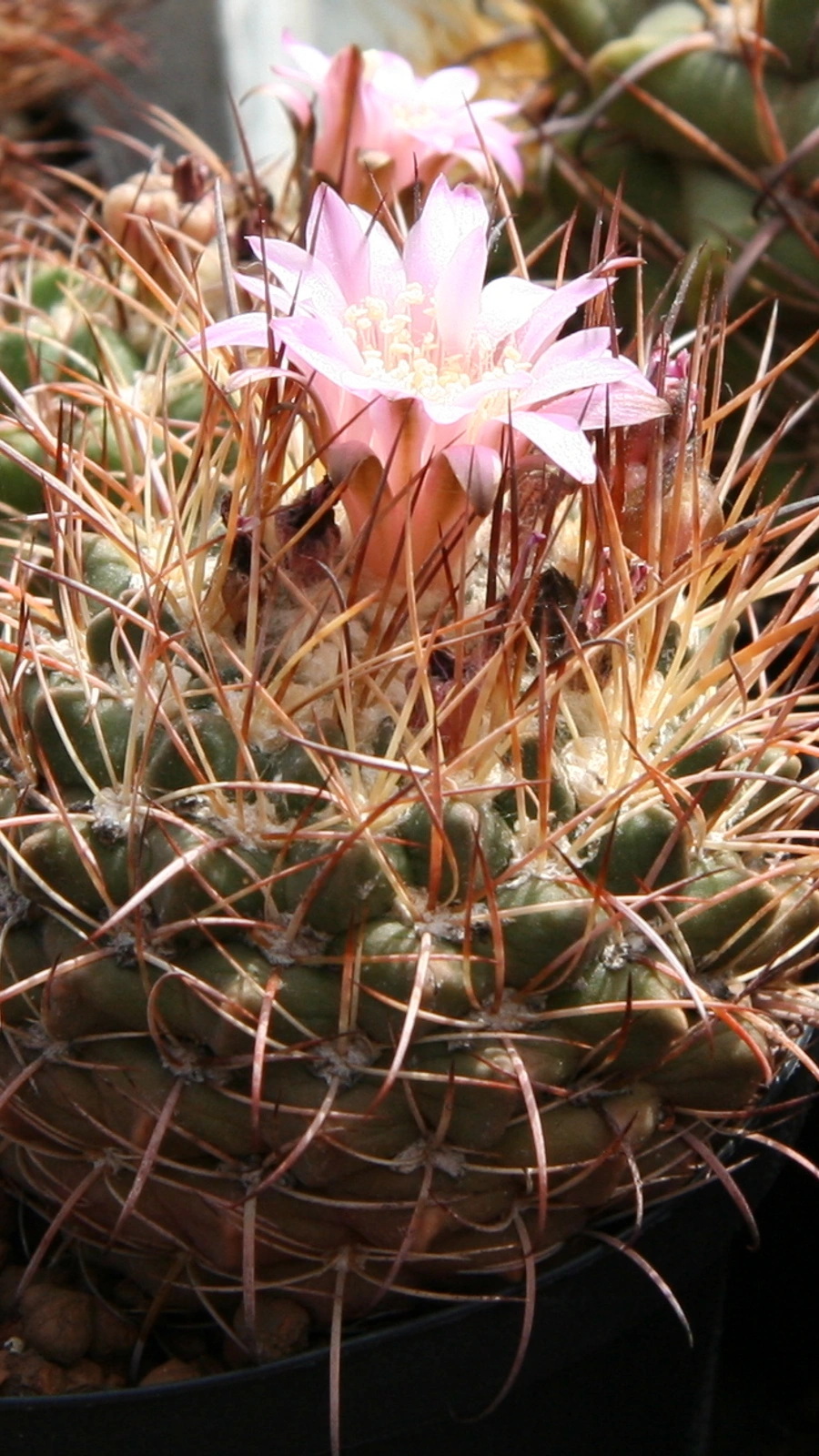
The plant has a solitary, depressed-globose, greyish-green stem reaching up to 10 cm in diameter. It features prominent, spirally arranged tubercles. The spines are strong, curved, and hook-like, shielding the plant. The funnel-shaped flowers are white to pale pink and emerge from the deep center of the crown.
In cultivation, this species is considered a challenge. Due to its large taproot, it requires deep pots with an exclusively mineral substrate. It demands maximum sunlight and excellent ventilation. It must be kept bone-dry in winter to survive cold dormancy.
The most prevalent mistakes are using peat-based soils and overwatering, both of which cause rapid taproot rot. Lack of strong direct sunlight leads to etiolation, ruining its characteristic flattened shape.
Requires full sun and strong light to keep its natural compact shape and promote blooming.
Water strictly on a soak-and-dry cycle in summer; leave completely dry during winter.
Use a heavy mineral mix consisting of pumice, perlite, and coarse sand with zero organic matter.
Equipped with strong, hooked spines. Non-toxic to pets, but handle with care.
Difficult to grow due to high rot sensitivity and specific altitude-mimicking climate needs.
Found natively in the harsh, windswept high-altitude grasslands and rocky deserts of the Andes Mountains, adapting perfectly to cold nights and intense solar radiation.
