
Light
Bright Indirect Light
Requires plenty of bright, indirect light; protect from harsh afternoon sun to avoid scorching.
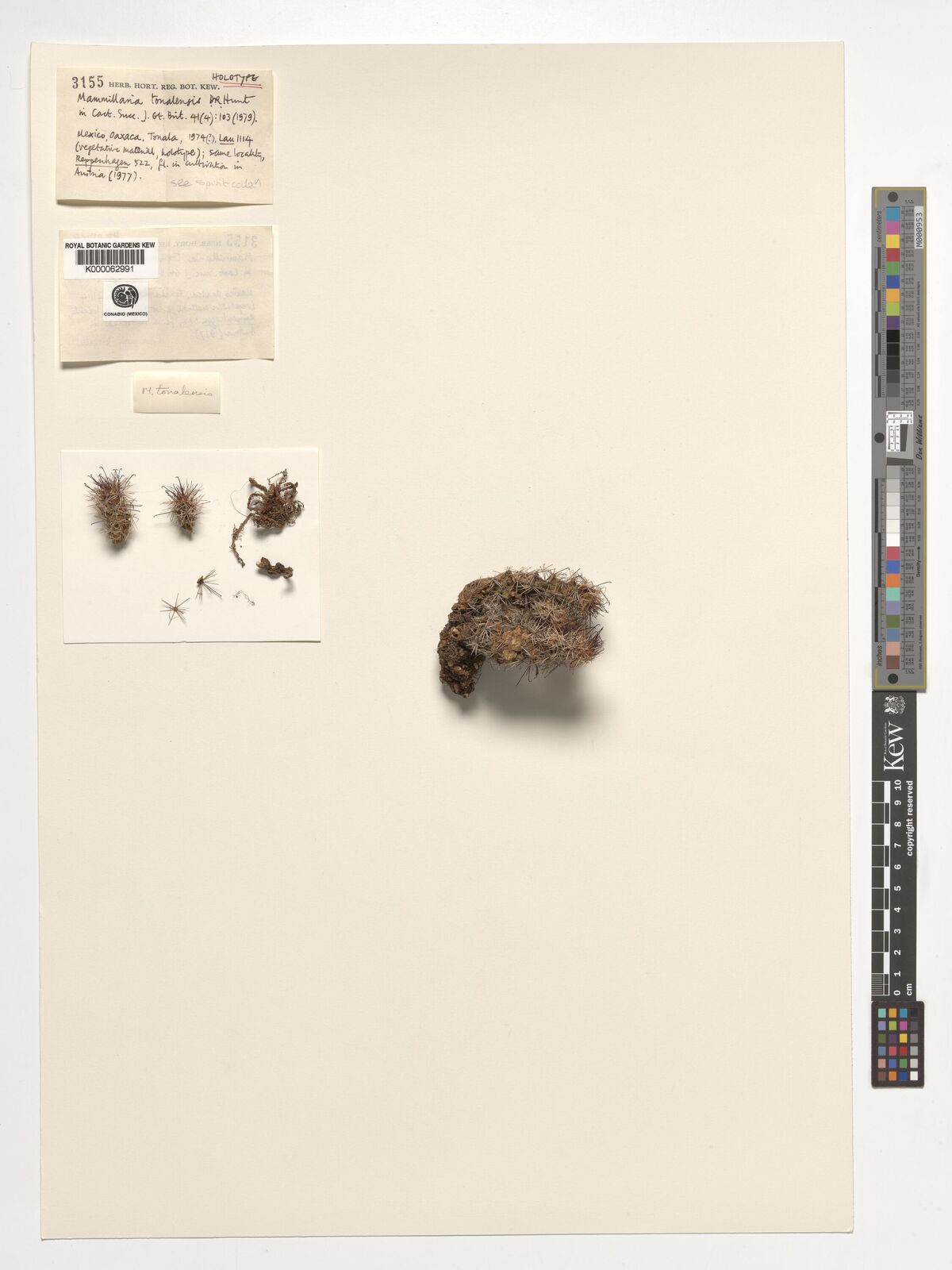 Reference image
Tonalensis Oehmea
Oehmea tonalensis (commonly referred to as Mammillaria tonalensis) is an extremely rare and highly decorative clustering cactus species in the family Cactaceae. Growing naturally as a succulent subshrub in rocky, arid environments, it is celebrated among collectors for its intriguing hooked spines and vibrant blossoms 1.
While initially described under its own genus Oehmea, contemporary phylogenetic studies and the Kew Royal Botanic Gardens (POWO) database often group this taxon within the genus Mammillaria 1. Nevertheless, many specialists and growers preserve the name Oehmea tonalensis due to distinct seed coat patterns and localized stem traits. The specific epithet tonalensis refers to Tonala, the Mexican region of its discovery 2.
This species is endemic to southern Mexico, mainly distributed across the dry landscapes of Oaxaca and Guerrero 2. It grows primarily on steep limestone cliffs and gravelly slopes within dry deciduous shrublands, adapted to intense heat and severe seasonal droughts.
Its stems are cylindrical, green to grayish-green, reaching up to 15 cm in height and about 3-4 cm in diameter. The plant tends to offset from the base, forming attractive clusters over time. Tubercles are conical with areoles bearing 1-3 central hooked spines and numerous finer, whitish radial spines. Flowers are usually bright pinkish-red or magenta, emerging from upper axils.
In cultivation, Oehmea tonalensis demands an exceptionally porous mineral substrate consisting mostly of pumice, perlite, and coarse sand. It has highly sensitive roots prone to rot if kept wet. Watering must follow the soak-and-dry method, ensuring the soil dries out fully between applications.
The most prevalent issue is overwatering during its winter dormancy, which quickly causes root loss and fungal rot. Insufficient sunlight will cause etiolation, weakening the plant's structural integrity and preventing flowering.
Requires plenty of bright, indirect light; protect from harsh afternoon sun to avoid scorching.
Water thoroughly only when the soil is 100% dry. Keep dry in winter.
Use a specialized mix high in grit, pumice, and sand with minimal organic matter.
Features sharp, hooked central spines; handle with care and keep away from pets.
Moderate care level; requires strict discipline with watering and winter dormancy.
Endemic to the rugged limestone hillsides and dry deciduous scrublands of southern Mexico.
