
Light
Full Sun
Requires full, unfiltered sun for at least 6-8 hours daily to maintain its compact shape.
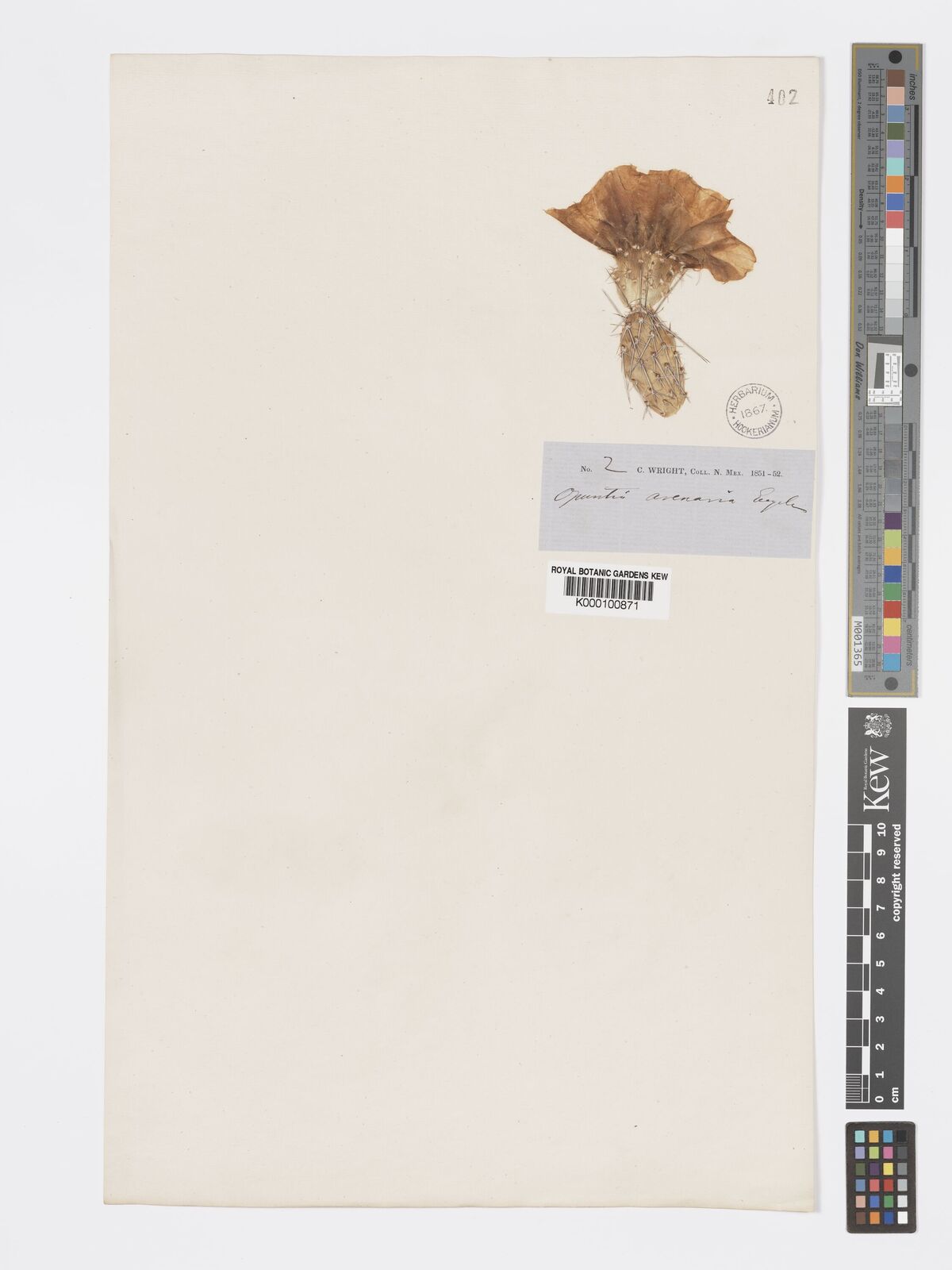 Reference image
Sand Prickly Pear
Opuntia arenaria is a low-growing, spreading succulent subshrub belonging to the Cactaceae family. Highly adapted to hyper-arid conditions, this unique cactus is celebrated for its ability to stabilize sand dunes and survive extreme temperature fluctuations 1.
Classified within the genus Opuntia, the species was formally described by George Engelmann. The specific epithet "arenaria" originates from Latin, translating to "sandy," pointing directly to its specialized habitat 2. Its common names include the sand prickly pear and dune prickly pear.
This species is native to the desert biomes of North America, particularly the northern parts of Mexico and the southwestern United States (such as Texas and New Mexico) 1. It is predominantly found in loose, shifting sand dunes, alluvial plains, and dry riverbanks 3.
Opuntia arenaria features small, club-shaped or slightly flattened stem joints (cladodes) measuring 4 to 8 cm. The areoles bear prominent, slender spines along with dense clusters of tiny, barbed glochids. In late spring, it produces attractive, vibrant yellow flowers that transform into dry, spiny fruits 2.
In cultivation, this plant requires maximum light and exceptional drainage. It thrives in a potting medium composed mostly of coarse sand, pumice, and grit. It is highly cold-hardy, tolerating deep sub-zero temperatures during the winter if kept completely dry 3.
The most prevalent issue is overwatering combined with heavy, water-retaining soils, which rapidly leads to root rot. Additionally, handling the plant without protective gear exposes growers to painful glochids that are difficult to remove from the skin.
Requires full, unfiltered sun for at least 6-8 hours daily to maintain its compact shape.
Water only when the soil is dry to the bottom. Keep completely dry in winter.
Requires extremely sandy, gravelly, and low-nutrient substrate with rapid drainage.
Equipped with tiny, irritating glochids. Keep out of reach of children and curious pets.
Very easy to care for, provided it is not overwatered and receives sufficient sunlight.
Mainly found in the sandy regions of western Texas, southern New Mexico, and the northern states of Mexico, thrives on shifting dunes and sandy desert flats.
