
Light
Full Sun
Requires full, direct sun for robust growth; prone to etiolation in shade.
 Reference image
Tiger Pear
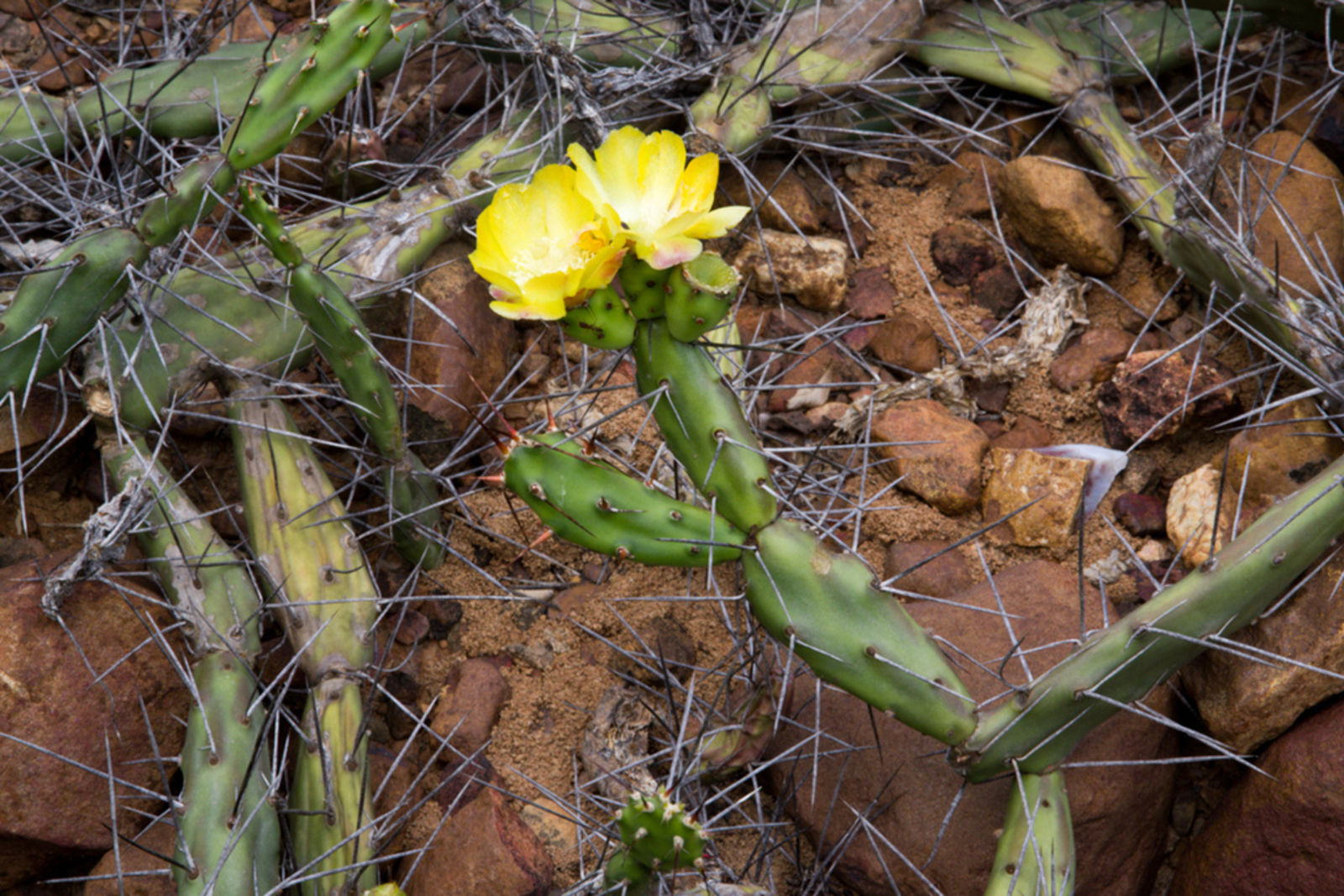
Opuntia aurantiaca, commonly known as the jointed cactus or tiger pear, is a low-growing, highly resilient, and spiny succulent shrub belonging to the family Cactaceae 1. It is well-known for its easily detached stem segments and formidable, barbed spines. While easily cultivated, it is widely recognized as a highly troublesome invasive weed in pastures.
Classified under the subfamily Opuntioideae, the species was formally described as Opuntia aurantiaca. The specific epithet 'aurantiaca' is derived from Latin, referring to the orange-yellow hues often seen on its flowers or under certain stress conditions 2.
Native to southern South America, particularly Argentina and Uruguay, it thrives in subtropical, semi-arid, and open grassland environments 1. It has naturalized and become a noxious weed in countries like Australia, South Africa, and parts of southern Europe, where its vegetative propagation makes control difficult 3.
The plant features dark green to purplish-green, cylindrical or slightly flattened stem joints that detach at the slightest touch. Each areole bears sharp, brownish-yellow, barbed spines that readily cling to skin or clothing. It produces showy, bright yellow to orange flowers during late spring.
In cultivation, it requires maximum sunlight exposure and exceptionally free-draining sandy loam. Watering should follow the 'soak and dry' method, keeping the substrate bone-dry during winter dormancy.
The most frequent mistakes include overwatering, which immediately induces root rot, and growing the plant in low-light indoor environments, leading to weak, elongated growth 2.
Requires full, direct sun for robust growth; prone to etiolation in shade.
Allow the soil to dry out completely between waterings. Reduce to zero in winter.
Requires highly porous, gritty soil with sand, perlite, and pumice.
Armed with barbed spines that detach easily. Keep away from pets and children.
Extremely easy to keep alive, but handling requires extreme caution.
Native to the subtropical grasslands and semi-arid regions of Argentina and Uruguay. It has widely naturalized across dry temperate and subtropical zones of Australia and Africa.
