
Light
Full Sun
Requires at least 6 hours of direct sunlight; ideal for bright south-facing windows.
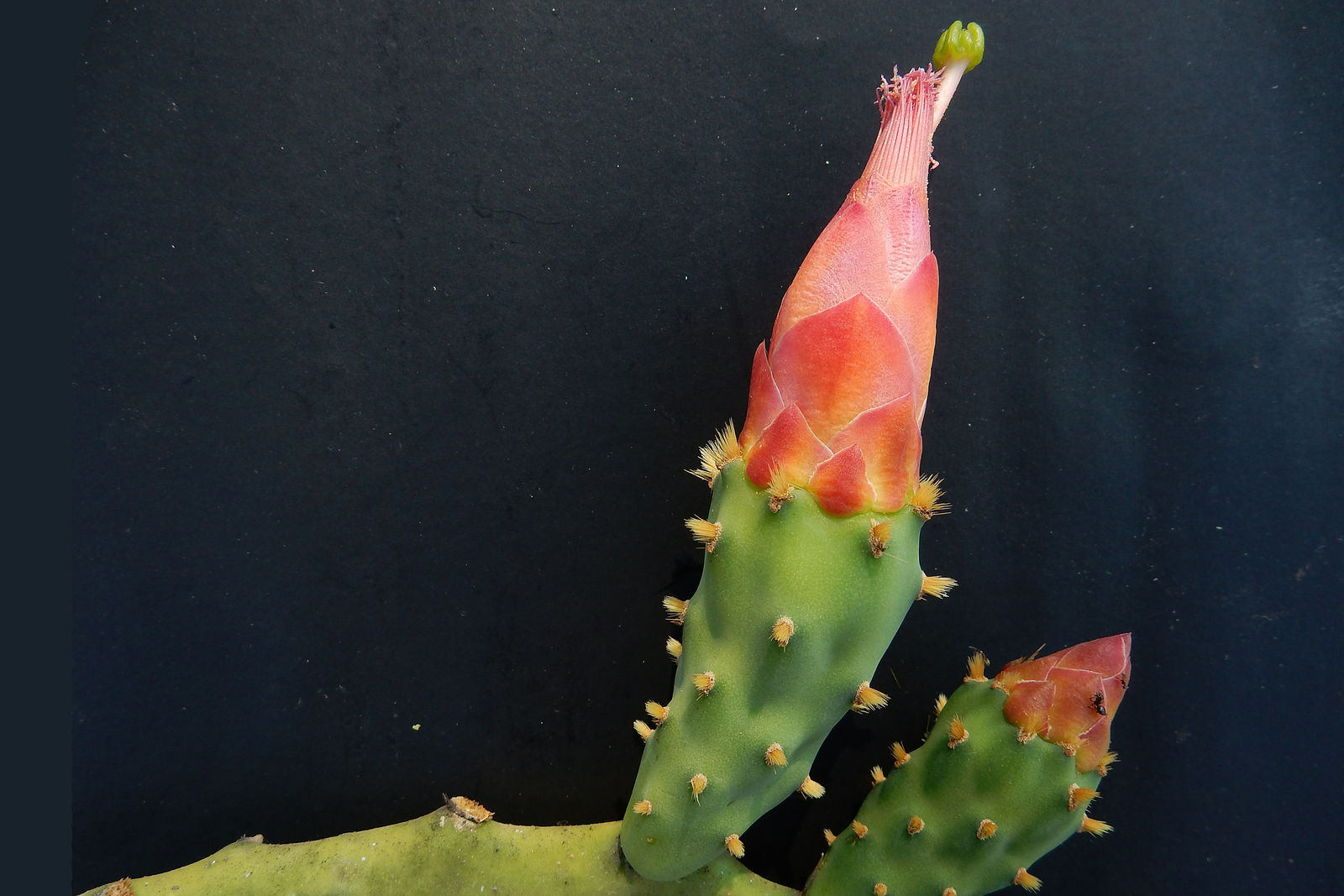 Reference image
Cochineal Cactus
Opuntia cochenillifera is an arborescent, nearly spineless cactus species belonging to the Cactaceae family 1. Historically, it holds immense economic and cultural importance as the primary host plant for rearing the cochineal insect (Dactylopius coccus) used to produce carmine dye.
Originally described by Carl Linnaeus as Cactus cochenillifer, it was subsequently transferred to the genus Opuntia by Philip Miller 2. The specific epithet 'cochenillifera' literally translates to 'cochineal-bearing'.
This species is native to Mexico and the Caribbean region. Due to historical cultivation, it has successfully naturalized across Central America, Colombia, Fiji, Sudan, and Tanzania, establishing in dry shrublands and desert biomes 12.
Growing as a succulent tree up to 3 to 4 meters tall, it features a woody main trunk and jointed, obovate, bright green pads that are remarkably smooth and spine-free. The flowers are narrow, tubular, and deep pink to red, with prominent stamens protruding outwards.
It thrives in full sun and fast-draining, gritty soils. Watering should be deep but infrequent during summer, letting the soil dry completely. In winter, keep the plant almost entirely dry and protect it from prolonged freezing temperatures.
Overwatering and compacted soils are the leading causes of root rot. Insufficient light results in weak, elongated, and pale green pads, which destroys the natural aesthetic of this robust succulent.
Requires at least 6 hours of direct sunlight; ideal for bright south-facing windows.
Allow the substrate to dry out entirely between waterings. Reduce to a minimum in winter.
Requires excellent drainage. Use a mix of commercial cactus soil, pumice, and coarse sand.
Mainly spineless but tiny glochids may still be present in the areoles. Non-toxic to pets.
Very easy and forgiving of neglect, making it perfect for beginners.
Indigenous to the arid regions of Mexico and the Caribbean islands, this species has been widely introduced and naturalized across dry tropical zones globally due to its historical agricultural value.
