
Light
Full Sun
Requires full sun, ideally 6+ hours of direct sunlight daily for healthy growth.
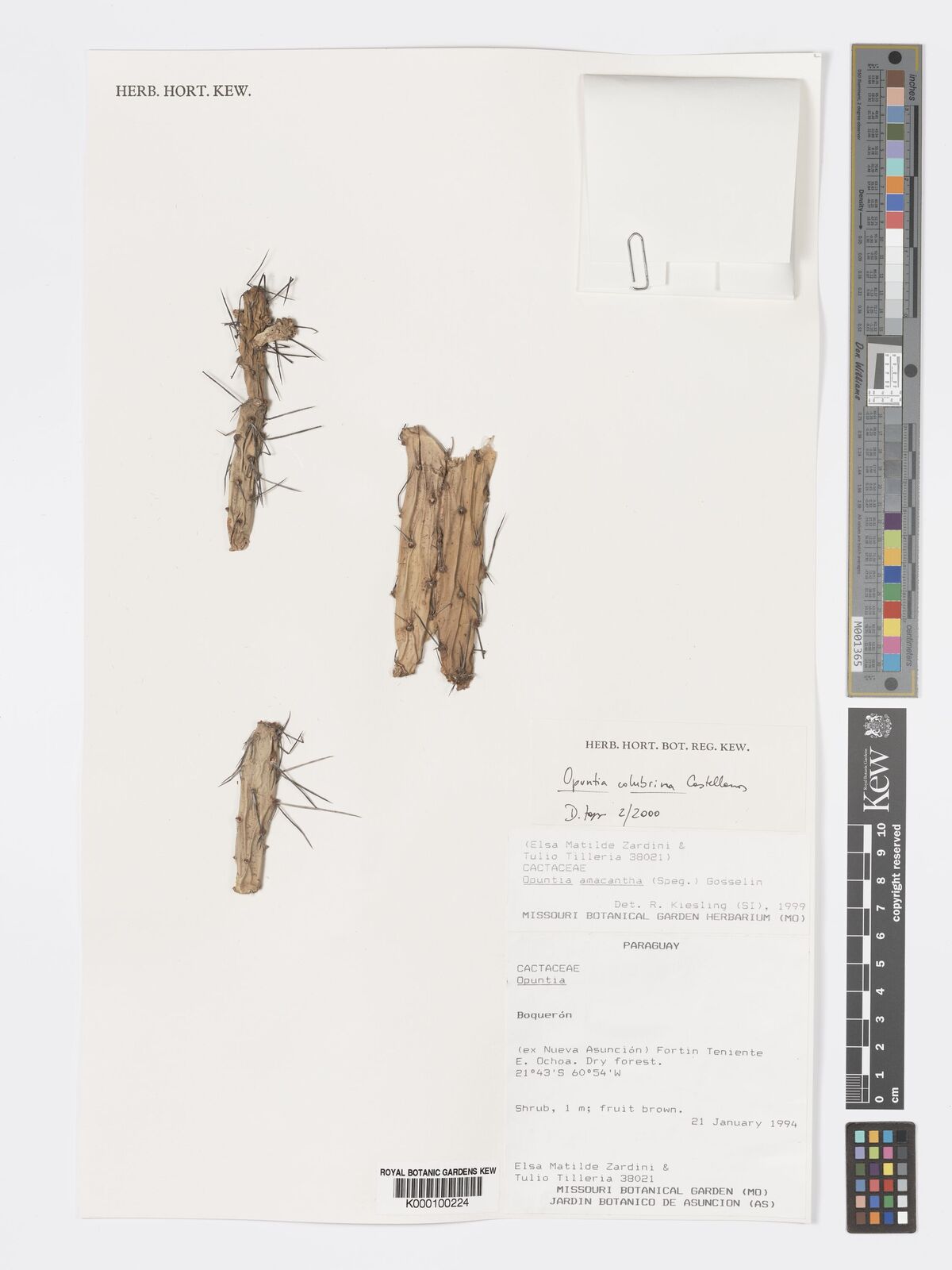 Reference image
Snake Prickly Pear
Opuntia colubrina is a distinctive semi-erect or decumbent, shrubby cactus species belonging to the family Cactaceae 1. Unlike typical wide-padded prickly pears, it is characterized by relatively slender, cylindrical, and segmented joints, giving it a unique architectural appeal suitable for xeric landscapes.
Classified under the genus Opuntia, the species epithet "colubrina" translates to "snake-like", referencing its long, sprawling, and narrow segments 2. It represents a highly adaptable evolutionary branch within the subtropically adapted cacti of South America, occasionally discussed in relation to cylindrical-jointed opuntioids 3.
This species is native to southern South America, mainly distributed across northern and central Argentina (including Chaco, Formosa, Entre Ríos, and La Pampa) as well as Paraguay 1. It thrives in subtropical climates, inhabiting dry forests, sandy plains, and rocky shrublands where soils are poor and dry.
The plant consists of narrow, pale-green to grayish-green segmented stems. The areoles are small, bearing slender, yellowish-brown spines and tiny glochids 2. During late spring and summer, it produces bright yellow, cup-shaped flowers that bloom during daytime, followed by small reddish-purple fleshy fruits 3.
In cultivation, Opuntia colubrina requires maximum solar radiation to maintain its compact growth form. It is highly drought-tolerant and thrives in poor, mineral-heavy soils with superior drainage. Water deeply but infrequently, allowing the medium to dry out completely between waterings.
The most prevalent issue is root rot induced by overwatering or compacted soil. Additionally, insufficient sunlight leads to etiolation, causing the stems to become weak, pale, and excessively stretched.
Requires full sun, ideally 6+ hours of direct sunlight daily for healthy growth.
Drench thoroughly, then allow the soil to dry out completely. Keep dry in winter.
Cactus mix blended with generous pumice, perlite, and coarse sand.
Contains tiny, irritating glochid spines. Mildly toxic to curious pets if ingested.
Highly resilient and drought-tolerant; excellent for beginners with sunny spots.
Native to the subtropical dry forests and sandy plains of northern Argentina and Paraguay, adapted to high heat and prolonged dry spells.
