
Light
Full Sun
Requires at least 6 hours of direct sun daily; shade leads to weak, leggy growth.
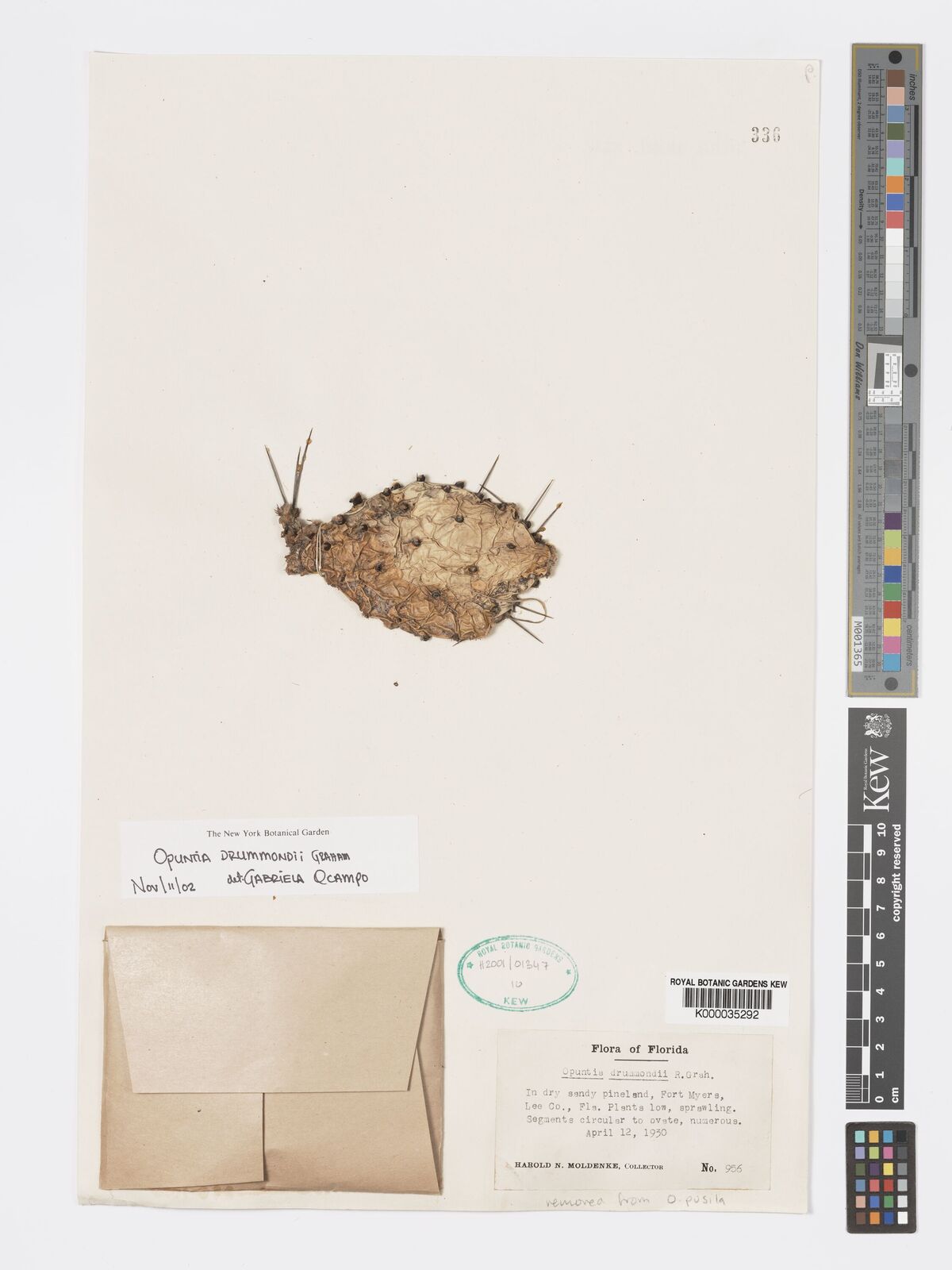 Reference image
Drummond's Prickly Pear
Opuntia drummondii, commonly known as Drummond's prickly pear or cockspur cactus, is a low-growing, prostrate succulent in the Cactaceae family. Adapted to sandy, coastal soils, this resilient cactus is famous for its easily detached segments (cladodes) that hitchhike on passing animals or hikers to disperse across its habitat.
The species epithet honors Thomas Drummond, a prominent 19th-century Scottish botanical collector who documented North American flora 1. Within the genus Opuntia, it is closely allied to Opuntia pusilla, and some taxonomists treat them as conspecific or highly integrated sister taxa within the southeastern coastal plains complex 2.
This subshrub is native to the Southeastern United States, thriving along coastal dunes, sandy clearings, maritime forests, and pine flatwoods. Its range spans from Texas, Louisiana, and Mississippi through Alabama, Florida, Georgia, up to North and South Carolina 1.
It forms loose mats of small, pale-green, flattened, elliptical stem segments, usually measuring 3-6 cm in length. The areoles bear one to three stout, yellowish-to-gray spines alongside small glochids. In late spring, it produces attractive, bright yellow flowers, followed by small, reddish, spineless, fleshy fruits.
Opuntia drummondii is exceptionally drought-tolerant and thrives in poor, sandy substrates. It requires full sun to maintain its compact growth form and prevent etiolation. In temperate zones, it can be grown outdoors in well-drained rock gardens, as it exhibits considerable cold hardiness down to USDA Zone 8 if kept dry during winter.
The most prevalent issue is root rot triggered by waterlogged, heavy soils or overwatering. Inadequate light levels will also result in weak, pale, and unnaturally elongated stem joints.
Requires at least 6 hours of direct sun daily; shade leads to weak, leggy growth.
Allow soil to dry out completely between waterings; extremely prone to rot from wet soil.
Extremely well-draining sandy or gravelly cactus mix.
Spines are barbed and segments detach easily, clinging to skin and fur. Keep away from pets.
Very easy to care for under neglect; the main rule is not to overwater.
Naturally occurs in coastal sand dunes, sandy pine barrens, and maritime scrub areas along the southeastern coast of North America.
