
Light
Full Sun
Needs at least 6 hours of direct sunlight daily. An unobstructed south-facing window or patio is ideal.
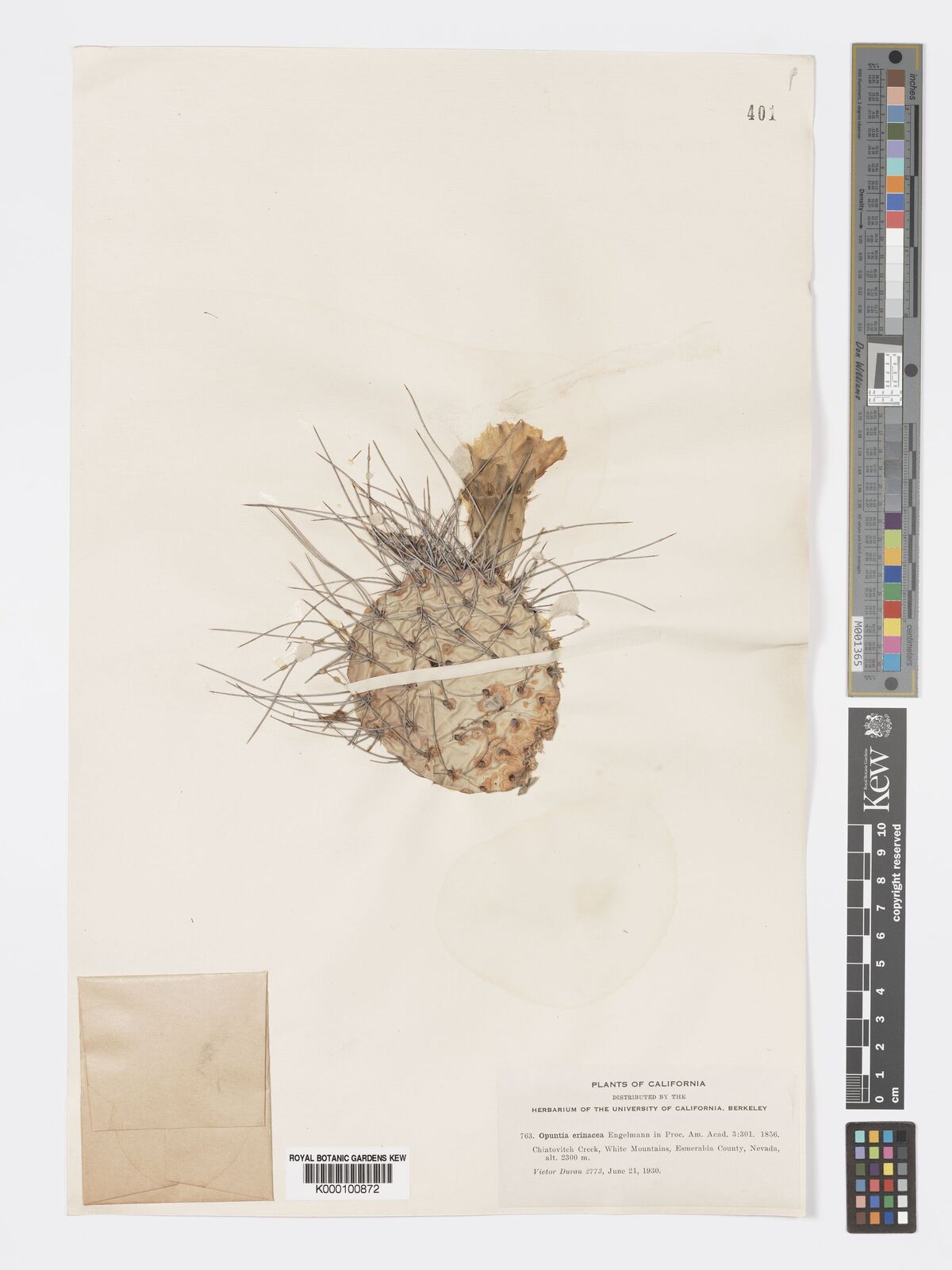 Reference image
Grizzly Bear Cactus
Opuntia erinacea, commonly known as the Grizzly Bear Cactus or Mojave Prickly Pear, is a striking succulent subshrub belonging to the Cactaceae family 1. It is highly distinguished by its dense cover of long, flexible, hair-like white spines.
First described by George Engelmann and John Milton Bigelow, this taxon is frequently treated by modern botanists as a variety of the widespread star-flowered prickly pear, designated as Opuntia polyacantha var. erinacea 2. The specific epithet erinacea derives from Latin for "hedgehog-like," referencing its extremely spiny pads.
This species is native to the southwestern United States (including Utah, Nevada, Arizona, and California) and northern Mexico 1. It thrives in high-elevation desert scrub, dry gravelly slopes, and arid plains.
The plant forms low, spreading clumps of flattened, obovate to circular jointed pads. These pads are heavily armed with flexible, woolly, or thread-like spines that can reach up to 12 cm in length, creating a "shaggy" look 2. Large, showy flowers in shades of yellow, pink, or bronze appear in late spring.
Opuntia erinacea requires full sun and extremely well-draining, gritty soil to prevent root decline. It is exceptionally cold-hardy, surviving sub-zero temperatures with ease, provided the substrate remains dry during winter dormancy 3.
Overwatering is the single most common cause of failure, quickly leading to root rot. Insufficient sunlight will cause weak, elongated growth (etiolation) and prevent the development of its iconic dense, white spines 3.
Needs at least 6 hours of direct sunlight daily. An unobstructed south-facing window or patio is ideal.
Water only when the substrate is completely dry. Keep nearly bone dry throughout the winter months.
Use a porous mineral substrate rich in coarse sand, pumice, and perlite with minimal organic matter.
Non-toxic, but the microscopic barbed bristles (glochids) cause painful skin irritation and require careful handling.
Very easy to maintain, provided you avoid overwatering and provide abundant light.
Hails from the high-altitude rocky slopes, barren plains, and gravelly washes of the Mojave Desert and Great Basin.
