
Light
Direct Sun
Requires full direct sun; shading will cause weak, etiolated growth.
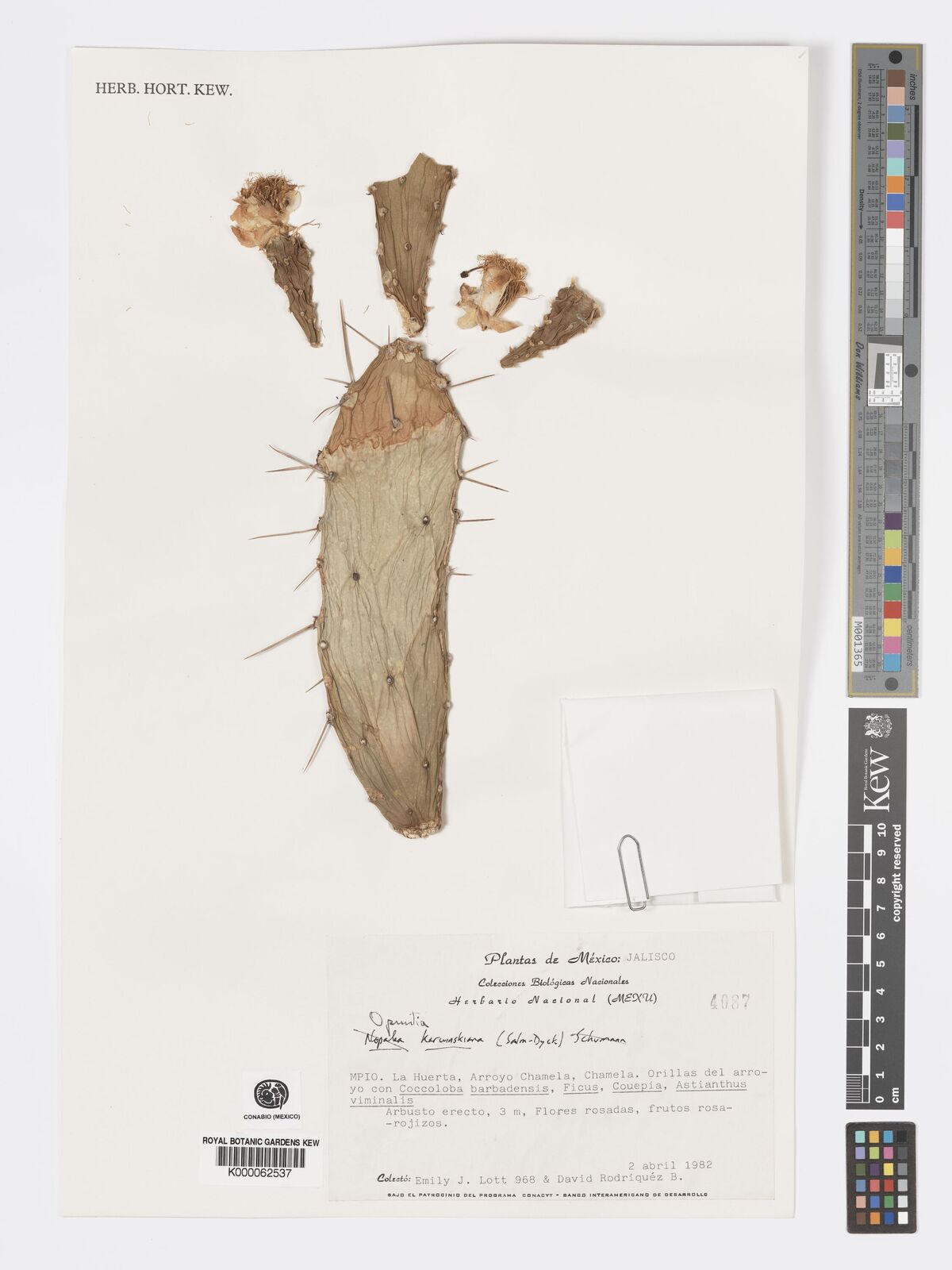 Reference image
Karwinski's Prickly Pear
Opuntia karwinskiana is a perennial, highly resilient succulent cactus species belonging to the genus Opuntia within the Cactaceae family. In its native habitats, it develops into large shrubs or small trees, serving as an ecological cornerstone of arid biomes 1. Its superb drought tolerance and architectural pad structure make it a popular specimen in xeriscaping.
The species was formally described by the renowned botanical author Salm-Dyck. The specific epithet "karwinskiana" was established in honor of Wilhelm Friedrich von Karwinsky, a prominent 19th-century Bavarian naturalist and plant collector who conducted extensive expeditions in Mexico 2. It is commonly known as Karwinski's prickly pear.
This cactus is native to the western and southwestern regions of Mexico. It is commonly found throughout states such as Colima, Jalisco, Michoacán, Nayarit, and Oaxaca 1. It thrives on rocky slopes, volcanic substrates, and dry deciduous scrub forest margins where drainage is optimal.
While restricted in size when grown in containers, wild specimens can reach 2 to 4 meters in height, supported by a woody, well-developed trunk. The flattened stem segments, or pads, are oblong-obovate, showing a dull grayish-green color. The areoles carry pale yellowish spines accompanied by clusters of tiny, irritating glochids. It produces vibrant yellow or orange flowers, followed by reddish, edible fruits 2.
Cultivating this species is straightforward. It demands ample direct sunlight and a highly porous, gritty soil medium that drains instantly. Water must be applied sparingly, allowing the potting substrate to dry out entirely between sessions. During the winter dormancy, watering should be reduced to a bare minimum.
The most frequent cultivation error is overwatering, which rapidly triggers root rot and structural collapse. Insufficient light exposure is another issue, causing etiolation, wherein the new pads grow weak, pale, and abnormally elongated 1.
Requires full direct sun; shading will cause weak, etiolated growth.
Never water until the soil is bone-dry; water once a month in winter.
Use a highly gritty, sandy cactus mix with excellent drainage.
Non-toxic to pets, but the tiny glochid spines can easily lodge in skin and cause severe irritation.
Very easy to maintain due to low watering needs, just avoid overwatering.
Native to the arid and semi-arid shrublands of western and southwestern Mexico, particularly abundant in states like Jalisco, Michoacán, Nayarit, and Colima.
