
Light
Bright Indirect Light
Requires plenty of bright, indirect sunlight or lightly filtered morning sun.
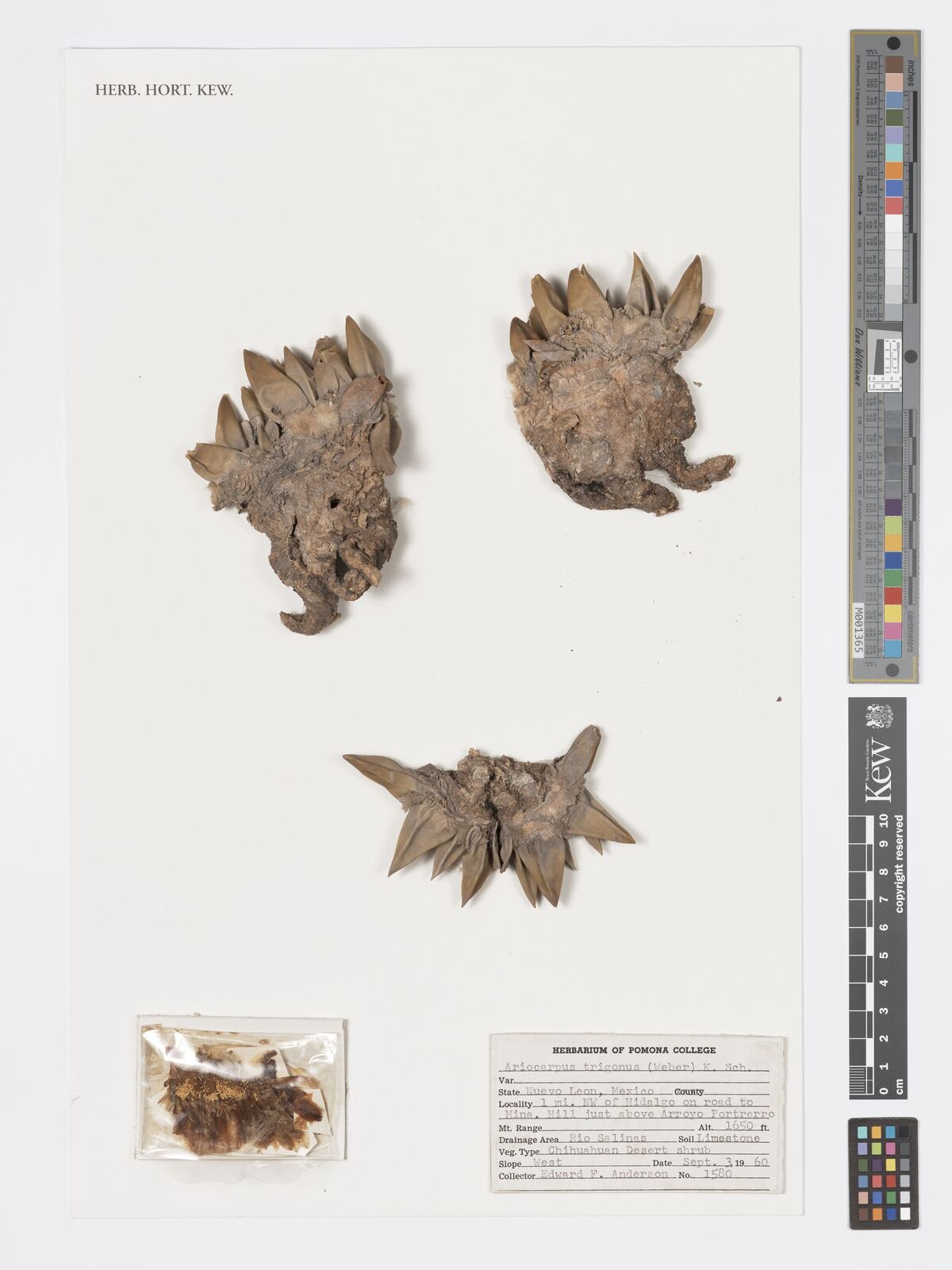 Reference image
Three-Angled Living Rock
Ariocarpus trigonus is a highly sought-after, extremely slow-growing succulent subshrub in the family Cactaceae. Known for its rock-like appearance in the wild, this geophytic cactus is a prized specimen among advanced collectors 1.
Originally described by Weber in 1893, the specific epithet trigonus refers to its distinct three-angled tubercles. While some taxonomists treat it as a subspecies under the variable Ariocarpus retusus complex, it remains widely recognized under its binomial name in horticulture 2.
This species is endemic to northeastern Mexico, spanning across states such as Tamaulipas, Nuevo León, and San Luis Potosí. It thrives in Chihuahuan desert scrub, predominantly on limestone-rich gravelly hills and alluvial plains 1.
It features a globose, grey-green stem that is mostly subterranean, protected by long, curved, triangular tubercles (3-5 cm long). Unlike other cacti, it lacks sharp spines. During late autumn, it produces stunning, pale yellow to cream-colored flowers from the woolly center.
Cultivating this species requires high discipline. It develops a large, tuberous taproot that demands deep, exceptionally well-drained pots. Watering must be sparse, limited only to active growth phases, and ceased completely during winter dormancy.
The most prevalent failure is using standard potting soils high in organic peat, which leads to immediate root rot. Lack of adequate sunlight results in etiolation, ruining its compact, natural geometry.
Requires plenty of bright, indirect sunlight or lightly filtered morning sun.
Water only during hot summer months when the substrate is bone dry; keep dry in winter.
Requires a gritty, 100% mineral-based substrate with limestone chips and no peat.
Spineless but contains toxic alkaloids; keep away from curious pets and cats.
Very slow-growing and highly intolerant to overwatering; suitable for experts.
Native to the dry mountain ranges of northeastern Mexico, where it grows embedded in calcareous soil and gravelly deposits, mimicking the surrounding limestone rocks.
