
Light
Bright Indirect Light
Prefers bright, filtered sunlight; shield from intense midday sun to prevent scorching.
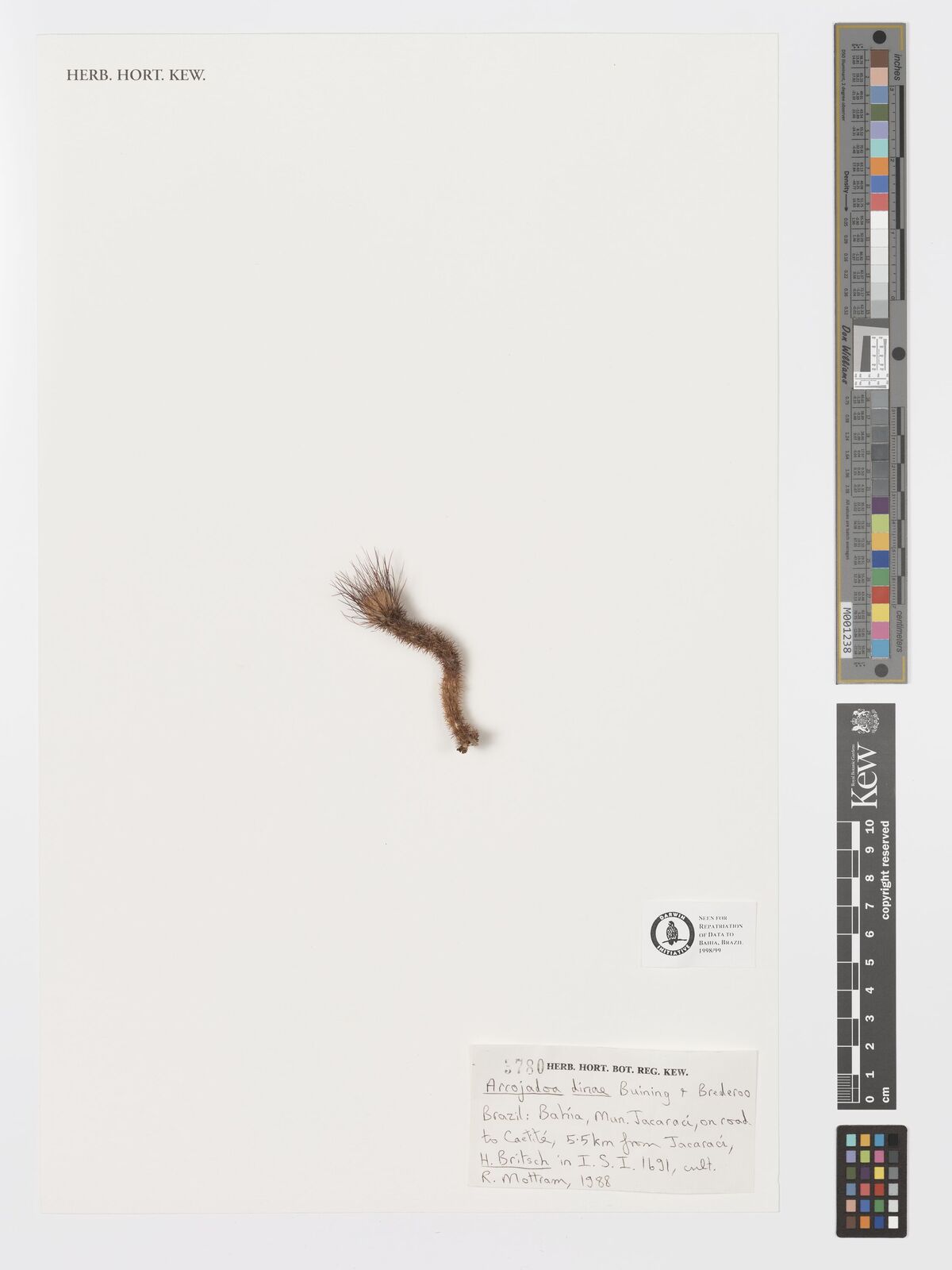 Reference image
Dina's Tail Cactus
Arrojadoa dinae is a unique, semi-shrubby succulent cactus endemic to Brazil, highly prized by collectors for its slender stems and distinct ring-like flowering structures called cephalia 1.
Belonging to the Cactaceae family and the genus Arrojadoa, this species is named in honor of botanical explorers. It stands out in taxonomy due to its transitional growth habit and specialized woolly cephalia that do not terminate the stem's growth permanently 2.
This species is native to eastern Brazil, particularly throughout the states of Bahia and Minas Gerais. It thrives in seasonally dry tropical biomes, growing mainly on rocky outcrops, crystalline soils, and quartzitic stony fields within the Caatinga vegetation 1.
The slender, cylindrical stems can grow upright or semi-prostrate. Its most striking feature is the terminal cephalum—a dense collar of colorful bristles and wool from which tubular, tubular pinkish-red to magenta flowers emerge. Growth continues through the cephalum, creating segmented sections over time 3.
In cultivation, Arrojadoa dinae requires a highly porous, mineral-rich substrate to prevent moisture retention. It prefers bright, indirect sunlight or partially filtered sun. Water thoroughly during the hot summer months, allowing the soil to dry out completely between waterings, and keep dry in winter.
The most prevalent issue is root rot caused by organic-heavy soils or overwatering. Exposure to temperatures below 8°C can also damage the stem tissues and cause fatal fungal infections 3.
Prefers bright, filtered sunlight; shield from intense midday sun to prevent scorching.
Water moderately in summer when soil is dry; keep dry and cool during winter dormancy.
Highly porous mineral substrate containing pumice, perlite, and coarse sand.
Non-toxic, but the small spines can irritate skin; handle with care and keep away from pets.
Moderate. Demands precise watering and winter cold protection to avoid rot.
Naturally distributed in the dry Caatinga and rocky outcrops of Bahia and Minas Gerais, thriving in low-nutrient, sandy soils.
