
Light
Bright Indirect Light
Strong light is preferred. A plant grown in shade should be acclimated to intense sun in stages rather than moved abruptly.
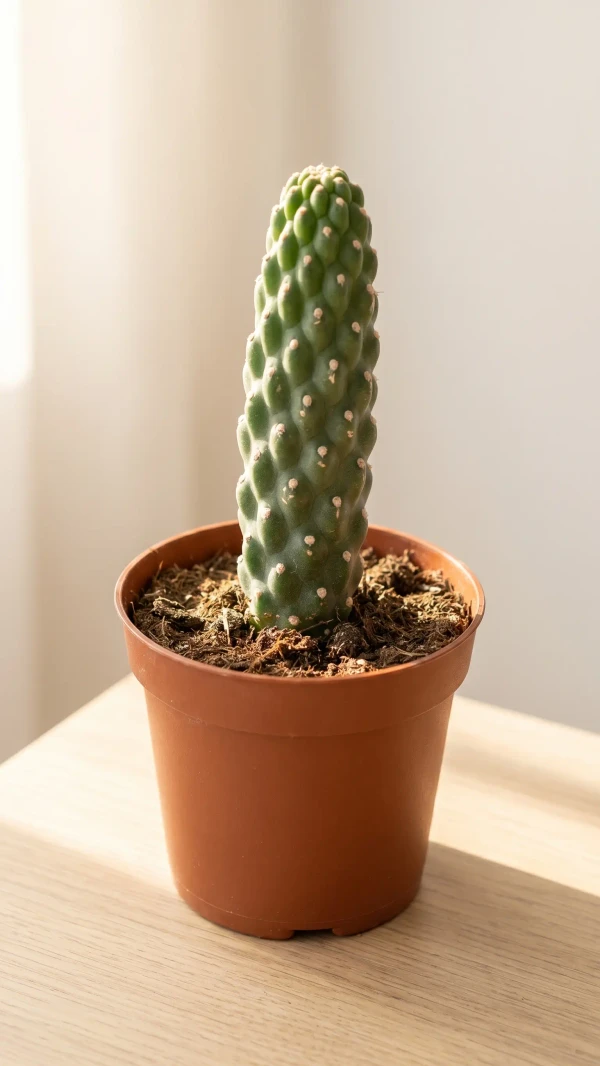
Cylindrical Opuntia
Austrocylindropuntia cylindrica is a cylindrical-segmented cactus associated with the Andean region of Central Colombia, Ecuador, and north-western Peru.1 It may develop as a shrub or small tree. The ageing main stem can become woody, while dark or bluish green shoots carry conspicuous rhomboid tubercles.2
Fleshy leaves may be visible on young growth. They are not the same organs as the spines emerging from areoles and eventually fall. Areoles commonly carry several spines. Scarlet flowers are recorded, but regular flowering should not be promised for every container-grown plant.2
Young, non-flowering specimens can be confused with other cylindrical opuntioids. The pattern of stem tubercles, duration of the leaves, and structure of the areoles and spines should be considered together. One photograph or gallery alt label is not a secure identification.
The native range is Central Colombia, Ecuador, and north-western Peru; many records on other continents represent introduced populations.1 Kew's IUCN integration records the species as NT — Near Threatened.3 Adana is the production origin of the commercial plant, not part of the natural range.
Strong light supports compact stem development. Indoors, choose the brightest practical position; outdoors, increase direct sun in stages. A plant grown in low light may be damaged if moved abruptly into harsh midday sun.
Water according to complete drying of the growing medium rather than a fixed calendar. Once dry, soak the root ball and let excess water escape quickly. Drying slows in cool or low-light periods, so watering naturally becomes less frequent. Continuously moist soil increases the risk of root and stem rot.
Use a drainage-holed pot and an airy, mineral-rich, fast-draining mix. No universal minimum temperature, annual growth rate, or summer/winter watering interval is given because results depend on light, airflow, pot size, root volume, and local climate.
The best-supported concern is mechanical injury from spines and minute glochids, not an unsupported claim of chemical toxicity. Keep the pot away from children, pets, and busy walkways, and use gloves plus tools when handling or repotting it.
Strong light is preferred. A plant grown in shade should be acclimated to intense sun in stages rather than moved abruptly.
Do not use a fixed-day interval. Water after the mix has dried throughout; reduce frequency when cool or low-light conditions extend drying time.
Use a drainage-holed pot and an airy, mineral-rich, fast-draining mix.
Spines and glochids present a mechanical injury risk. Keep the plant away from children and pets, and use gloves plus tools when handling it.
Manageable with strong light and strict drainage; the main risks are overwatering, insufficient light, and abrupt sun exposure.
The native range is Central Colombia, Ecuador, and north-western Peru. Records on other continents represent introduced or naturalized populations.[^1] [^1]: Plants of the World Online. “Austrocylindropuntia cylindrica (Lam.) Backeb.” Royal Botanic Gardens, Kew. Accessed: 2026-08-04. https://powo.science.kew.org/taxon/urn:lsid:ipni.org:names:128942-1
