
Light
Full Sun
Requires full sun, ideally a south-facing window with direct sunlight exposure.
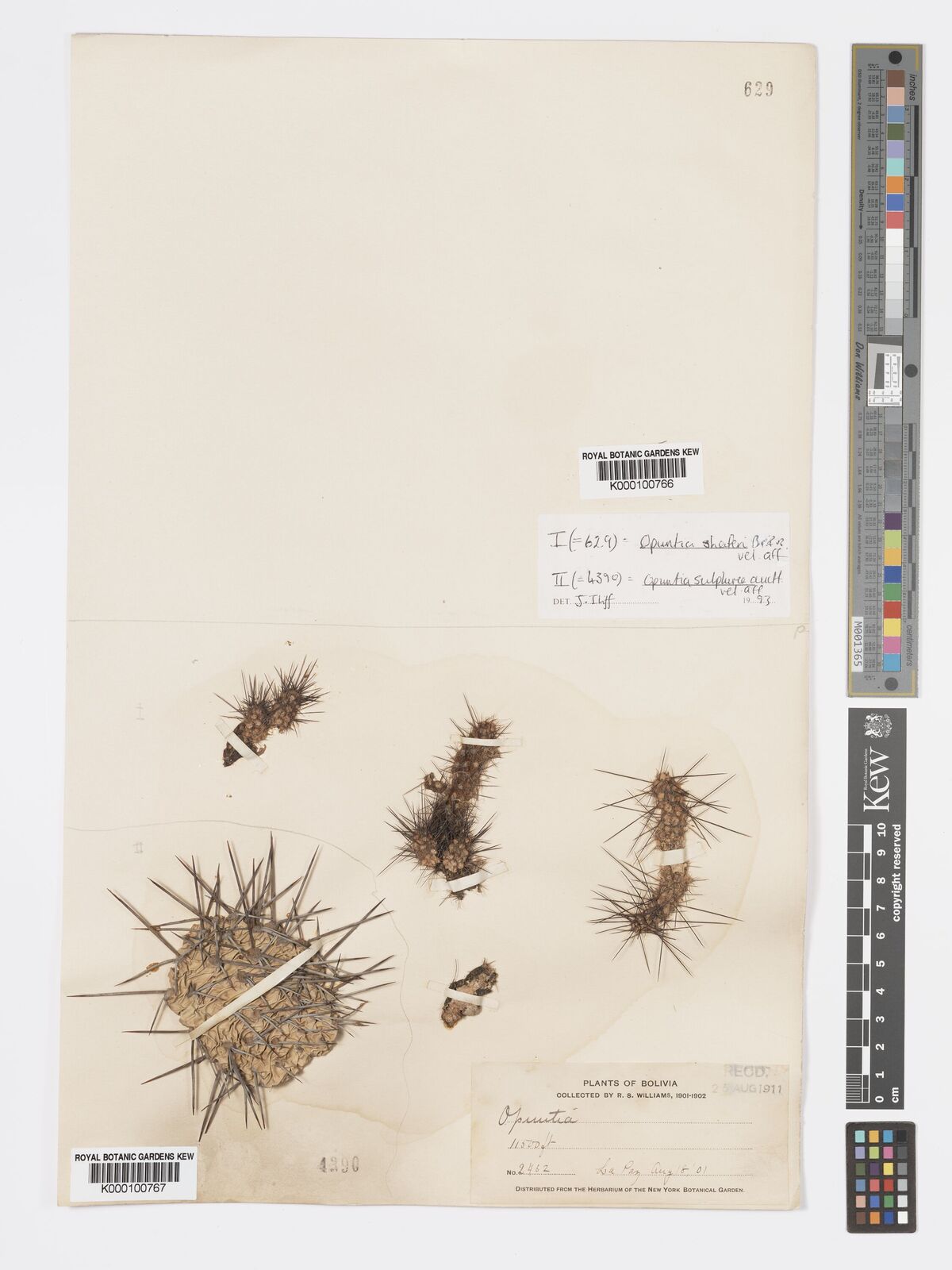 Reference image
Shafer's Cylindrical Opuntia
Austrocylindropuntia shaferi is a distinct, shrubby succulent cactus belonging to the family Cactaceae 1. Characterized by its upright cylindrical stems and prominent spination, this species is highly adapted to arid and semi-arid montane environments.
Named after the renowned botanist John Adolph Shafer, the species was originally placed in the broad genus Opuntia. It was later transferred to Austrocylindropuntia to reflect its distinct cylindrical stem morphology and specific areole features which differentiate it from flat-padded prickly pears 2.
This cactus is native to western and southern South America, particularly restricted to the high-altitude provinces of Jujuy and Salta in northwestern Argentina 3. It thrives in dry shrublands and deserts, occupying rocky slopes and gravelly soils at elevations between 1,500 and 3,000 meters above sea level.
Austrocylindropuntia shaferi forms branched, shrubby cushions reaching heights of 1 to 1.5 meters. The stems are cylindrical, greyish-green, and segmented. Areoles are covered with dense white-yellowish wool and bear 1 to 5 straight, needle-like spines. In summer, it produces vivid yellow to orange-red cup-shaped flowers near the stem tips 4.
In cultivation, it is highly resilient. It requires full sun exposure and a mineral-rich, highly porous soil mix to mimic its natural mountain habitat. During the winter dormancy, keeping the plant completely dry allows it to tolerate brief sub-zero temperatures down to -5°C 2.
Overwatering in poorly draining soil is the most prevalent cause of root rot. Insufficient sunlight results in etiolation, causing the stems to stretch, weaken, and lose their typical compact form.
Requires full sun, ideally a south-facing window with direct sunlight exposure.
Allow soil to dry out fully between waterings. Keep completely dry in winter.
Prefers mineral-heavy, fast-draining soil with a high content of pumice and sand.
Non-toxic, but sharp spines require cautious handling away from children and pets.
Very low maintenance as long as overwatering and dark rooms are avoided.
Native to the high-elevation rocky slopes and arid shrublands of northwestern Argentina in South America.
