
Light
Bright Indirect Light
Bright indirect light or filtered sun. Protect from harsh afternoon summer sun.
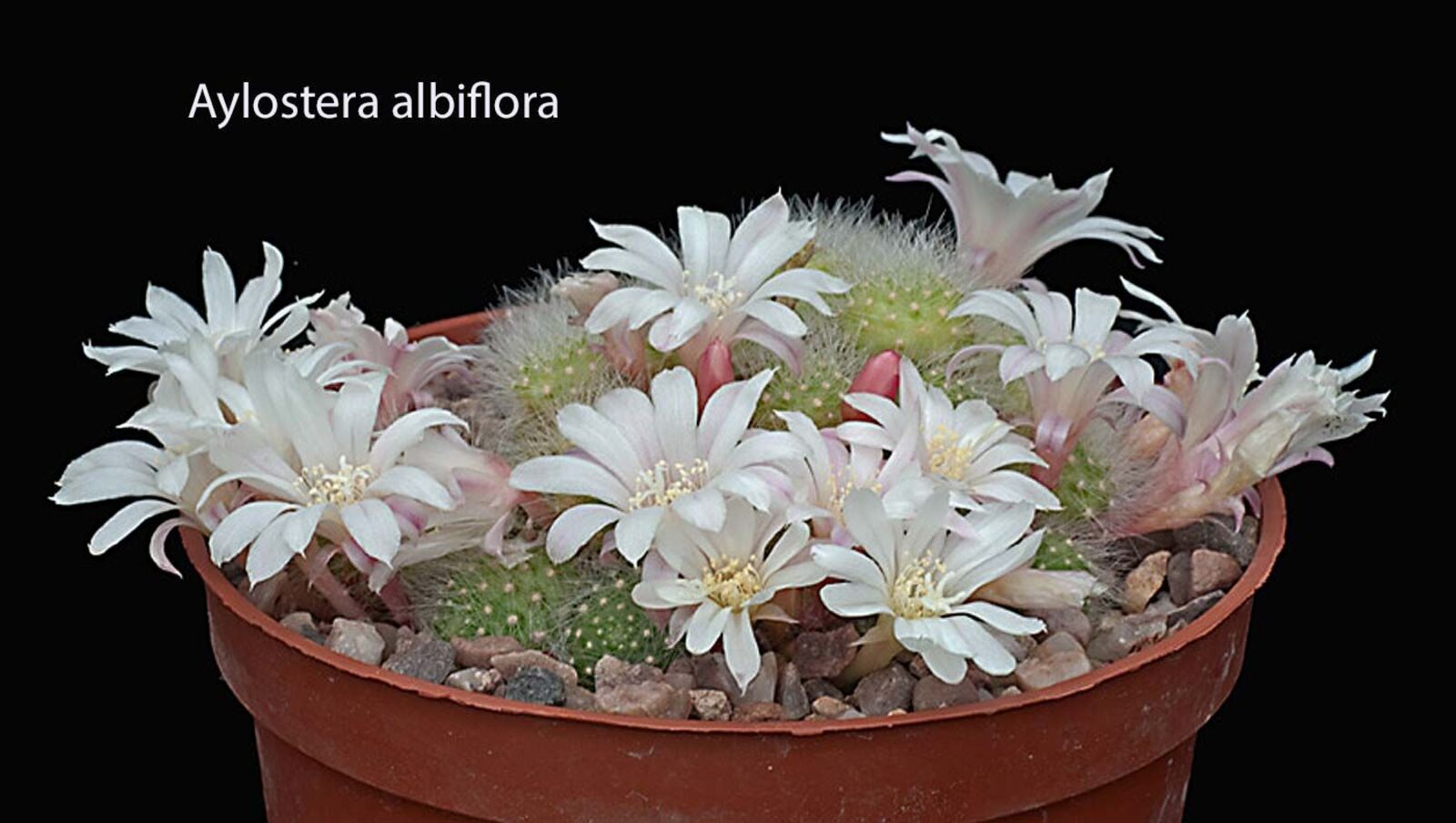 Reference image
White-flowered Aylostera
Aylostera albiflora (formerly Rebutia albiflora) is a small, heavily clustering cactus species within the family Cactaceae, widely admired for its profuse white-to-pale pink blossoms. Characterized by its miniature clustering habit, it forms dense mats of globose heads covered with fine, soft white spines 1.
Originally described by Friedrich Ritter, this species has historically been classified under the genus Rebutia. Modern phylogenetic studies and morphological features support its placement within the resurrected genus Aylostera 2. The specific epithet 'albiflora' derives from Latin, meaning 'white-flowered', pointing to its signature blooms.
Native to Bolivia, specifically the Tarija department, Aylostera albiflora is found growing in rocky crevices and sheer cliffs at elevations ranging from 2,500 to 2,800 meters above sea level 1. It thrives in arid to semi-arid montane shrublands where drainage is absolute.
The individual stems are globose to short-cylindrical, measuring only about 1.8 to 2.5 cm in diameter. It offsets freely from the base to create impressive cushions. The spines are short, bristly, and glass-white. The funnelform flowers arise from the lower body in spring, showcasing pure white petals with a soft pink blush.
This species is highly rewarding and relatively easy to cultivate. It requires bright, filtered sunlight and excellent air circulation. The potting medium must be highly porous, consisting mainly of mineral elements. Water thoroughly during the active growing season only when the soil is completely dry, and keep dormant specimens dry in winter.
The most prevalent failure is root rot triggered by overwatering or compacted soil with high organic retention 2. Insufficient light leads to etiolation, causing the natural globose stems to stretch weakly toward the light source.
Bright indirect light or filtered sun. Protect from harsh afternoon summer sun.
Water thoroughly when soil is dry in spring and summer; keep dry in winter.
Well-draining mineral mix with plenty of pumice, perlite, and coarse sand.
Has fine, bristly spines that can irritate skin. Non-toxic to cats and dogs.
Very easy to maintain, provided you avoid overwatering and stagnant humidity.
Discovered in high-altitude rocky terrains and cliffs in the Tarija region of Bolivia, growing under dry, mountainous conditions.
