
Light
Bright Indirect Light
Enjoys generous bright, indirect light. Filtered sun is best as harsh direct midday sun may scorch the stem.
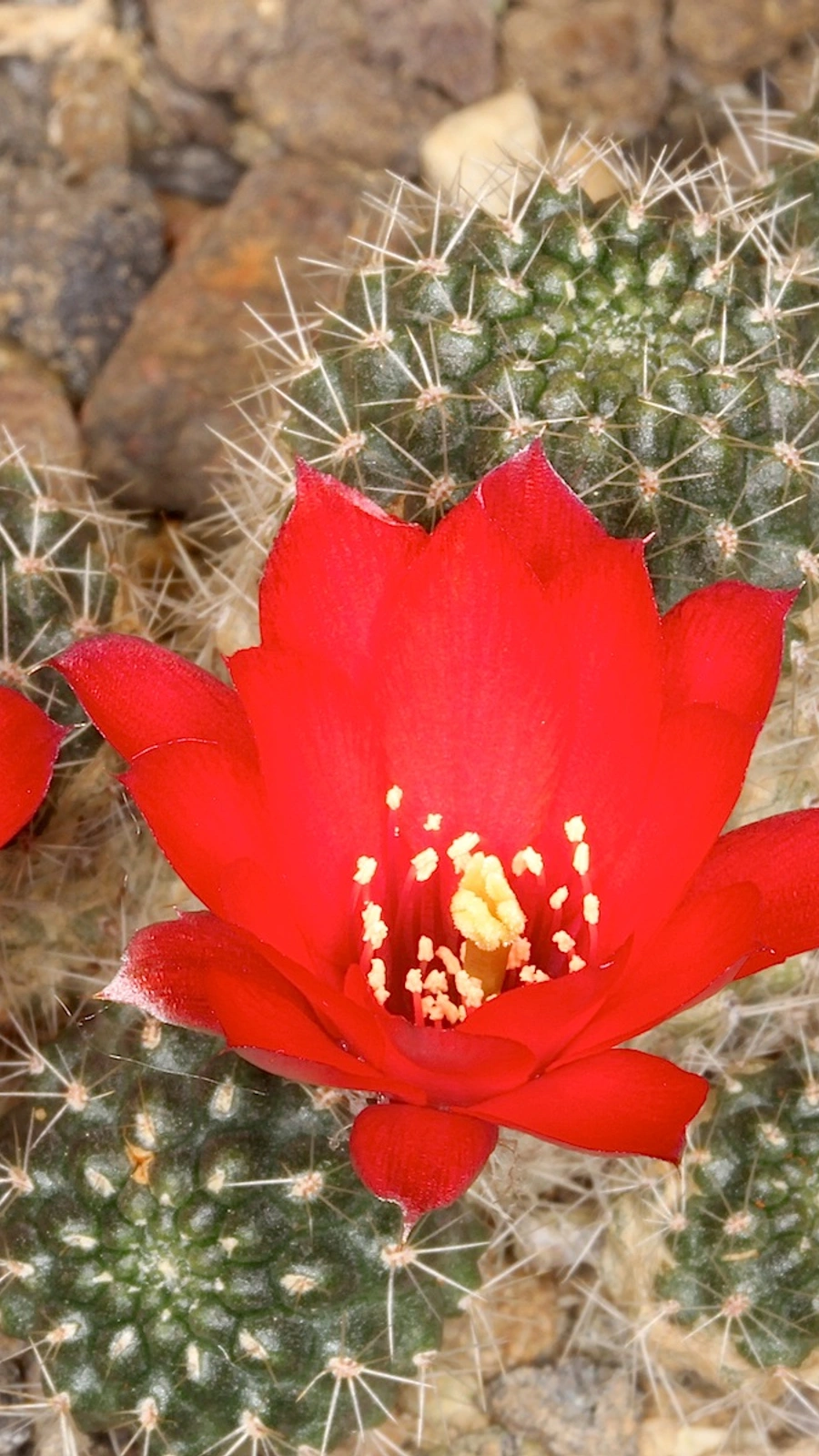 Reference image
 Reference image
False Red Aylostera
Aylostera pseudominuscula (often classified under the synonym Rebutia pseudominuscula) is a diminutive, highly attractive globose cactus species from the family Cactaceae. Celebrated for its prolific, brilliant red flowers and compact clustering growth habit, it is a prized specimen for indoor succulent collections.
Situated within the genus Aylostera, this species has experienced taxonomical shifts, frequently grouped into Rebutia sensu lato 1. Modern phylogenetic studies re-establish Aylostera as a distinct genus based on the presence of hairs and bristles on the flower tube and specific seed morphology 2.
Native to western South America, its distribution ranges across high-altitude regions in Bolivia (BOL) and northwestern Argentina (such as Salta, Jujuy, and Tucuman). It thrives at elevations between 1,500 and 3,000 meters above sea level, nestled under the shade of sparse shrubs or rock crevices in arid shrublands.
The stem is dark green, globose to short cylindrical, forming dense clumps from the base over time. Areoles feature fine, bristle-like, grayish-white to brown spines that wrap closely around the body. In spring, it produces a spectacular display of funnel-shaped, vibrant red to deep orange flowers arising from the lower section of the stem.
This species demands bright, indirect sunlight or filtered sun. It requires highly porous, mineral-based potting media containing pumice, perlite, and coarse sand. Water thoroughly only when the soil has dried out completely during the active growing season. During winter dormancy, keep the plant dry and cool.
Overwatering is the primary cause of failure, quickly leading to root rot. Additionally, a lack of a cool winter dormancy period prevents the plant from setting flower buds for the subsequent spring and causes weak, elongated growth.
Enjoys generous bright, indirect light. Filtered sun is best as harsh direct midday sun may scorch the stem.
Water moderately in summer when soil is dry; keep entirely dry in winter during its cold dormancy.
Requires excellent drainage. Use a gritty mineral soil mix consisting of pumice, gravel, and minimal organic matter.
Non-toxic to pets and humans, but the tiny, fine bristles can cause mild skin irritation upon contact.
Very easy to care for, making it an excellent choice for beginner succulent enthusiasts seeking flowers.
Found in the high-altitude rocky slopes and dry valleys of the Andes. It is adapted to gravelly soils, cold winter nights, and hot, dry summers under sparse vegetation cover.
