
Light
Full Sun
Needs at least 6 hours of direct sunlight daily.
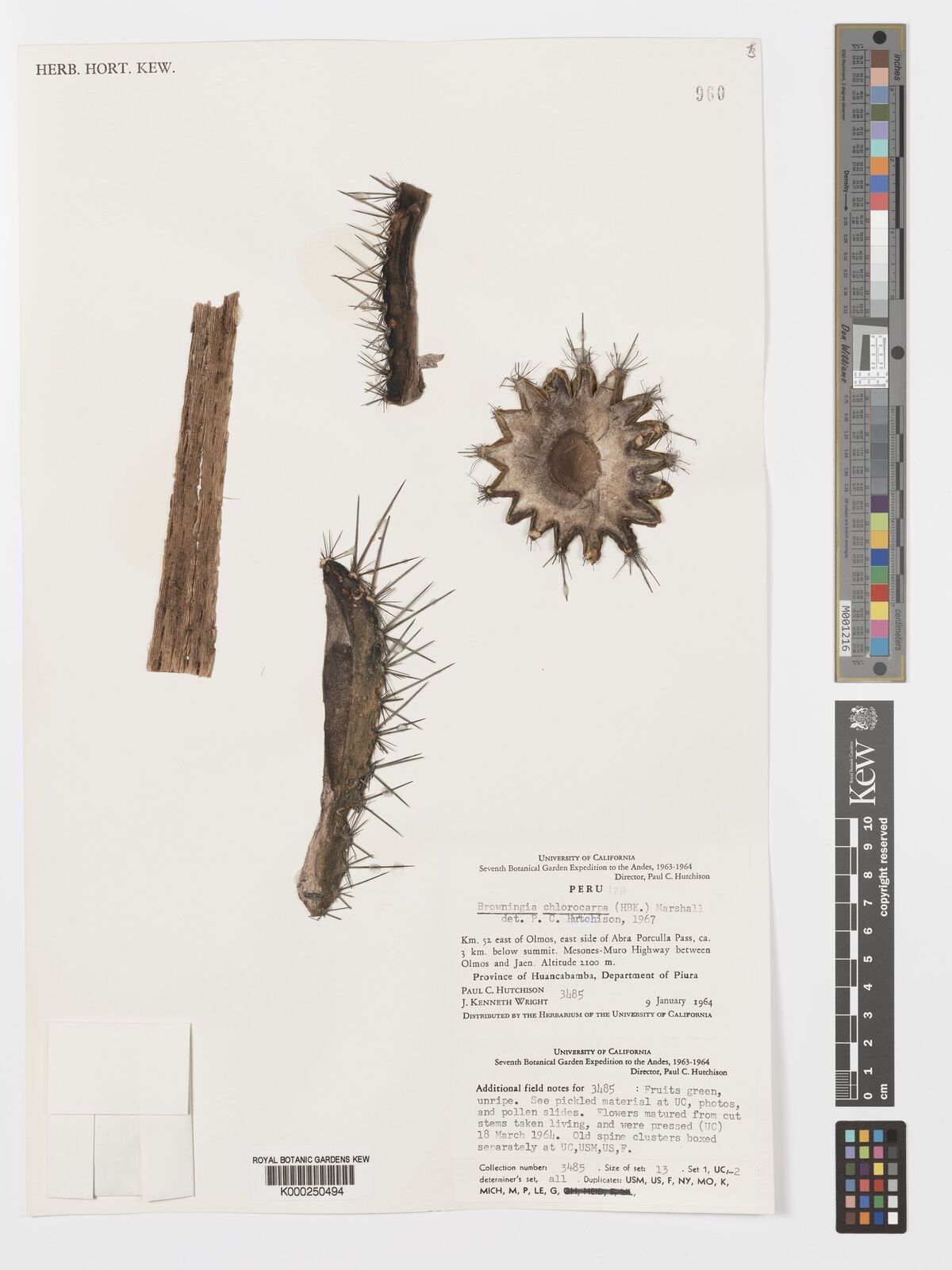 Reference image
Green-fruited Browningia
Browningia chlorocarpa is a rare and striking succulent shrub belonging to the Cactaceae family 1. Known for its branching, tree-like habit and heavily ribbed stems, this desert cactus is a highly prized specimen among collectors of Andean succulent flora.
Originally described by Humboldt, Bonpland, and Kunth as Cereus chlorocarpus, it was later transferred to the genus Browningia 2. The specific epithet "chlorocarpa" originates from Greek, translating to "green-fruited," referencing the characteristic color of its mature globose fruit.
This species is native to western South America, specifically endemic to the dry inter-Andean valleys of northern Peru (Piura and Cajamarca regions) 1. It thrives on steep rocky slopes and dry shrublands, primarily along the Huancabamba river basin at elevations between 700 and 2,000 meters.
In its natural habitat, Browningia chlorocarpa grows into a heavily branched shrub or small tree reaching 1.5 to 5 meters in height. The stems are cylindrical, greyish-green, featuring 9 to 14 distinct ribs. Young branches are heavily armed with golden-brown spines, which tend to deciduous on mature, woody trunks. Its nocturnal flowers are relatively small, funnelform, and greenish-white, followed by smooth green fruits.
It requires a highly porous, mineral-rich substrate to prevent root compaction 2. It demands full sun exposure to maintain its compact form and robust spine development. Watering should be thorough but infrequent during the summer, allowing the soil to dry completely, while being completely suspended during cold winter months.
The most prevalent error in cultivation is overwatering coupled with poor drainage, which rapidly induces basal stem rot 1. Keeping the specimen cold and wet simultaneously during the winter dormancy period is almost always fatal.
Needs at least 6 hours of direct sunlight daily.
Water only when soil is bone dry; keep completely dry in winter.
Mineral-rich, fast-draining gritty soil is highly recommended.
Sharp spines can cause injury; keep away from pets and children.
Requires moderate care due to high sensitivity to overwatering.
Endemic to the inter-Andean dry valleys of northern Peru, specifically within the Piura and Cajamarca regions. It is primarily found growing on steep rocky slopes and arid shrublands along the Huancabamba river basin.
