
Light
Full Sun
Requires full sun, minimum 6-8 hours of direct sunlight daily to maintain its blue-green hue and dense spines.
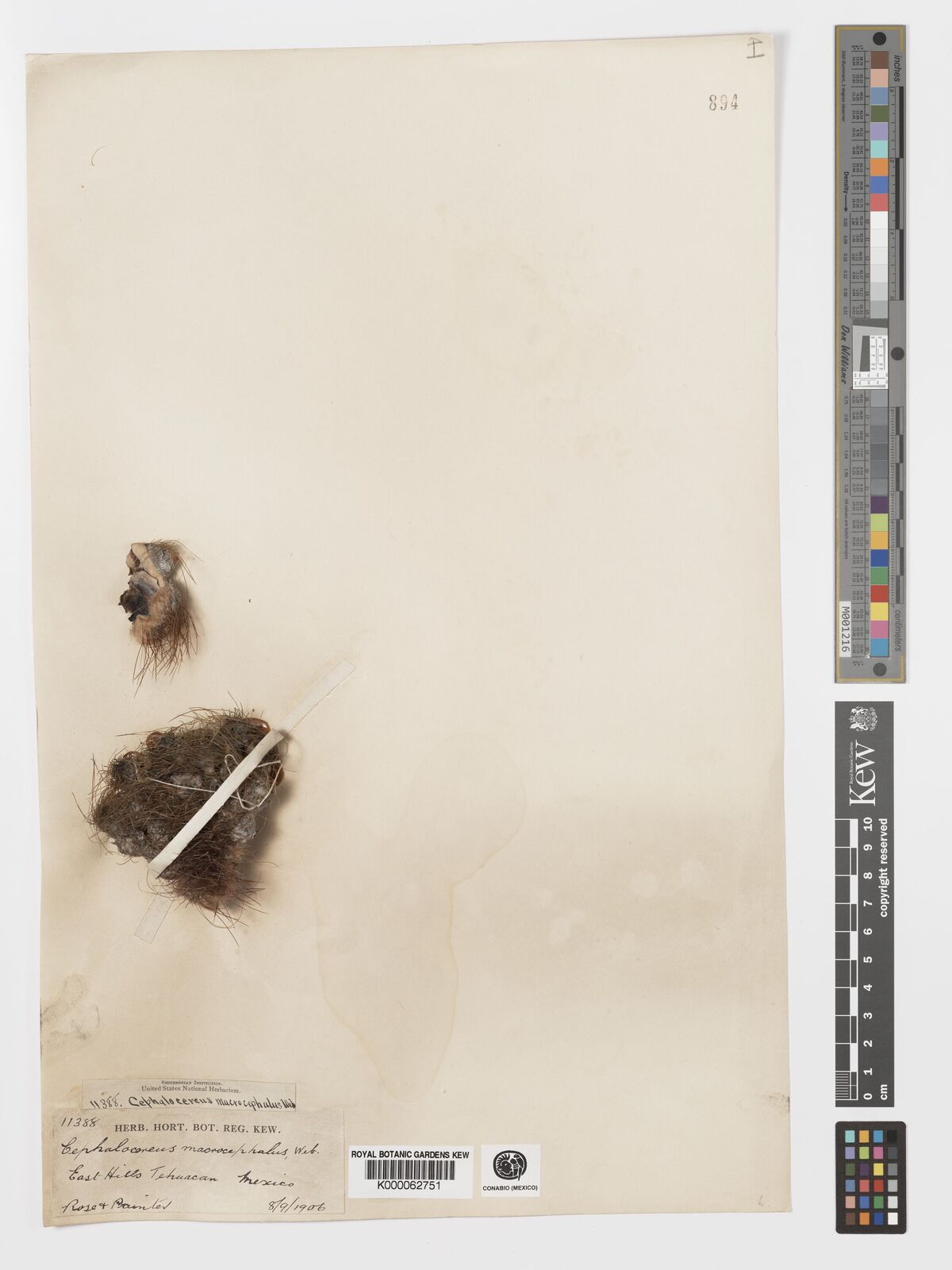 Reference image
Big-Headed Columnar Cactus
Cephalocereus macrocephalus is a massive, arborescent columnar cactus belonging to the family Cactaceae. In its native habitats, it stands as a dominant forest-forming giant, famous for its stout trunk and the dense, woolly pseudocephalium at the stem tips 1.
Originally described by Pfeiffer in 1838 as Cereus macrocephalus, it was later combined into the genus Cephalocereus by Karl Schumann 2. The specific epithet macrocephalus translates from Greek as "large-headed," referring to the prominent, woolly cephalium structure that forms at the apex of mature stems to bear flowers.
This species is endemic to southern and central Mexico, with major populations in Puebla, Oaxaca, and the Tehuacán-Cuicatlán Valley 1. It thrives on limestone hills, arid plains, and dry deciduous shrublands at elevations up to 1,500 meters above sea level.
Cephalocereus macrocephalus grows as a tall, tree-like cactus reaching heights up to 15 meters, with a well-defined trunk branching extensively. The stems are greyish-green, featuring prominent ribs. The apex displays a distinct cephalium packed with yellowish-brown wool and bristles. It bears nocturnal, bell-shaped, cream-to-pinkish flowers pollinated by bats.
This cactus requires full sun and thrives in intense light. A highly porous mineral substrate mixed with pumice is critical. During the active growing season, water deeply but allow the soil to dry out completely. Keep virtually dry during the cold winter dormancy.
The most prevalent issue is overwatering, especially in low-temperature winter periods, which rapidly leads to root rot 2. Insufficient sunlight will cause etiolation, stretching the robust stems into weak, thin growth.
Requires full sun, minimum 6-8 hours of direct sunlight daily to maintain its blue-green hue and dense spines.
Water thoroughly only when the soil is completely dry. Keep almost dry during winter.
Inorganic, gritty soil with excellent drainage, rich in pumice, lava rock, and coarse sand.
Sharp spines can cause physical injury. Handle with care using thick leather gloves or tongs.
Moderate. Requires strict watering discipline, especially during the cold winter months.
Inhabits the arid valleys and dry deciduous shrublands of southern-central Mexico, growing on steep limestone slopes where it acts as a keystone species.
