
Light
Bright Indirect Light
Requires abundant bright indirect light; midday direct sun may scorch its delicate waxy skin.
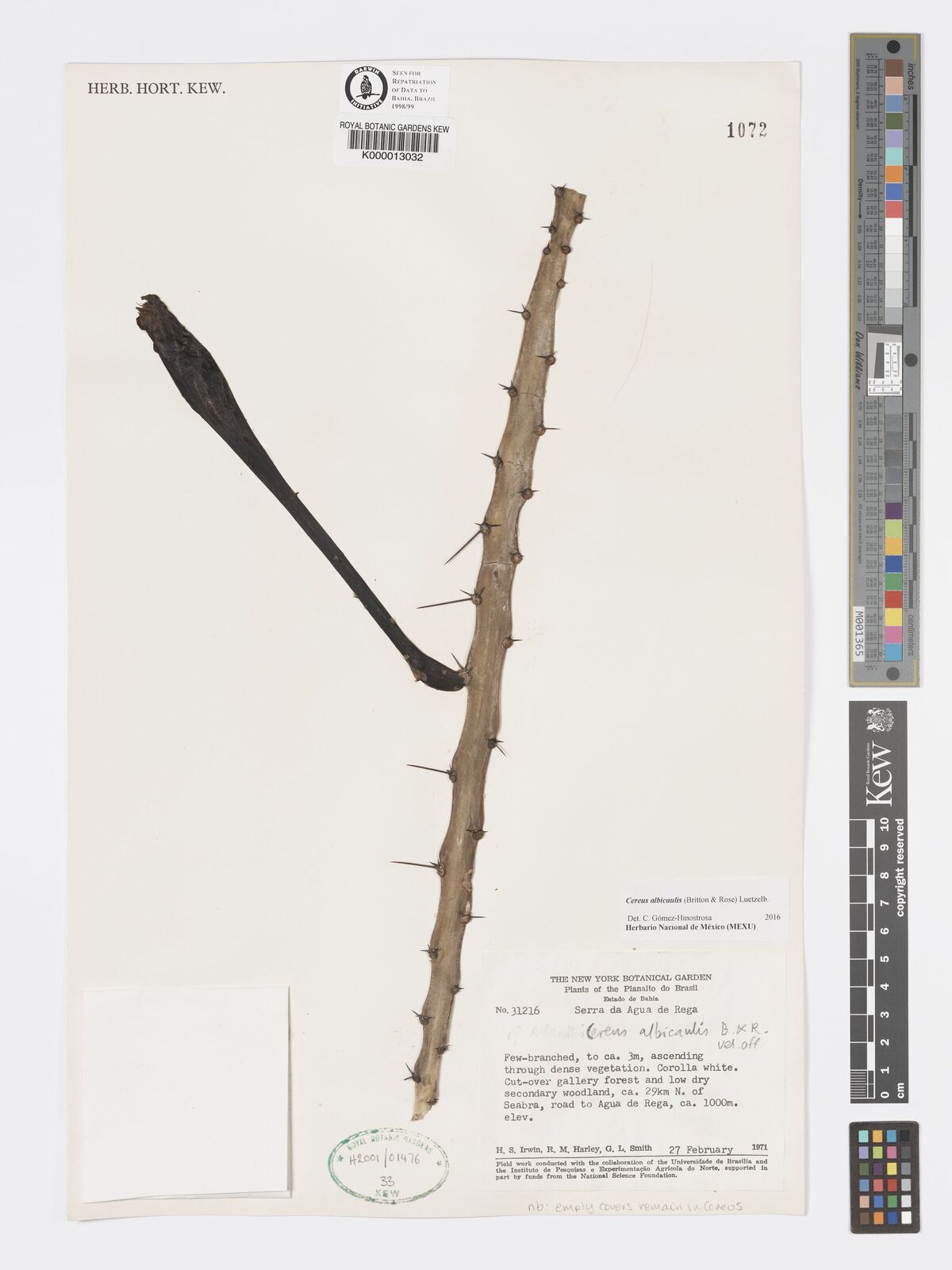 Reference image
White-stemmed Cereus
Cereus albicaulis is an intriguing succulent tree belonging to the cactus family (Cactaceae). Characterized by its semi-scandent or climbing growth habit, it is highly sought after by collectors for its striking white-to-bluish pruinose stems 1.
Originally described by Swedish-Brazilian botanist Albert Löfgren, the specific epithet albicaulis translates from Latin to mean 'white-stemmed,' highlighting the pale waxy coating covering its branches 2. It resides within the Cereus genus, famed for large night-blooming flowers.
Endemic to Brazil, its distribution covers northeastern and southeastern regions including Bahia and Minas Gerais 1. It thrives in seasonally dry tropical biomes, particularly in Caatinga scrub vegetation, often scrambling through surrounding trees for structural support.
The stems are quadrangular or pentagonal, starting erect but becoming arching or decumbent over time. They exhibit a distinct powdery-blue or milky-white epidermis. Areoles carry sparse, needle-like grey spines. Its nocturnal flowers are large, white, and funnel-formed 2.
Unlike desert cacti, this tropical species prefers bright, filtered light and slightly higher humidity. Soil must be exceptionally porous. Water thoroughly, but allow the medium to dry out completely between sessions.
Overwatering and poor drainage quickly lead to root rot. Additionally, low light levels will cause etiolation, wherein the stems stretch out, lose their beautiful white coating, and become weak.
Requires abundant bright indirect light; midday direct sun may scorch its delicate waxy skin.
Water thoroughly once the substrate is completely dry, and limit watering significantly in winter.
Use an airy cactus substrate heavily amended with pumice, grit, and coarse sand.
Equipped with sharp spines. Wear protective gloves when handling or repotting. Keep away from pets.
Moderate. It requires mindful watering and support structures as it transitions to a climbing habit.
Native to the Caatinga dry forests and scrublands of Brazil, where it climbs up through surrounding vegetation in semi-shaded settings.
