
Light
Full Sun
Requires at least 6 hours of direct sunlight daily to prevent etiolation and maintain form.
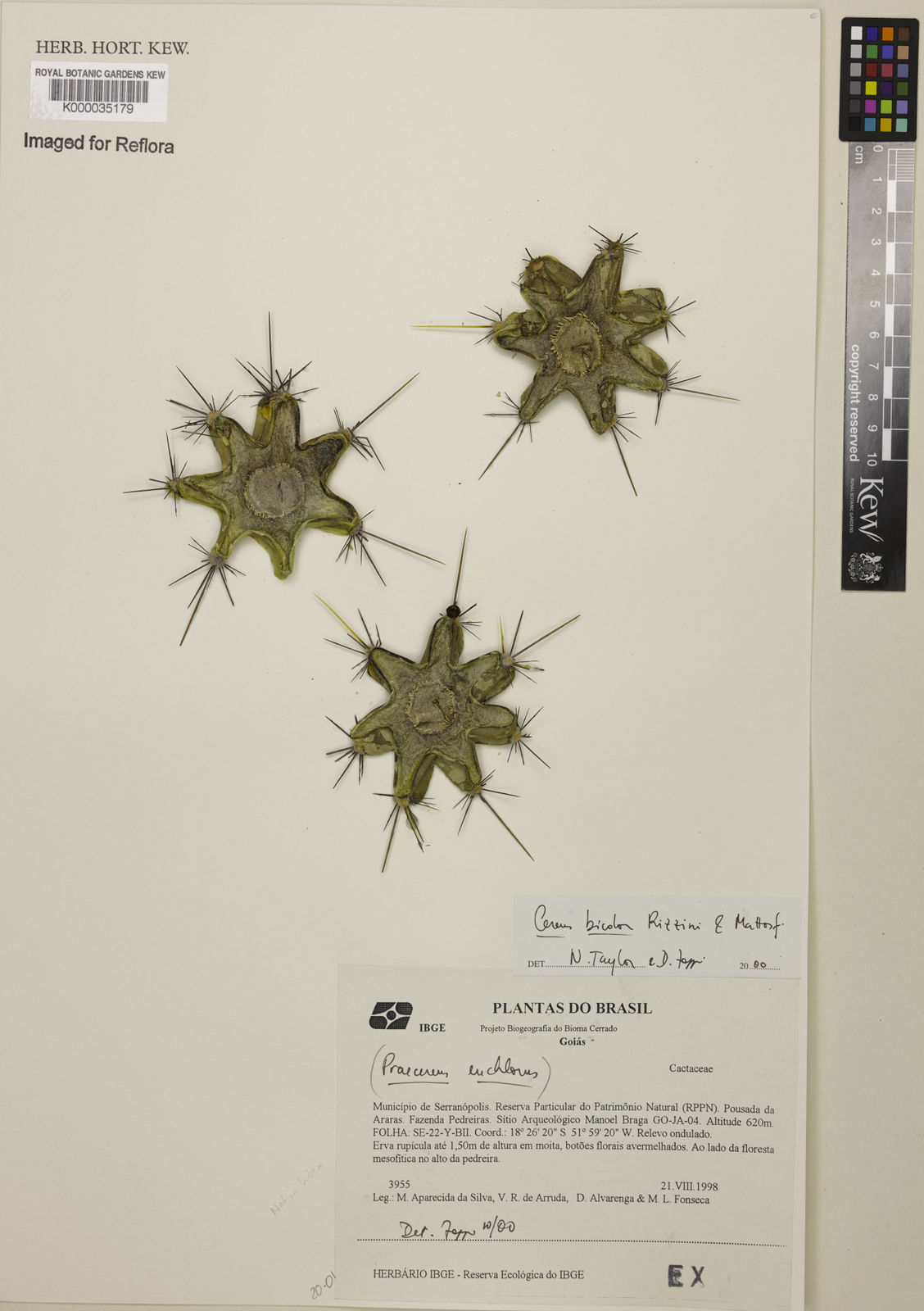 Reference image
Two-tone Columnar Cactus
Cereus bicolor is a striking columnar cactus belonging to the family Cactaceae, native to the seasonally dry tropical environments of Brazil 1. Known for its shrubby or tree-like growth habit, it is appreciated in cultivation for its impressive stature and distinct bicolored spines.
The species is classified within the genus Cereus. The specific epithet "bicolor" refers to the contrasting two-tone coloration of its spines, which typically exhibit a yellowish-brown base with dark, reddish, or greyish tips 2.
This species is native to central Brazil, particularly within the states of Goiás, Distrito Federal, Mato Grosso, and Mato Grosso do Sul 1. It thrives in the Cerrado savanna biome, growing on rocky outcrops and sandy soils in seasonally dry tropical forests.
The plant features erect, blue-green stems that branch with age. It is characterized by prominent ribs lined with woolly areoles bearing sharp, two-toned spines. In summer, it produces large, nocturnal white flowers designed to attract nocturnal pollinators like moths 2.
In cultivation, Cereus bicolor requires full sun exposure and highly porous, free-draining soil. Water thoroughly during the active growing season but allow the substrate to dry out completely between waterings. During winter, watering should be suspended.
Overwatering and poor soil drainage are the most frequent causes of root rot in this species. Additionally, inadequate light exposure leads to etiolation, causing the stems to become weak, thin, and pale 3.
Requires at least 6 hours of direct sunlight daily to prevent etiolation and maintain form.
Let the substrate dry completely before watering again. Keep completely dry in winter.
Thrives in mineral-rich, porous soil with high grit, pumice, and sand content.
Has sharp spines. Handle with thick gloves and keep away from children and pets.
Very low maintenance once established in a bright, warm, and dry environment.
Native to the central dry regions of Brazil, particularly the Cerrado savanna, where it grows in sandy, rocky soils under seasonally dry tropical conditions.
