
Light
Full Sun
Requires full sun; bright, direct sunlight is essential for strong spines and healthy growth.
 Reference image
Island Columnar Cactus
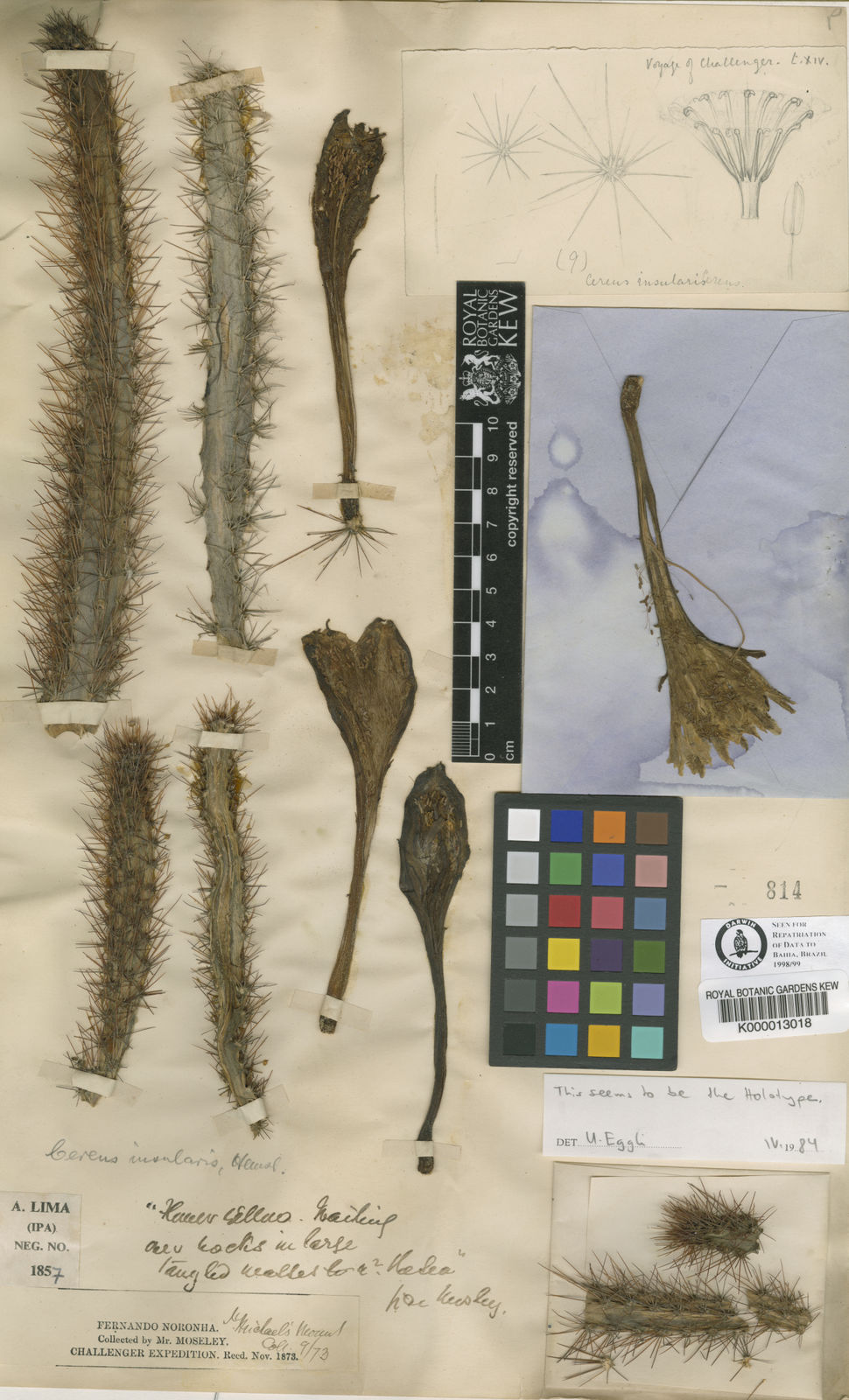
Cereus insularis is a shrubby, clumping columnar cactus species belonging to the family Cactaceae. Known for its coastal resilience, this succulent shrub is native to rocky shorelines and seasonally dry tropical habitats 1. It is highly adapted to wind and salt spray.
The species was first described in the early 20th century. The genus name Cereus derives from the Latin word for "candle" or "torch," referring to the upright, columnar growth habit of these cacti 2. The specific epithet insularis translates to "of an island" or "insular," highlighting its primary distribution on oceanic islands 3.
This cactus is endemic to northeastern Brazil, including the Fernando de Noronha archipelago and coastal states such as Bahia, Pernambuco, and Ceará 1. It thrives in seasonally dry tropical biomes, growing directly on rocky outcrops, sandy soils, and coastal scrublands under intense sunlight.
Cereus insularis features creeping to semi-erect, branching stems that form dense low-growing thickets. The stems are yellowish-green to bright green with multiple prominent ribs. Areoles bear numerous golden-yellow to brownish spines. It produces funnel-shaped, nocturnal flowers that are typically creamy-white 2.
In cultivation, it is a highly resilient species. It demands full sun to maintain its compact spination and robust form. Watering should follow a strict soak-and-dry method, ensuring the soil dries out completely between waterings. Cultivate in a well-draining, mineral-based cactus mix.
Overwatering and poorly draining pots are the leading causes of root rot. Insufficient sunlight leads to etiolation, where the stems become pale, thin, and weak.
Requires full sun; bright, direct sunlight is essential for strong spines and healthy growth.
Water only when the substrate is fully dry. Prone to rot if kept wet.
Use a mineral-heavy, porous cactus substrate with plenty of pumice.
Spines are sharp and can cause irritation; non-toxic but keep out of reach of pets and children.
Very easy to care for as long as it gets plenty of light and minimal water.
Native to the volcanic islands of Fernando de Noronha and the northeastern coastal strip of mainland Brazil, where it thrives in sandy, rocky, and dry tropical environments.
