
Light
Bright Indirect Light
Prefers bright, indirect light or filtered sun; avoid scorching afternoon rays.
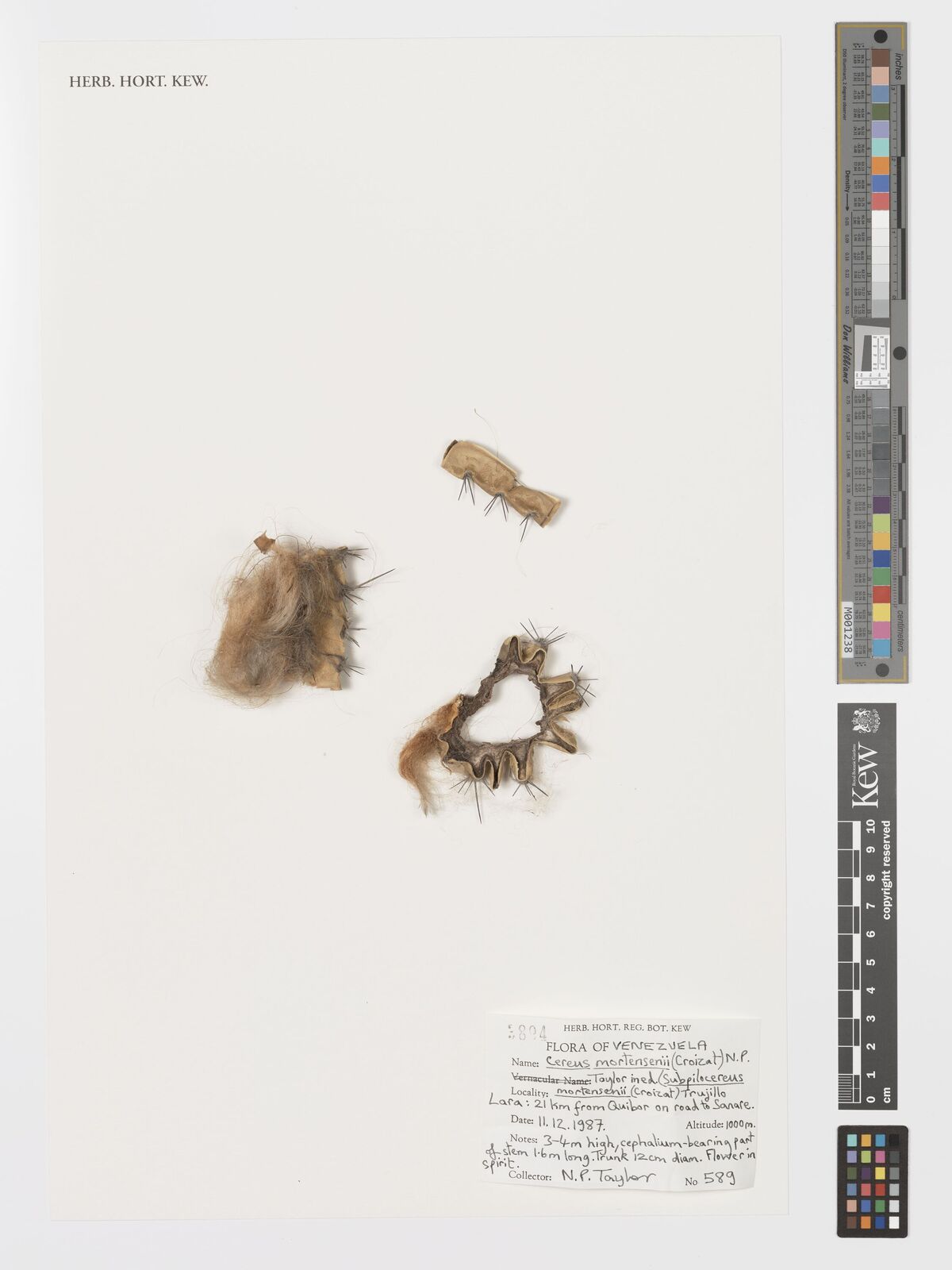 Reference image
Climbing Columnar Cactus
Cereus mortensenii is an intriguing, climbing succulent species belonging to the Cactaceae family. Unlike standard upright columnar cacti, this species displays a scandent or semi-clambering growth habit that adapts beautifully to supportive structures.
Historically subjected to different generic assignments, molecular and morphological evaluations recorded by the Kew Plants of the World Online (POWO) have placed this species firmly within the genus Cereus 1. The specific epithet honors Mortensen for botanical contributions.
This species is native to northern South America, particularly Venezuela 2. It thrives in seasonally dry tropical biomes, often growing as a clambering shrub or climber among deciduous forests and rocky scrublands, showing outstanding drought tolerance.
The stems are slender, cylindrical, light green, and divided into several ribs bearing small aeroles with short, protective spines. Its flowers are nocturnal, large, white-to-cream colored, and highly fragrant, adapted for moth pollination.
In cultivation, it requires a support trellis or moss pole to guide its climbing habit. It prefers bright, indirect sunlight rather than harsh direct midday sun. Water thoroughly only when the substrate is completely dry, and maintain dry conditions during winter dormancy.
Overwatering in poorly draining soil leads to immediate root rot. Furthermore, failing to provide physical support can result in sprawling, weak stems that are susceptible to damage and breakage.
Prefers bright, indirect light or filtered sun; avoid scorching afternoon rays.
Water thoroughly only when the soil is dry. Drastically reduce in winter.
Highly porous cactus soil enriched with pumice, perlite, and coarse sand.
Non-toxic, but the small spines can cause physical skin irritation if handled poorly.
Moderate care required, mainly due to the need for physical climbing support.
Native to the seasonally dry tropical forests and rocky scrublands of Venezuela, where it climbs up tree trunks and rocks to capture light.
