
Light
Direct Sun
Requires at least 6 hours of direct sunlight daily to prevent weak, stretched growth.
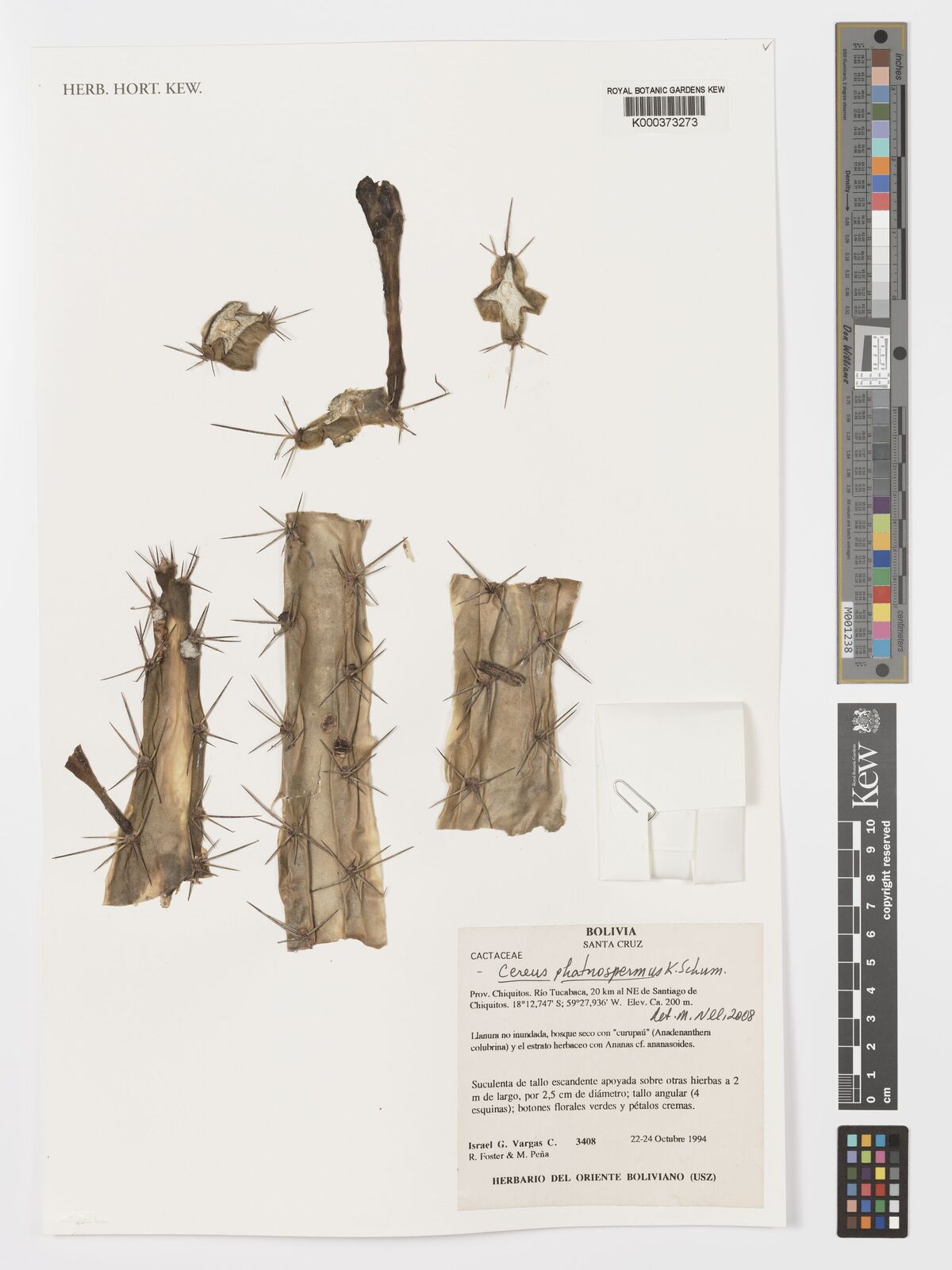 Reference image
Night-blooming Columnar Cactus
Cereus phatnospermus is a perennial succulent shrub belonging to the Cactaceae family. Characterized by its semi-erect, clumping columnar branches and large nocturnal white flowers, it is a resilient and ornamental species suited for dry environments.
The species was formally described by Karl Moritz Schumann in 1899 1. The genus name Cereus originates from the Latin word for 'wax candle', denoting the architectural, upright growth form of these cacti. It is sometimes classified under the synonym Monvillea phatnosperma 2.
Native to central South America, its range spans Bolivia, Paraguay, northern Argentina (including Formosa, Chaco, and Entre Ríos), and parts of Brazil (Mato Grosso, Distrito Federal) 1. It thrives in dry shrublands, deciduous forests (Gran Chaco), and savannah biomes, growing in rocky or sandy substrates 2.
This cactus exhibits a shrubby habit, with stems that can be erect or sprawling, reaching up to 2 meters in length. The stems are typically light green, possessing 4 to 5 sharp ribs. Areoles bear sharp, greyish spines. The spectacular funnel-shaped flowers are up to 15 cm long, displaying white inner petals and reddish-green outer sepals that open at night. The resulting fruits are red and globose.
In cultivation, Cereus phatnospermus requires full sun and exceptionally well-draining soil. It is drought-tolerant, requiring moisture only during the warm growing season when the substrate has dried out completely. Winter care involves keeping the plant dry and protecting it from freezing temperatures.
Overwatering, especially during the cold winter dormancy, is the primary cause of root rot. Lack of sufficient direct sunlight leads to etiolation, where the stems become pale, thin, and structurally weak.
Requires at least 6 hours of direct sunlight daily to prevent weak, stretched growth.
Water deeply but infrequently, allowing the potting mix to dry out 100% between waterings.
Use a specialized porous cactus soil mix with high mineral content (pumice, sand, perlite).
Non-toxic to pets, but has sharp spines that can cause physical injury. Handle with care.
Very easy to grow, ideal for beginners due to high drought and neglect tolerance.
Widely distributed across the dry forest and shrubland regions of the Gran Chaco, spanning Bolivia, Paraguay, Brazil, and northern Argentina.
