
Light
Filtered Sun
Requires 5-6 hours of daily bright indirect or filtered sunlight.
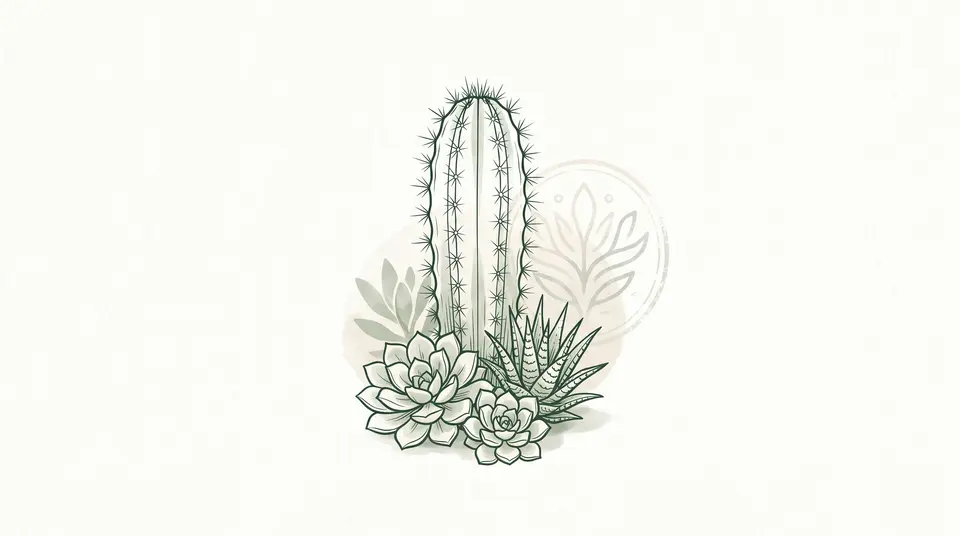 Reference image
Rufer's Columnar Cactus
Cereus % ruferi is a fast-growing, columnar hybrid cactus belonging to the Cactaceae family. Highly appreciated in the horticultural world for its distinctive blue-green skin and symmetrical form, it serves as a stunning structural accent in succulent collections 1.
The genus name Cereus originates from the Latin word for candle, describing its candle-like columnar growth habit. The "%" in its scientific name denotes its hybrid origin, indicating either an intentional horticultural cross or a naturally occurring interspecific hybrid within botanical collections 2.
As a hybrid taxon, Cereus % ruferi does not occupy a distinct wild habitat. Instead, its parental lineage originates from the vast arid and semi-arid scrublands of South America, adapting it to rocky soils and prolonged dry periods 1.
This cactus exhibits ribbed columnar stems featuring a fine glaucous blue-green coating. Radial spines sprout uniformly from its woolly areoles along the margins of the ribs, displaying beautiful geometric patterns that become more robust with mature sun exposure.
It thrives in porous, gravelly, and non-calcareous potting media that allow fast water drainage. It requires full or lightly filtered sunlight and a warm environment. Watering must follow the soak-and-dry method, with irrigation completely withheld during winter dormancy 2.
The most common error is overwatering during cold months, which leads to root rot. Lack of sufficient sunlight causes the stems to grow thin, weak, and pale (etiolation), ruining its iconic cylindrical stature.
Requires 5-6 hours of daily bright indirect or filtered sunlight.
Allow the substrate to dry out fully before re-watering.
Very porous, mineral-rich medium with pumice and sand.
Features sharp spines; handle carefully and keep away from pets.
Very easy to maintain, ideal for busy growers.
This plant has no natural wild distribution, though its ancestral species thrive across the dry rocky plateaus of South America, primarily Brazil and Argentina.
