
Light
Full Sun
Prefers full, direct sunlight, ideally near a south- or west-facing window.
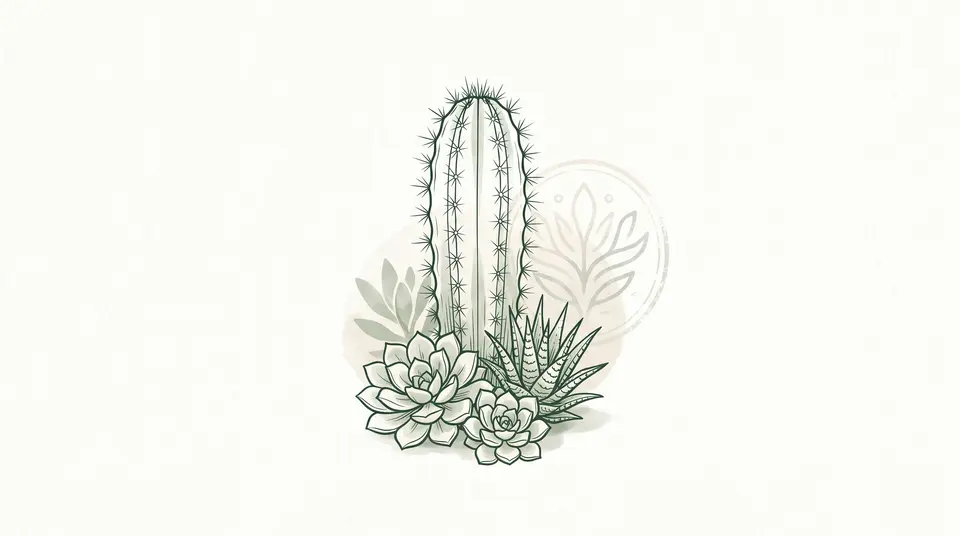 Reference image
Cereus Sirul
Cereus sirul is a column-shaped, upright-growing rare cactus species belonging to the Cactaceae family 1. Prized in indoor collections for its architectural, majestic stature, this cactus stands out for its high resilience and minimal maintenance needs.
The genus Cereus encompasses large, columnar cacti primarily native to South America. Cereus sirul shares distinct morphological traits with its congeners, including ribbed stems and large, nocturnal flowers 2. The specific epithet likely relates to its unique spine arrangement or rib structure.
While its precise distribution is narrowly documented, it originates from the arid and semi-arid regions of South America, typifying the scrublands and rocky slopes of Brazil, Paraguay, or Bolivia 1. It thrives in well-draining, nutrient-poor, sandy soils under intense solar radiation.
The stem is grayish-green to glaucous blue-green, featuring prominent vertical ribs. The areoles bear stiff, grayish-brown to yellowish spines. Mature specimens produce large, nocturnal, funnel-shaped white or cream flowers during late spring and summer 2.
This species requires full, direct sun to maintain its robust form. Watering should only be done when the substrate has completely dried out. During winter dormancy, watering must be suspended almost entirely. Highly porous, sandy cactus mixes are vital for root aeration.
Overwatering is the most critical threat, rapidly leading to root and stem rot. Additionally, low-light conditions cause etiolation, where the plant grows thin, weak, and loses its natural coloration.
Prefers full, direct sunlight, ideally near a south- or west-facing window.
Water thoroughly only when the soil is dry. Keep almost dry in winter.
Requires excellent drainage; use a grit-heavy mix with pumice or perlite.
Features sharp spines; keep out of reach of children and curious pets.
Very easy to care for, requiring minimal attention if provided with ample light.
Native to the arid, rocky terrains and scrublands of South America. It has adapted to survive prolonged periods of drought under intense sunlight and low atmospheric humidity.
