
Light
Full Sun
Requires full sun, preferably at least 6 hours of direct sunlight daily.
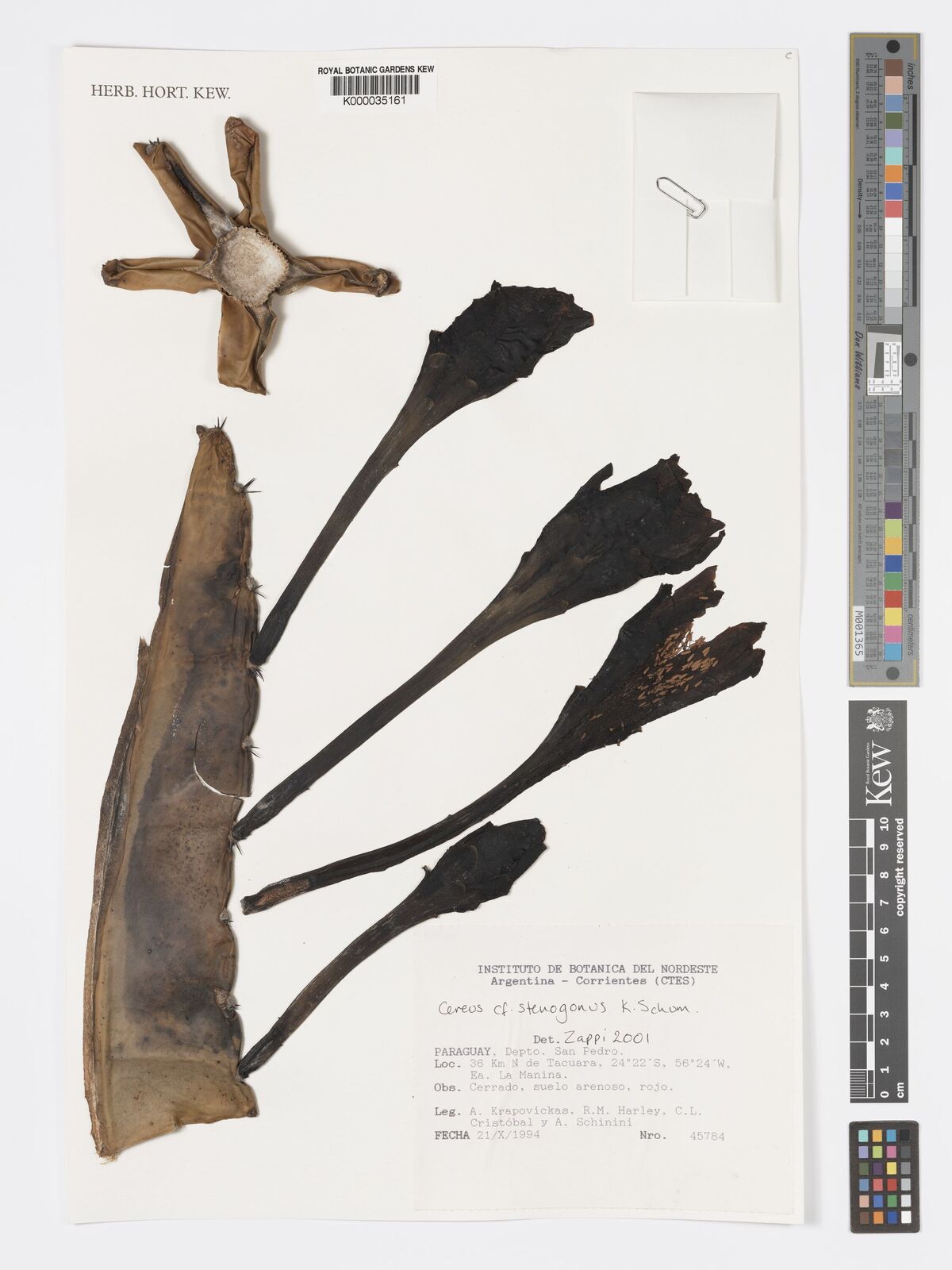 Reference image
Narrow-Ribbed Columnar Cactus
Cereus stenogonus is a large, arborescent columnar cactus belonging to the family Cactaceae. Known for its imposing stature in the wild, this species is a popular ornamental choice for expansive outdoor xeriscapes and bright indoor botanical collections.
This species was first described in 1899 by the German botanist Karl Moritz Schumann. The genus name Cereus translates from Latin to mean "wax torch," reflecting the vertical columnar growth habit of these cacti. The specific epithet stenogonus is derived from Greek roots meaning "narrow-angled" or "narrow-ribbed," describing the sharply defined stem margins 1.
Cereus stenogonus is native to Southern and Western South America, particularly in Bolivia, Paraguay, northern Argentina, and Brazil (specifically Mato Grosso and Mato Grosso do Sul) 2. It thrives in seasonally dry tropical forests, rocky outcrops, and scrublands, demonstrating excellent adaptation to prolonged droughts.
In its natural habitat, it develops into a multi-branched, succulent tree reaching 6 to 8 meters in height. The glaucous blue-green or deep green stems feature 4 to 5 thin, highly pronounced ribs. Areoles bear short, sharp, grayish-yellow spines. In summer, it produces large, nocturnal, funnel-shaped flowers that are pinkish on the outer tepals and pure white inside 1.
This species requires full sun to maintain its structural integrity and prevent etiolation. It should be grown in sandy, extremely porous potting substrates. Water thoroughly during the active growing season only when the soil has dried out completely, and keep the plant dry in winter.
The most prevalent errors include placing the cactus in low-light conditions, which causes weak, stretched growth, and overwatering, which quickly triggers root rot 2. Wet cold during winter is particularly fatal.
Requires full sun, preferably at least 6 hours of direct sunlight daily.
Water only when the substrate is completely dry. Keep dry in winter.
Highly porous cactus mix amended with coarse sand and pumice.
Features sharp spines; keep out of reach of children and pets.
Very easy and forgiving, making it perfect for beginner collectors.
Native to the seasonally dry tropical forests, rocky hillsides, and arid scrublands of central South America.
