
Light
Full Sun
Requires full sun and at least 6-8 hours of direct sunlight daily.
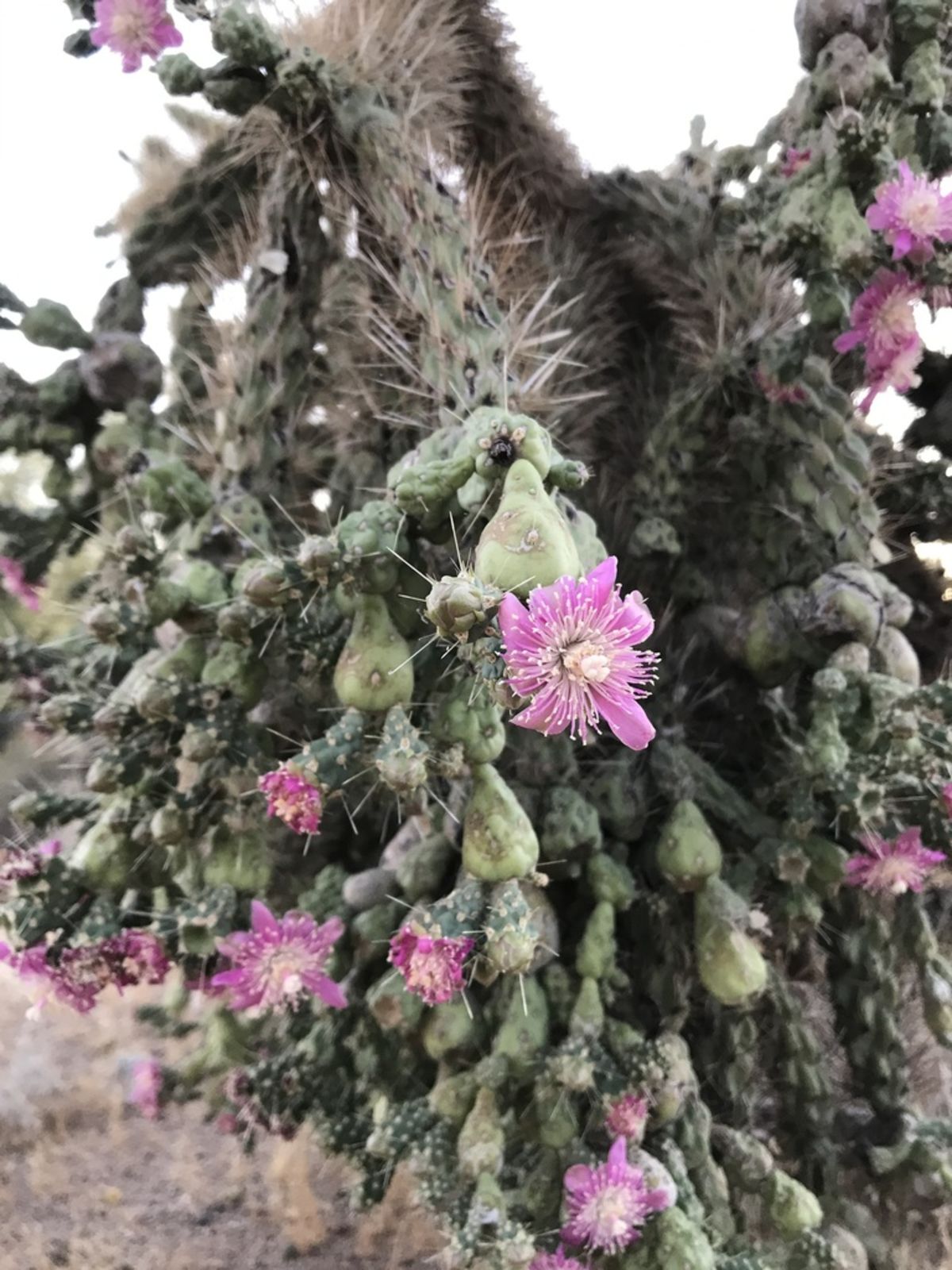 Reference image
Jumping Cholla
Cylindropuntia fulgida, commonly known as the jumping cholla, is a distinctively spiny succulent shrub native to North American desert ecosystems. Famously known for its easily detached stem joints, this species plays an essential ecological role while presenting a formidable barrier to uninvited guests due to its intensely sharp armament 1.
First described in the 1850s by George Engelmann, this cactus was initially placed under the genus Opuntia. It was later moved to Cylindropuntia owing to its cylindrical stem structure and characteristic papery spine sheaths. The specific epithet 'fulgida' refers to the glistening or shining appearance of its silvery spines under the desert sun 2.
The jumping cholla is native to the Southwestern United States (primarily Arizona) and Northwestern Mexico (Sonora). It thrives in dry shrublands, gravelly slopes, and sandy desert flats from sea level up to 1,200 meters. It has also naturalized in parts of South Africa and Australia, where it is occasionally managed as an invasive weed 1.
Cylindropuntia fulgida is an arborescent shrub growing up to 1 to 3 meters tall. It features cylindrical, pale green jointed segments measuring 5 to 15 cm in length. These segments are heavily armed with 2 to 3 cm long spines covered in reflective, papery sheaths. The flowers are pink to magenta and bloom during mid-summer. One of its unique features is the hanging chains of persistent, fleshy green fruits that rarely contain fertile seeds 2.
In cultivation, it demands full sun exposure and an extremely porous, mineral-based soil. Watering should be sparse and restricted only to when the substrate is completely bone-dry. During winter dormancy, watering must be halted entirely. While hardy to light frost, it must be protected from wet winter cold.
The most frequent mistakes are overwatering, insufficient light, and dense soils. These conditions rapidly lead to root rot. Additionally, handling the plant without appropriate thick leather gloves can lead to painful skin penetrations.
Requires full sun and at least 6-8 hours of direct sunlight daily.
Water only when the soil is completely dry, suspend watering in winter.
Requires an extremely gritty, mineral-dominated cactus mix with excellent drainage.
Extremely hazardous to pets and children due to highly barbed, easily detached spines.
Very easy to keep alive if not overwatered, but highly difficult to handle safely.
Native to the Sonoran Desert plains of Arizona and northwestern Mexico, inhabiting gravelly desert slopes and sandy flats under intense heat.
