
Light
Bright Indirect Light
Thrives in bright, indirect light or filtered sunlight; avoid direct, scorching midday sun.
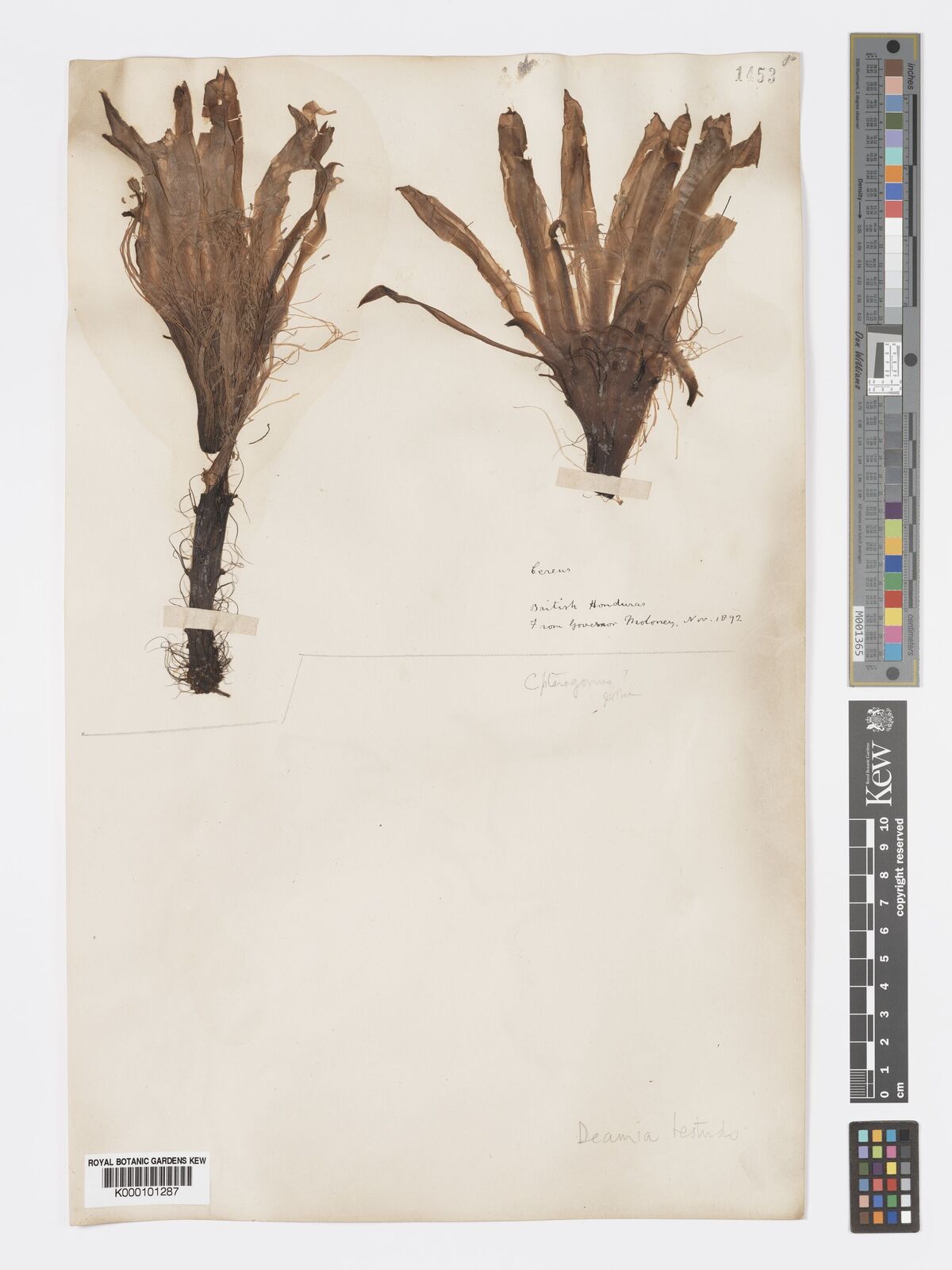 Reference image
Dog-Tail Cactus
Deamia testudo is a remarkable epiphytic and lithophytic cactus species native to the tropical forests of southern Mexico and Central America. Known for its climbing growth habit and climbing aerial roots, it clings to host trees and rocky cliffs. It is commonly referred to as the "Dog-Tail Cactus" or "Tortoise Cactus" due to its flattened, armored segment look as it matures 1.
Originally described by Karwinski in 1837 as Cereus testudo, the species was later classified under its own genus Deamia by Britton and Rose. The specific epithet testudo translates to "tortoise" or "turtle" in Latin, referring to the flattened, shell-like ribs of the stem segments that grip onto surfaces like a shell 2.
The natural range of Deamia testudo spans seasonally dry tropical biomes across southern Mexico, Belize, Guatemala, Honduras, and parts of Costa Rica 1. In these environments, it thrives in low-altitude forests, utilizing its aerial roots to anchor itself onto tree trunks or vertical limestone cliffs, receiving dappled light through the canopy.
The plant features sprawling, segmented, 3 to 8-winged green to grayish-green stems that can measure up to 30 cm in width. The prominent ribs are lined with close-set areoles bearing numerous brownish-yellow, bristly spines. During late spring, it produces spectacular, nocturnal, funnel-shaped white flowers reaching up to 25 cm in diameter that emit a strong sweet fragrance 2.
In cultivation, Deamia testudo does best in hanging baskets or mounted on bark slabs to mimic its natural epiphytic lifestyle. It requires bright, indirect sunlight and high ambient humidity. The potting medium must be highly porous, rich in organic matter, and fast-draining to prevent waterlogging around the roots 1.
The most frequent issue is root rot caused by dense, heavy soils and overwatering. Insufficient light leads to etiolated, weak stems and prevents the cactus from producing its magnificent nocturnal blooms.
Thrives in bright, indirect light or filtered sunlight; avoid direct, scorching midday sun.
Water regularly during active growth once the soil dries, and keep almost dry in winter.
An aerated, rich epiphytic mix containing pine bark, peat, and coarse perlite is ideal.
Non-toxic to pets, but has fine, sharp spines. Handle with gloves and keep out of reach of curious animals.
Moderate. Requires some experience with tropical epiphytic cacti to balance moisture and aeration.
Found in seasonally dry neotropical forests from southern Mexico down to Honduras, growing as an epiphyte on large forest trees or clinging to limestone cliffs.
