
Light
Full Sun
Requires full, unobstructed sunlight to maintain its structural form and vibrant spine color.
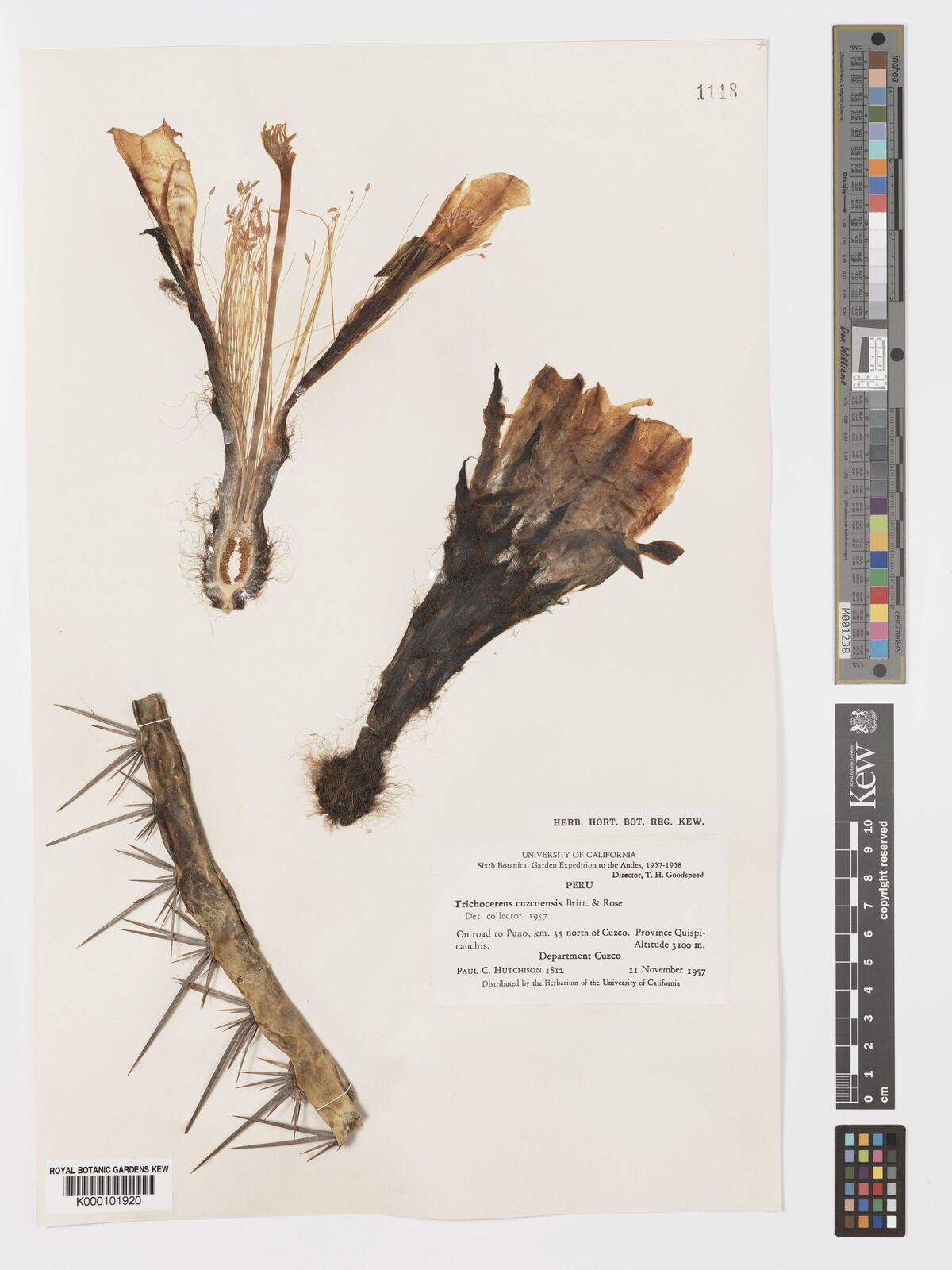 Reference image
Cuzco Columnar Cactus
Echinopsis cuzcoensis (syn. Trichocereus cuzcoensis) is a majestic, multi-stemmed columnar cactus belonging to the family Cactaceae. In its native habitats, it forms large, shrubby thickets, valued in rock gardens and collections for its formidable spination and large white nocturnal flowers 1.
First described by Britton & Rose in 1920, the specific epithet cuzcoensis refers to the historic city of Cusco (Cuzco), Peru, near which the species was first collected. While categorized under the broad genus Echinopsis in modern systems, many collectors and taxonomists still refer to it as a classic member of the Trichocereus group 2.
This species is native to the high-elevation valleys and slopes of the Andes in southern Peru, particularly in the regions of Cusco and Apurímac, at elevations of up to 3,000 meters above sea level. It thrives in arid shrublands, rocky slopes, and dry desert environments under intense solar radiation 1.
It is a treelike cactus growing up to 5-6 meters tall, branching freely from the base. The light-green stems have 9 to 14 deep, well-defined ribs. The large, rounded areoles bear extremely strong, rigid spines up to 10 cm in length. These spines are initially golden-yellow or brown, eventually weathering to a light grey. Large, funnelform white flowers open at night and last into the next morning 2.
Echinopsis cuzcoensis is an exceptionally hardy cactus when kept dry. It requires full sun exposure and a highly porous, mineral-based potting medium. Water thoroughly during the hot summer months only after the soil has dried completely, and withhold water almost entirely during the winter. It has mild frost tolerance for brief periods 1.
Overwatering is the primary cause of failure, quickly leading to root rot. Insufficient sunlight causes etiolation, where the stems stretch, become pale green, and produce weak, sparse spines.
Requires full, unobstructed sunlight to maintain its structural form and vibrant spine color.
Water deeply only when the soil is 100% dry; keep completely dry throughout the winter months.
Thrives in sandy, grit-heavy mineral mixes with plenty of pumice to ensure rapid drainage.
Features extremely sharp, rigid spines that can cause deep puncture wounds; contains alkaloids that are toxic if ingested.
Very easy to grow, provided it is not overwatered and is given sufficient winter dryness.
Originates from the high-altitude rocky valleys of the Peruvian Andes, around Cusco. It grows naturally on sunny slopes and has been successfully naturalized in other dry, subtropical regions such as the Canary Islands.
