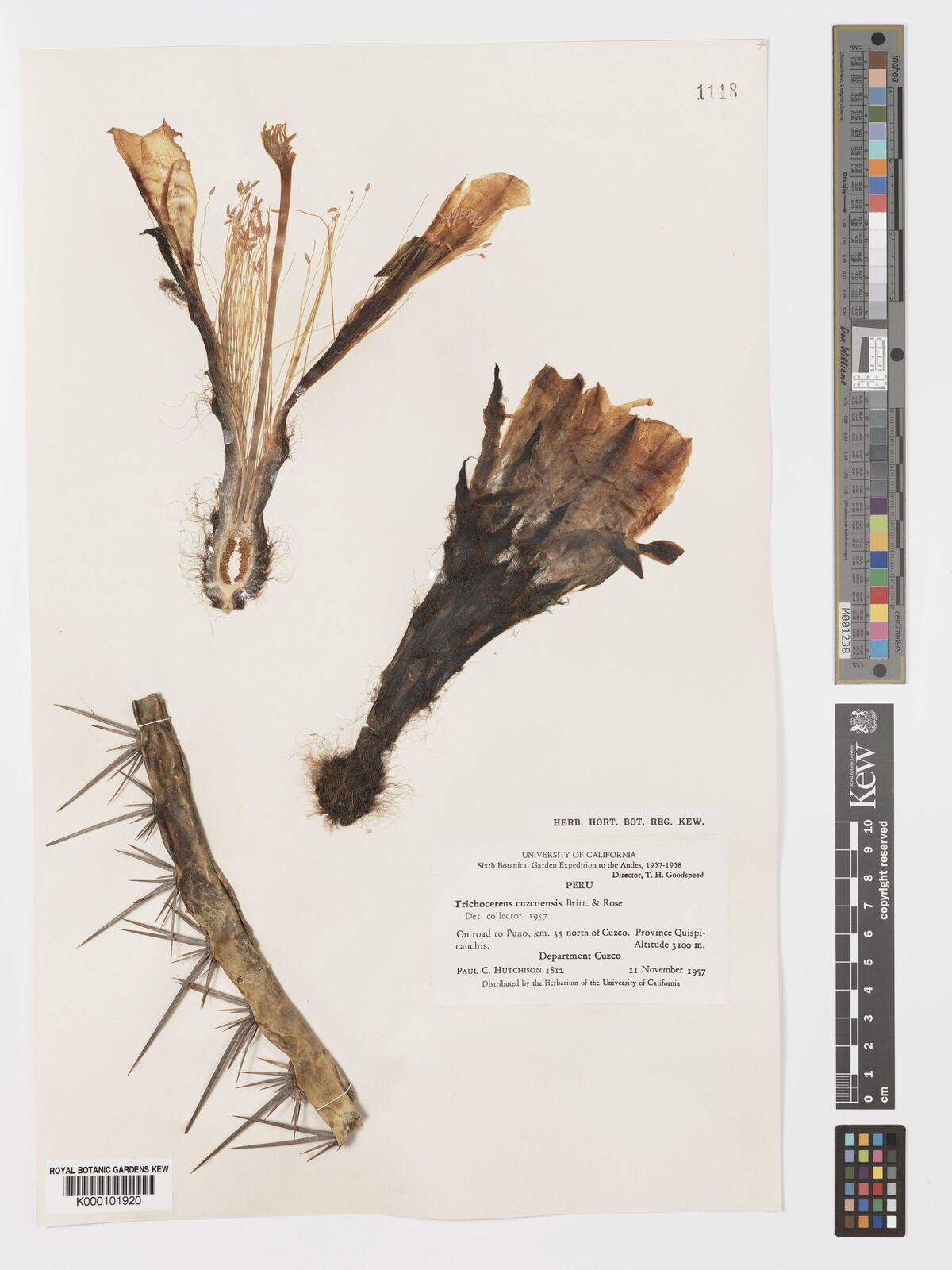
Species

Echinopsis cuzcoensis

Echinopsis cuzcoensis

Echinopsis cuzcoensis

Echinopsis cuzcoensis (Britton & Rose) H.Friedrich & G.D.Rowley is treated as an accepted taxon in Plants of the World Online.1

The current source-backed classification places it in Cactaceae within Echinopsis.12

Its recorded native range/source remark is SOUTHERNAMERICA, AFRICA, MACARONESIA, PEROO, PER, CNYOO, WESTERNSOUTH_AMERICA, CNY; Peru.1

POWO records the plant context as succulent shrub, desert or dry shrubland.1

This is a source-populated draft intended for later Kaktus Doktoru editorial rewriting; care advice and morphology should be reviewed before publication.

References

  1. Plants of the World Online. "Echinopsis cuzcoensis (Britton & Rose) H.Friedrich & G.D.Rowley". Royal Botanic Gardens, Kew. Accessed: 2026-06-10. https://powo.science.kew.org/taxon/urn:lsid:ipni.org:names:88373-2
  2. GBIF Secretariat. "Echinopsis cuzcoensis". GBIF Backbone Taxonomy. Accessed: 2026-06-10. https://www.gbif.org/species/5623013

Plants In This Group

Echinopsis cuzcoensis

Echinopsis cuzcoensis

Echinopsis cuzcoensis

Echinopsis cuzcoensis (syn. Trichocereus cuzcoensis) is a majestic, multi-stemmed columnar cactus belonging to the family Cactaceae. In its native habitats, it forms large, shrubby thickets, valued in rock gardens and collections for its formidable spination and large white nocturnal flowers 1.

Taxonomy and Naming

First described by Britton & Rose in 1920, the specific epithet cuzcoensis refers to the historic city of Cusco (Cuzco), Peru, near which the species was first collected. While categorized under the broad genus Echinopsis in modern systems, many collectors and taxonomists still refer to it as a classic member of the Trichocereus group 2.

Distribution and Habitat

This species is native to the high-elevation valleys and slopes of the Andes in southern Peru, particularly in the regions of Cusco and Apurímac, at elevations of up to 3,000 meters above sea level. It thrives in arid shrublands, rocky slopes, and dry desert environments under intense solar radiation 1.

Appearance

It is a treelike cactus growing up to 5-6 meters tall, branching freely from the base. The light-green stems have 9 to 14 deep, well-defined ribs. The large, rounded areoles bear extremely strong, rigid spines up to 10 cm in length. These spines are initially golden-yellow or brown, eventually weathering to a light grey. Large, funnelform white flowers open at night and last into the next morning 2.

Cultivation

Echinopsis cuzcoensis is an exceptionally hardy cactus when kept dry. It requires full sun exposure and a highly porous, mineral-based potting medium. Water thoroughly during the hot summer months only after the soil has dried completely, and withhold water almost entirely during the winter. It has mild frost tolerance for brief periods 1.

Common Cultivation Mistakes

Overwatering is the primary cause of failure, quickly leading to root rot. Insufficient sunlight causes etiolation, where the stems stretch, become pale green, and produce weak, sparse spines.

Bibliography

References

  1. Anderson, E. F. (2001). The Cactus Family. Timber Press.
  2. Hunt, D. (2006). The New Cactus Lexicon. DH Books.

Frequently Asked Questions

What is Echinopsis cuzcoensis?
Echinopsis cuzcoensis is a species-level taxonomy entry identified by the scientific name Echinopsis cuzcoensis.
Which rank is Echinopsis cuzcoensis?
Echinopsis cuzcoensis is shown as a species in our botanical dictionary.
Which groups sit below Echinopsis cuzcoensis?
No lower taxonomy landing pages are currently shown for Echinopsis cuzcoensis.
Are there plants related to Echinopsis cuzcoensis?
Yes. Related dictionary entries include Echinopsis cuzcoensis.
Is this taxonomy page a care guide?
No. This page explains scientific classification; light, watering, and safety guidance belongs on individual plant pages.
Is Echinopsis cuzcoensis a product category?
No. This is a scientific taxonomy record. Product categories are organized separately around customer search intent.
Why is the Latin name shown?
The Latin scientific name reduces ambiguity between common names across languages and regions.
Where can I see the parent ranks?
The taxonomy card shows the parent ranks of Echinopsis cuzcoensis inside the scientific hierarchy.
Can this page change over time?
Yes. Taxonomy and dictionary content can be updated as botanical data, greenhouse observations, and collection records improve.
Why is this different from a plant detail page?
This page explains a classification node. Individual plant pages contain care notes, collection links, and practical growing information.