
Light
Bright Indirect Light
Bright, indirect or filtered sunlight. Avoid direct midday sun which can scorch the flat stems.
 Reference image
Dwarf Queen of the Night
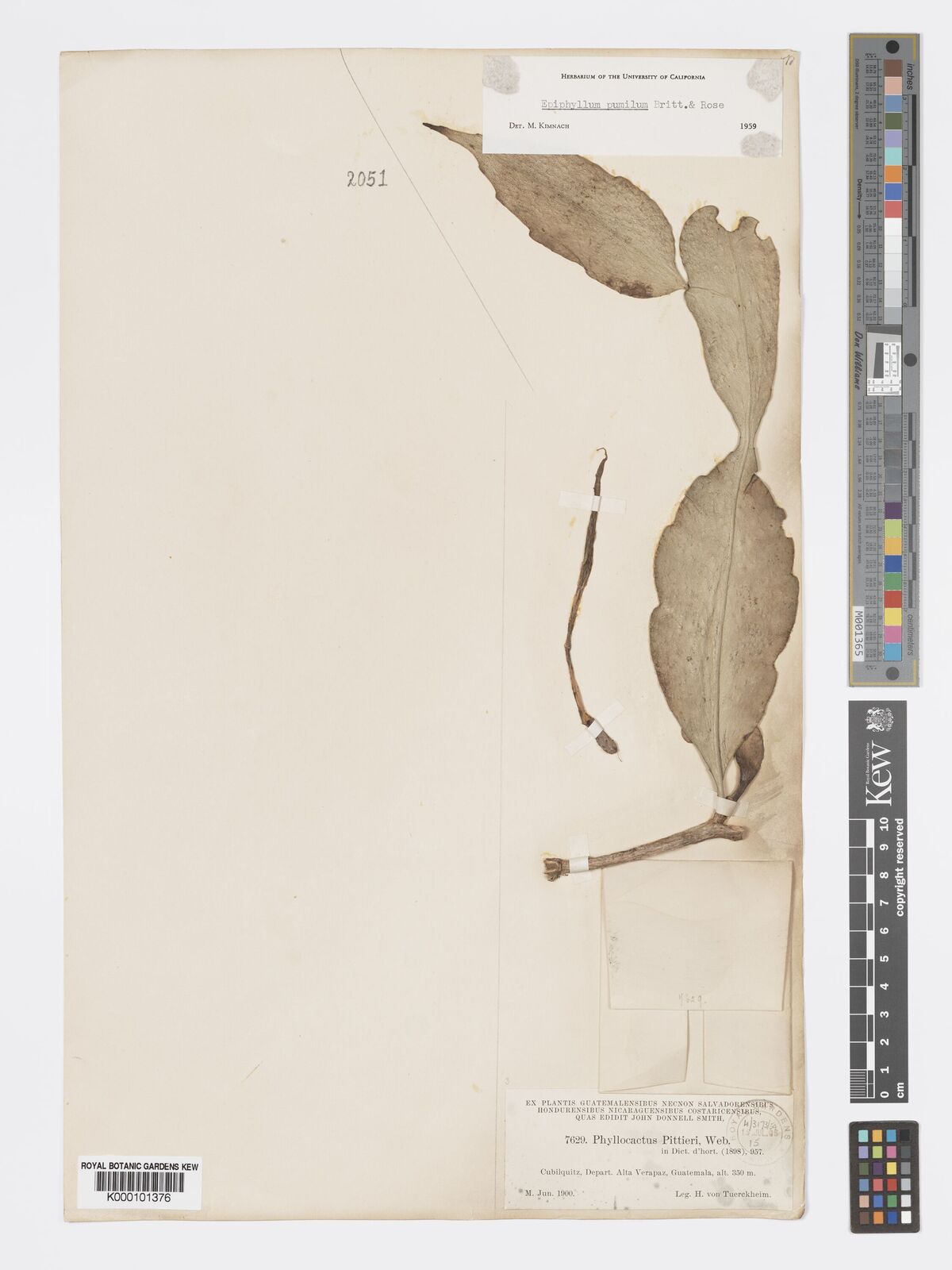
Epiphyllum pumilum is an elegant, night-blooming epiphytic cactus belonging to the family Cactaceae. Commonly known as the Dwarf Queen of the Night, this species thrives in tropical humid forests rather than arid deserts, growing on tree trunks and relying on atmospheric humidity and leaf litter for sustenance 1.
Originally described in botanical records, the specific epithet pumilum means 'dwarf' or 'small' in Latin. This name highlights its smaller, more delicate vegetative parts and flower structure compared to its larger relative, Epiphyllum oxypetalum 2.
The native range of this species extends through southern Mexico, Guatemala, and Honduras. It inhabits seasonally dry tropical biomes, primarily as an epiphyte in wet montane forests and lowland jungles at elevations up to 1,000 meters above sea level 1.
The plant features slender, semi-pendulous branches that are cylindrical at the base and become flat, leaf-like, and deeply scalloped towards the margins. The nocturnal flowers are 10-15 cm long, pure white, highly fragrant, and open for just one night, usually during late summer or early autumn 2.
In cultivation, it prefers bright, filtered light and high humidity. It requires a well-aerated, porous, acidic potting medium containing organic matter like orchid bark and perlite. Regular watering is needed during the growing season, allowing the top inch of soil to dry out between sessions.
The most frequent errors include placing the plant in direct, scorching sunlight, which bleaches the stems, and overwatering in dense, non-porous soil, leading to root rot. Low humidity can prevent flower buds from developing 1.
Bright, indirect or filtered sunlight. Avoid direct midday sun which can scorch the flat stems.
Keep the soil evenly moist but never waterlogged. Allow the topsoil to dry before watering again.
Highly porous, acidic mix containing peat, perlite, and coarse bark to mimic forest canopy soil.
Non-toxic and spineless, making it safe for households with cats, dogs, and children.
Easy to grow, but requires a cooler, drier rest period in winter to stimulate beautiful blooms.
Found growing natively in the moist, warm tropical forests of Southern Mexico, Guatemala, and Honduras, where it lives nestled in tree forks as a spineless epiphyte.
