
Light
Bright Indirect Light
Prefers bright, indirect light or filtered sun; shield from intense afternoon summer heat.
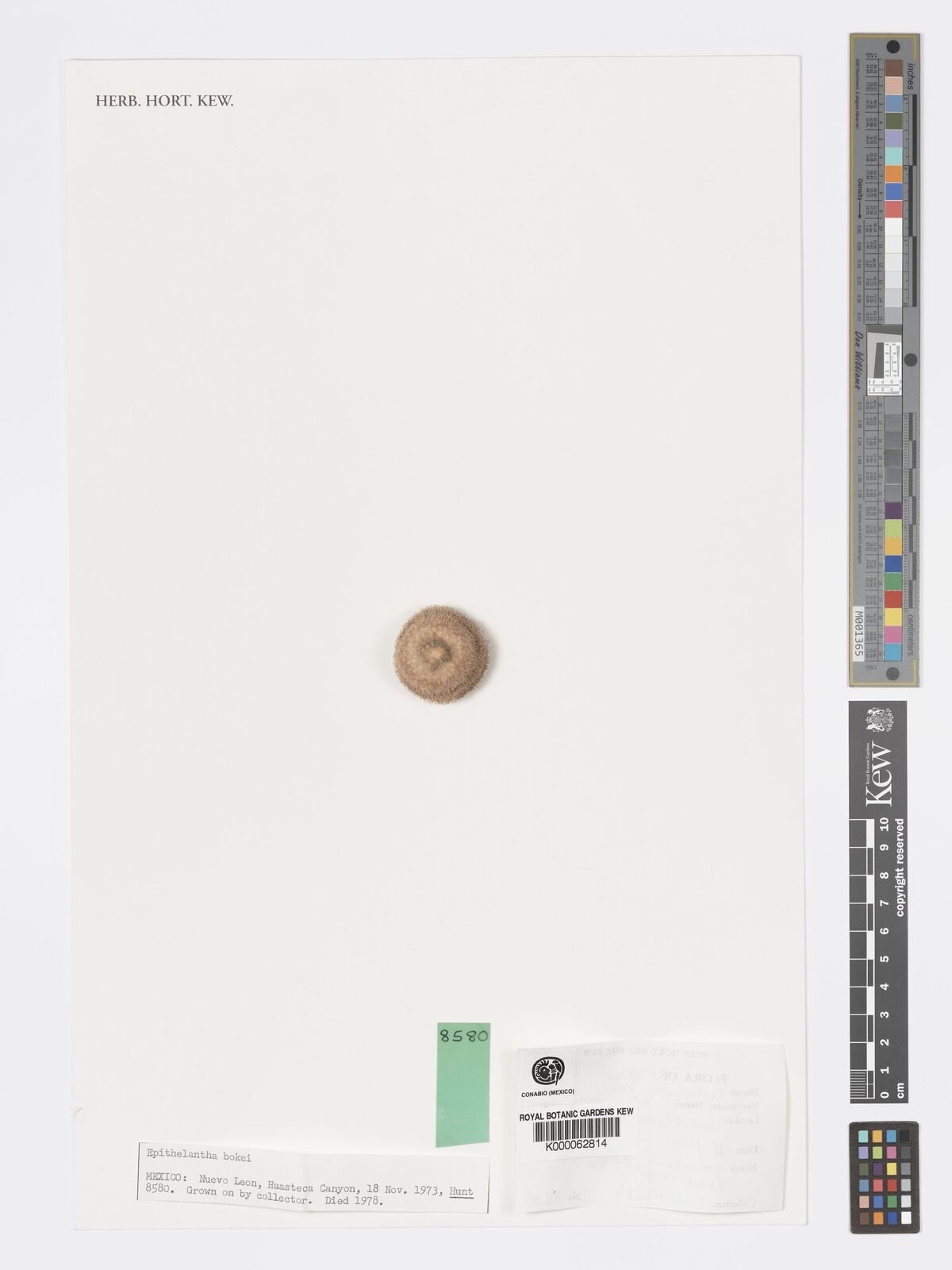 Reference image
Boke's Button Cactus
Epithelantha bokei is an extremely slow-growing, miniature succulent subshrub belonging to the Cactaceae (Cactus) family. Commonly referred to as "Boke's Button Cactus," it is highly prized among succulent enthusiasts for its dense, porcelain-like white spine cover and neat, geometric appearance 1.
Classified within the genus Epithelantha, this species was formally described by the American botanist Lyman Benson in 1969. The specific epithet honors Norman H. Boke, a prominent researcher of cactus anatomy. It is distinguished from its close relative, Epithelantha micromeris, by its much tighter, flatter, and smoother spine arrangement, which gives it a polished button look 2.
This species is native to a restricted range in the Chihuahuan Desert, spanning from southern Texas (specifically Brewster and Terrell counties) in the United States into northern Mexico (Coahuila and Nuevo León). It thrives on steep limestone hills, alluvial fans, and rocky crevices within dry shrublands, often blending perfectly with the surrounding limestone gravel 1.
The stem is solitary or slowly clustering, globose to flat-topped, rarely exceeding 5 cm in diameter. The entire body is tightly wrapped in numerous white, chalky radial spines that overlap like shingles, protecting the plant from intense solar radiation. Small, inconspicuous pale pink or cream-colored flowers emerge from the woolly apex in late spring, followed by slender, bright red decorative fruits 2.
In cultivation, Epithelantha bokei requires specialized care due to its extreme sensitivity to moisture. A purely mineral substrate mimicking its natural limestone habitat is crucial. Watering should be highly restricted and adapted to the seasons, allowing the soil to dry completely between sessions 1.
The most prevalent error is using standard organic potting soils and overwatering during the cold winter dormancy. This rapidly induces root rot. Insufficient light exposure will also cause etiolation, ruining its compact spherical shape.
Prefers bright, indirect light or filtered sun; shield from intense afternoon summer heat.
Water only when the medium is thoroughly dry. Stop watering entirely in winter.
Needs an inorganic, mineral-rich substrate with pumice, grit, and limestone gravel.
Non-toxic to pets, but the tiny, comb-like spines should be handled with care.
Moderate to hard; suited for growers who can manage strict watering schedules.
Naturally occurs in the Chihuahuan Desert of southern Texas and northern Mexican states, where it grows embedded in limestone chips and gravel on sun-baked hills.
