
Light
Bright Indirect Light
Needs bright, direct or slightly filtered sunlight. Insufficient light leads to pale stretching.
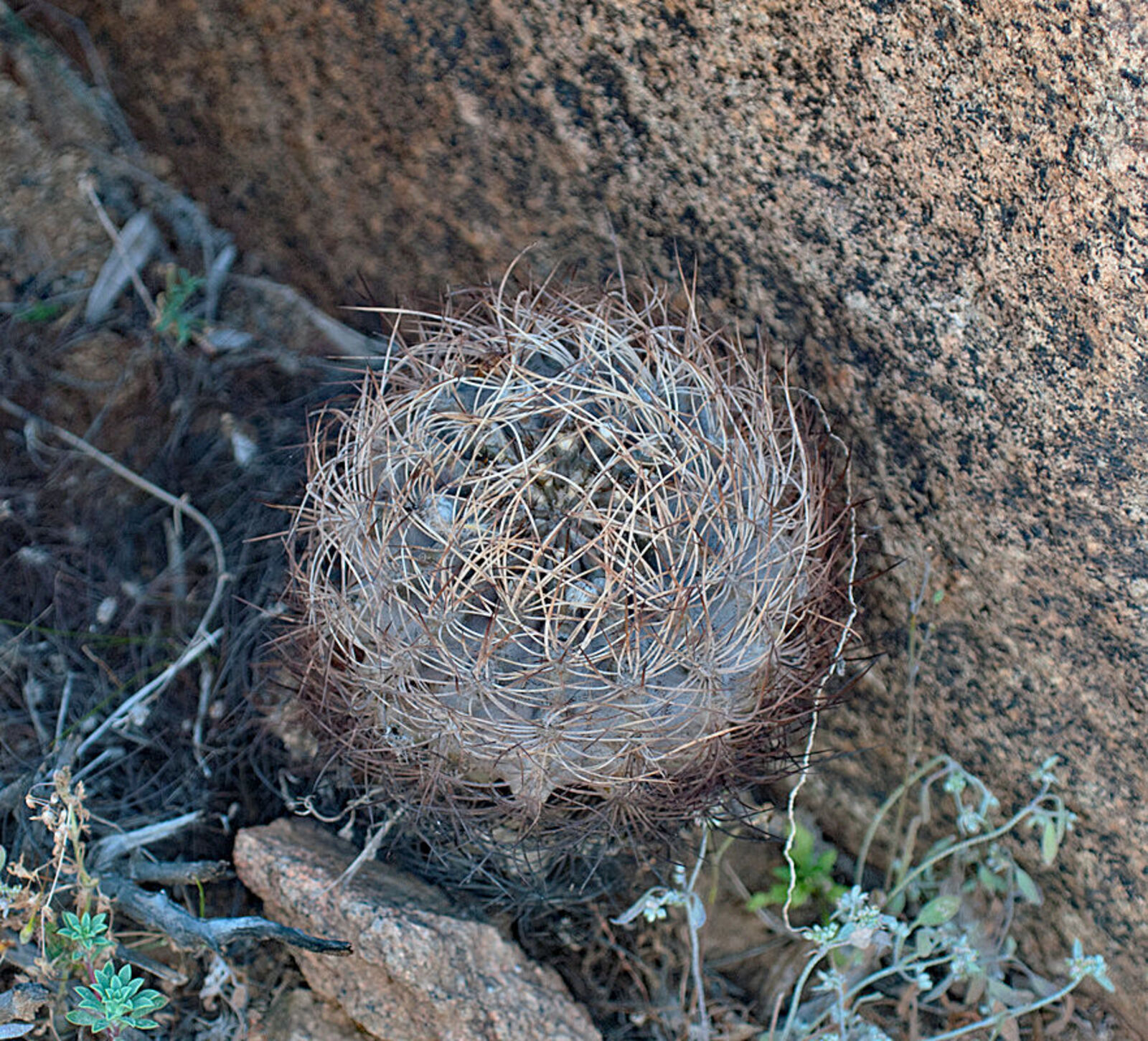 Reference image
Eriosyce crispa is a slow-growing, highly sought-after succulent subshrub belonging to the family Cactaceae. It is widely appreciated among cactus enthusiasts for its globose, dark-toned stems and dramatic, upward-curving blackish spines contrasting with delicate pastel flowers.
Belonging to the genus Eriosyce, this species has undergone various taxonomic shifts, previously classified under Pyrrhocactus crispus 1. The specific epithet 'crispa' translates from Latin to 'curled' or 'curly', directly referring to its twisting, dark spines that wrap around the rib structures.
This species is endemic to the coastal and semi-coastal hills of the Atacama Region in Chile, specifically around Huasco 2. It thrives in extremely arid desert ecosystems, growing on rocky, sun-drenched slopes and stony, mineral-rich soils that drain instantly.
The solitary stem is spherical to short-cylindrical, displaying a dark grayish-green, coppery-purple, or almost black epidermis. It features pronounced ribs with dense woolly areoles. The most notable features are the stiff, curly, dark spines and the gorgeous funnelform flowers arising from the apex, showcasing soft pink, cream, or pale yellow petals with darker midstripes.
In culture, Eriosyce crispa requires maximum light exposure and highly porous soils. Pumice, perlite, and coarse sand are essential components of its potting medium. Watering must follow a strict 'soak and dry' cycle, while cold, dry winter dormancy is crucial to encourage healthy development.
Overwatering is the single most common cause of failure, quickly leading to root and stem rot 2. Lack of sufficient sunlight will cause the plant to lose its dark coloration, grow etiolated, and produce weaker, thinner spines.
Needs bright, direct or slightly filtered sunlight. Insufficient light leads to pale stretching.
Allow the soil to dry out completely before watering. Keep completely dry in winter.
Use an ultra-drained mineral mix containing pumice, volcanic rock, and minimal organic matter.
Non-toxic to pets, but the sharp, curved spines can cause injury. Handle with care.
Moderate. Requires discipline with watering and a highly porous, gritty substrate.
Native to the arid coastal mountains of the Atacama Region in Chile, where it survives in rocky crevices and gritty mineral soils under intense solar radiation.
