
Light
Full Sun
Requires full, direct sunlight. Give it the brightest spot possible, preferably south-facing.
 Reference image
Iquique Eriosyce
Eriosyce iquiquensis is a rare and highly prized succulent subshrub in the family Cactaceae, native to the hyper-arid coastal deserts of northern Chile. Adapted to survive in some of the driest places on Earth, this cactus is characterized by its slow growth rate and dense, protective spination 1. It is highly valued by specialized collectors for its rugged, wild appearance.
The species name iquiquensis refers to the coastal city of Iquique in Chile, near where the species was discovered. It has undergone various taxonomic realignments, previously classified under Pyrrhocactus and Neoporteria, before being consolidated into the genus Eriosyce 2.
This species is endemic to the coastal cliffs of the Atacama Desert in northern Chile (Tarapacá and Antofagasta regions). It grows on steep, rocky, and gravelly slopes where rainfall is virtually non-existent 1. Survival is heavily dependent on the dense coastal fogs, locally known as "Camanchaca," which roll in from the Pacific Ocean 2.
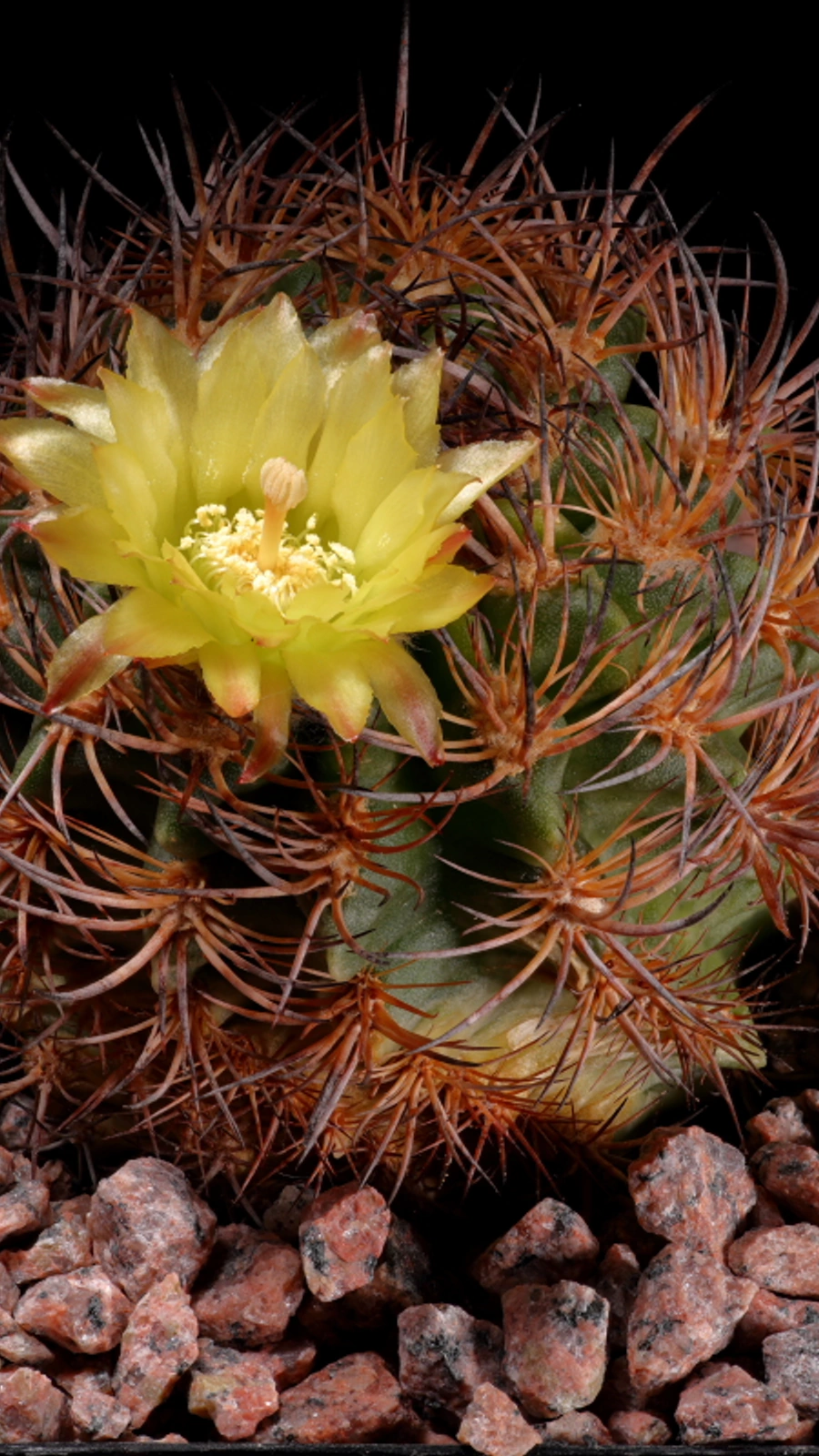
The stem is solitary, globose to short-cylindrical, grayish-green, and densely covered with strong, rigid, brownish-black spines. The apical area produces funnel-shaped flowers that range in color from pale yellow to creamy pink or greenish-yellow 1.
In cultivation, Eriosyce iquiquensis demands a strict watering regime. It requires full sun exposure and a highly mineral, porous potting medium with minimal organic matter. Excellent ventilation is crucial to mimic its coastal breeze-swept natural habitat.
The most frequent mistakes include using peat-heavy potting soils and watering during winter dormancy, both of which inevitably lead to root rot. Insufficient light will cause etiolation.
Requires full, direct sunlight. Give it the brightest spot possible, preferably south-facing.
Allow soil to dry out completely between waterings in summer. Keep absolutely dry in winter.
Use a strictly mineral mix containing pumice, grit, and perlite with minimal organic soil.
Features very sharp and dense spines. Handle with thick gloves and keep away from pets.
Requires moderate to advanced care due to its sensitivity to overwatering and strict dormancy.
Endemic to the extremely arid coastal slopes of northern Chile, particularly around Iquique. It thrives in a climate dominated by the cold Humboldt Current, receiving moisture almost exclusively from heavy morning sea fogs rather than rain.
