
Light
Direct Sun
Requires at least 6 hours of direct sunlight daily to maintain its dense, dark spine coloration.
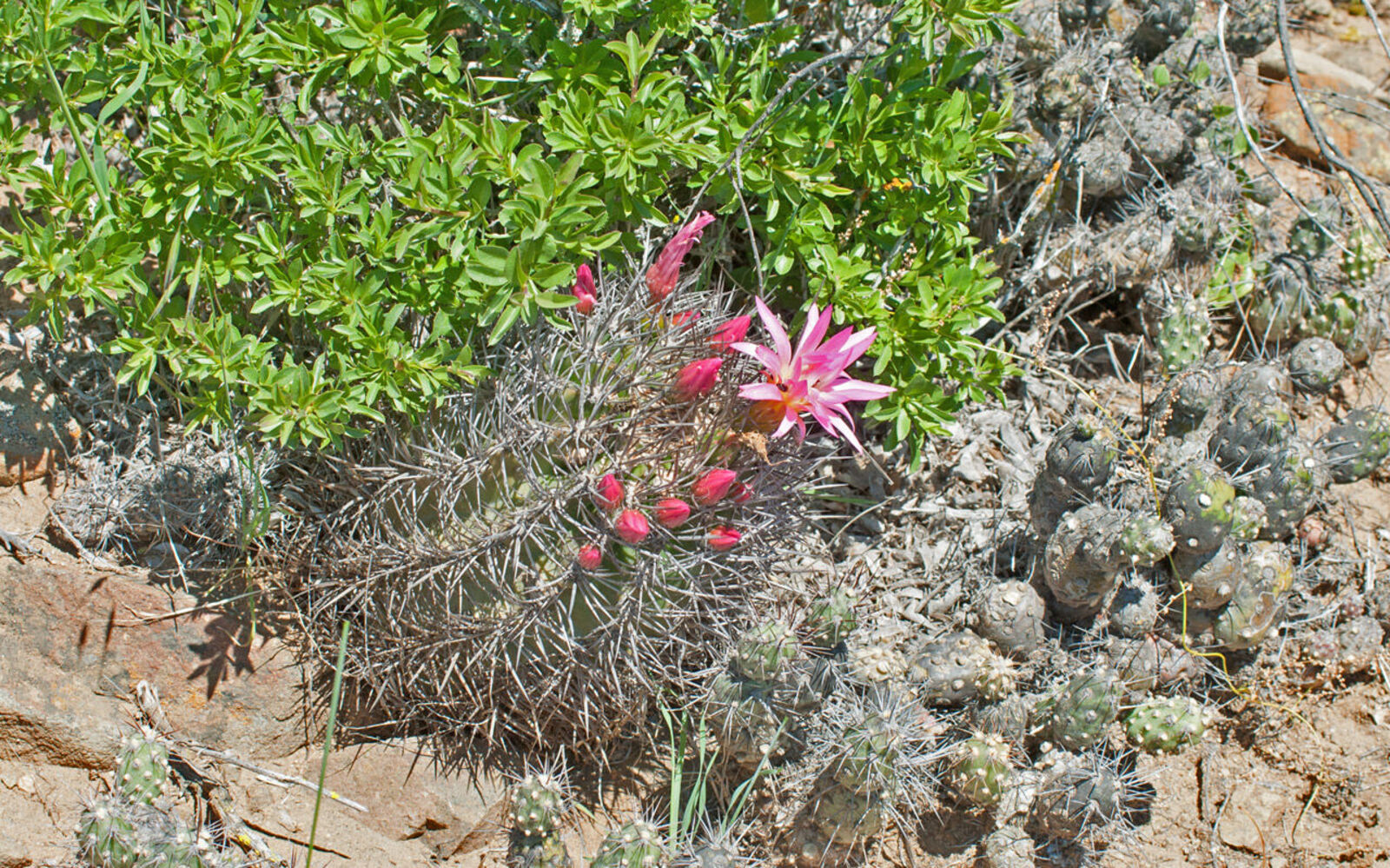 Reference image
Eriosyce nigrihorrida is a slow-growing cactus species within the Cactaceae family, highly appreciated by collectors for its intensely dark, rigid spines and robust nature. It typically grows as a solitary globose stem and is extremely drought-tolerant 1.
The genus Eriosyce comprises a diverse group of cacti native to western South America. Eriosyce nigrihorrida is often evaluated under the Eriosyce subgibbosa complex but is distinguished by its jet-black to dark brown spines and dark-toned epidermis, granting its specific epithet meaning 'dreadful black' 2.
This species is native to Chile, primarily found in coastal and near-coastal semi-arid subtropical hillsides. It thrives in gravelly, sharply draining soils where it relies heavily on coastal fog, known locally as Camanchaca, for moisture during long dry spells 1.
The stem is spherical to short cylindrical, colored grey-green to dark purplish-green. It features distinct ribs adorned with woolly areoles from which heavy, curved, blackish spines emerge. In spring and summer, it produces beautiful funnel-shaped, pinkish-red flowers near the apex 2.
It requires full sun and highly porous, mineral-rich potting substrates to prevent root rot. Watering should follow a soak-and-dry approach during the active growing season, and be completely suspended during cold winter dormancy 1.
Overwatering is the primary cause of failure, leading to rapid root decay. Insufficient light exposure causes etiolation (stretching) and weak spine production, which ruins the natural compact, fierce look of the plant 2.
Requires at least 6 hours of direct sunlight daily to maintain its dense, dark spine coloration.
Water only when the substrate is 100% dry. Maintain a strict dry spell throughout the winter.
Requires an gritty mineral mix composed of pumice, perlite, and coarse sand.
Non-toxic, but the spines are extremely sharp and rigid; handle with care and keep away from pets.
Moderate. Easy if watering is strictly regulated, but highly susceptible to overwatering.
Occurs along the coastal hills and semi-desert rocky slopes of Chile. The local climate is characterized by extreme dryness mitigated by dense coastal fogs rising from the Pacific Ocean.
