
Light
Full Sun
Requires full sun to maintain its compact shape and develop robust, golden-grey spines.
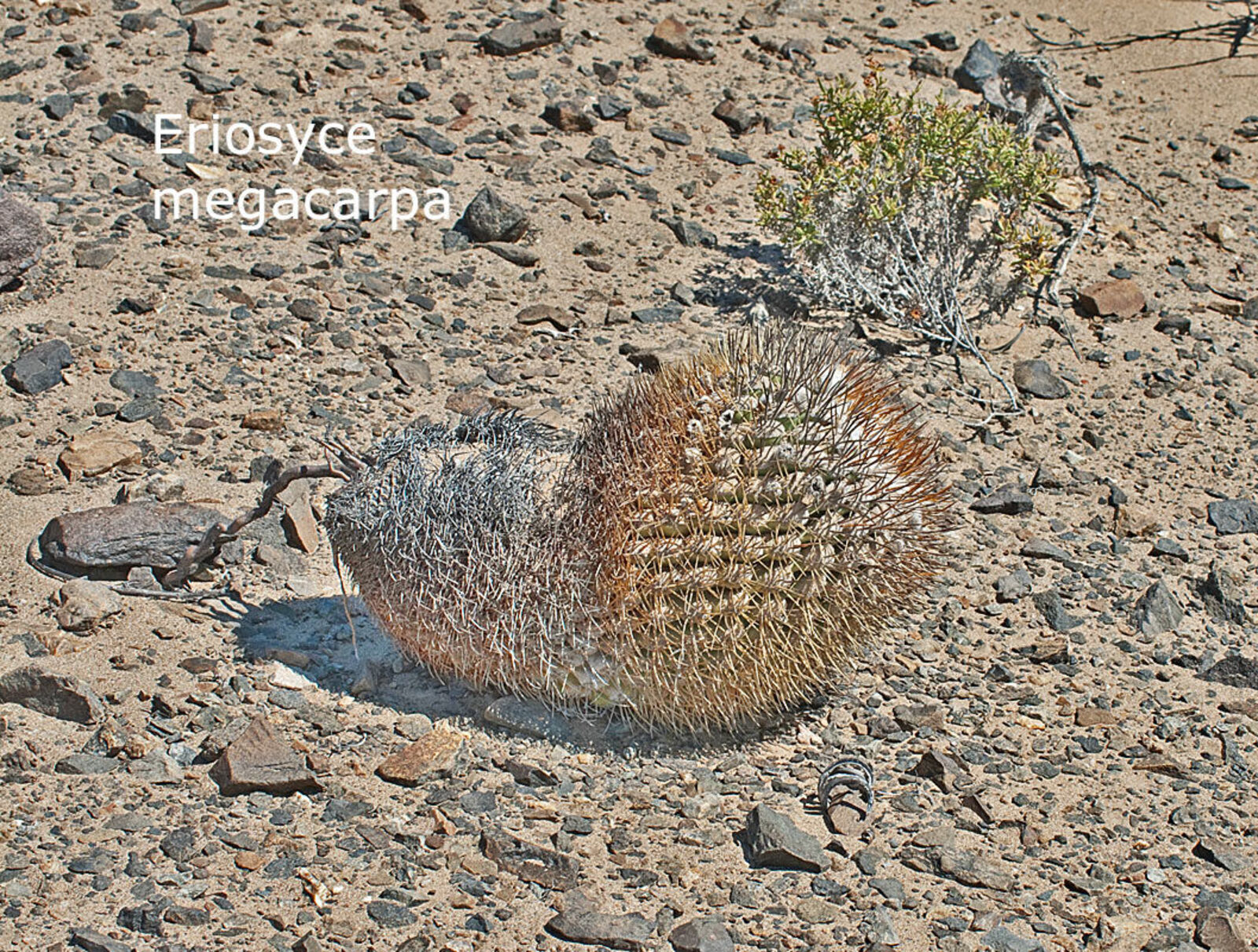 Reference image
Rodent Lover Cactus
Eriosyce rodentiophila is a highly specialized, slow-growing globose cactus native to the hyper-arid coastal regions of the Atacama Desert in Chile 1. It is well-regarded among collectors for its formidable spination and extreme drought tolerance.
Belonging to the genus Eriosyce in the family Cactaceae, the specific epithet 'rodentiophila' literally translates to 'rodent-loving.' This refers to the observation that local desert rodents frequently shelter around the protective spines of the plant and consume its seeds, facilitating dispersal 2.
This species is endemic to northern Chile, specifically within the Antofagasta and Atacama regions. It populates rocky slopes and coastal terraces where rainfall is virtually non-existent. Survival depends heavily on condensation from the dense coastal fogs known locally as 'camanchaca' 1.
The plant body is solitary, subglobose to short cylindrical, reaching diameters of up to 30 cm. It is heavily armed with thick, upward-curving, yellowish-brown to grey spines that act as a natural sunscreen. The flowers are funnel-shaped, woolly, and range from pale yellow to coppery red, emerging from the felted apex of mature specimens 2.
In cultivation, Eriosyce rodentiophila requires an exceptionally porous, mineral-heavy substrate. It must be kept completely dry during the cold winter months to prevent root rot. It thrives under full sun and requires excellent ventilation to mimic its windy desert habitat.
The most prevalent issue is root rot triggered by overwatering or organic-rich soil mixes. Standard commercial potting soils retain too much moisture. Insufficient sunlight leads to etiolation, causing the cactus to stretch and lose its dense spine cover.
Requires full sun to maintain its compact shape and develop robust, golden-grey spines.
Water thoroughly once every two weeks in summer, and suspend watering entirely in winter.
Thrives only in highly porous, mineral-heavy substrates consisting of pumice, lava rock, and coarse sand.
Equipped with very sharp, stiff spines. Non-toxic to pets, but keep away from traffic areas.
Moderately challenging due to its high susceptibility to root rot if moisture levels are not carefully managed.
Found along the hyper-arid coastal cliffs of northern Chile, where it survives primarily on moisture harvested from the heavy incoming maritime fog banks.
