
Light
Full Sun
Requires abundant direct sunlight to maintain its natural flattened form and robust spine coloration.
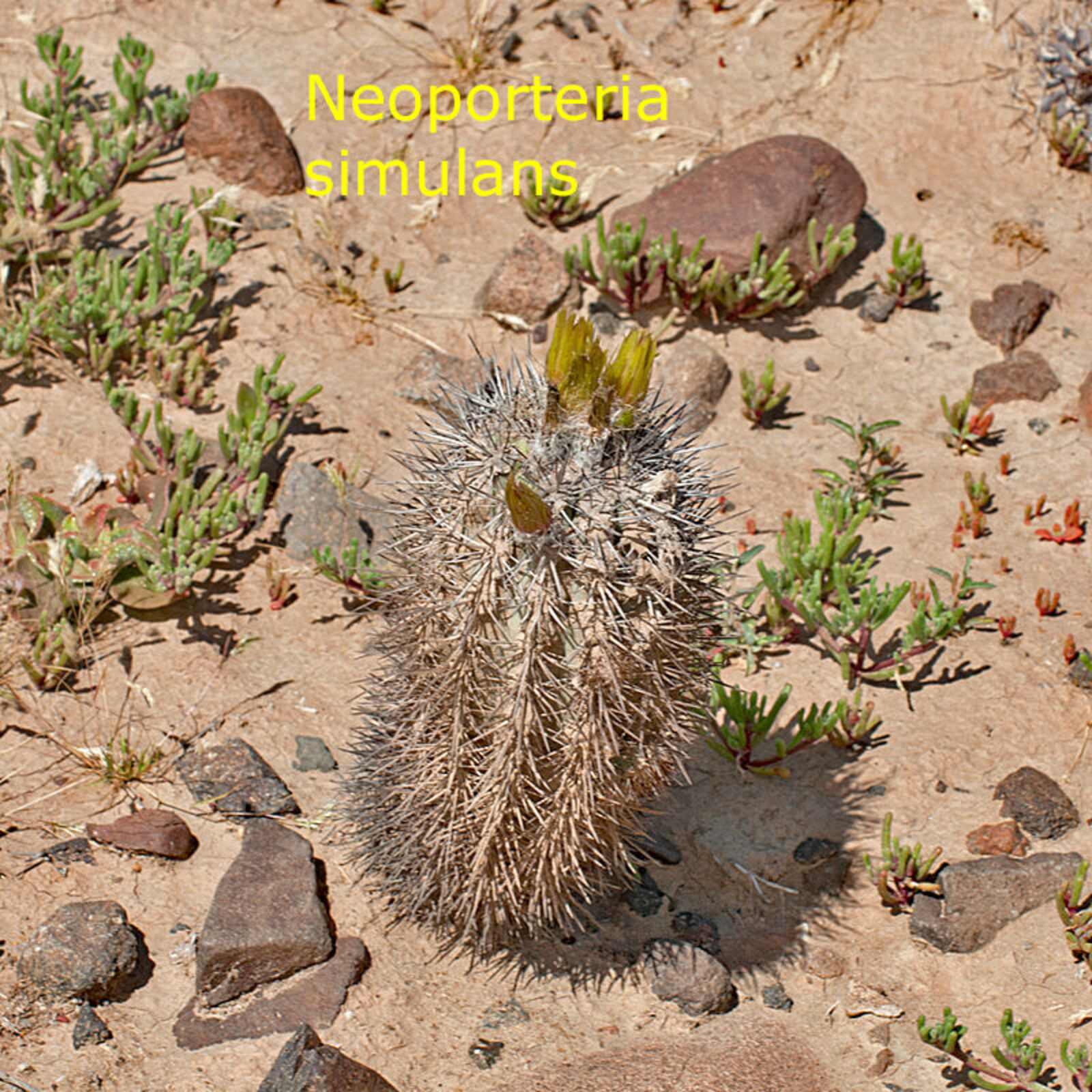 Reference image
Eriosyce simulans is a highly sought-after, rare globose cactus in the family Cactaceae, endemic to the extremely arid coastal regions of Chile 1. It is renowned for its remarkable ability to camouflage against the gravelly desert soils of its native habitat.
Originally described under the genus Pyrrhocactus as Pyrrhocactus simulans, it was later integrated into the broader genus Eriosyce 2. The specific epithet "simulans" refers to its mimicking nature, blending seamlessly with surrounding gray-brown stones and pebbles.
It is native to the coastal deserts of Coquimbo, Chile (particularly near Trapiche) 1. This habitat is characterized by hyper-arid conditions where rainfall is extremely scarce, and plants rely heavily on dense coastal fogs (locally known as camanchaca) for moisture.
This slow-growing, solitary succulent features a flattened-globose, dark grayish-green to brownish stem. It possesses distinct wavy ribs, a thick taproot, and appressed or slightly curved blackish-gray spines. The funnelform flowers arise from the apex, displaying pale yellow, cream, or dirty white hues.
Cultivating Eriosyce simulans requires experience due to its high susceptibility to root rot. It demands an almost entirely mineral, well-draining substrate. During winter, it must be kept absolutely dry and cool (5-10°C) to simulate its dormancy 2. In summer, water only after the substrate has completely dried.
The most common pitfall is overwatering, especially during the cold winter months, which quickly rots the thick taproot. Inadequate sunlight leads to etiolation, causing the cactus to lose its characteristic flat-topped shape and grow unnaturally columnar.
Requires abundant direct sunlight to maintain its natural flattened form and robust spine coloration.
Highly sensitive to root rot; keep completely dry in winter and water very sparingly during summer.
Use an extremely gritty, mineral-heavy substrate (80% pumice, lava rock, coarse sand).
Spines are sharp; wear protective gloves when handling. Non-toxic to humans and pets.
Best suited for experienced growers due to strict watering needs and a rot-prone taproot.
Endemic to the hyper-arid coastal deserts of the Coquimbo region in Chile. In this habitat, annual rainfall is virtually nonexistent, and the plants rely entirely on heavy coastal fogs rolling in from the Pacific Ocean.
