
Light
Bright Indirect Light
Requires bright, filtered sunlight; protect from intense, scorching midday summer sun.
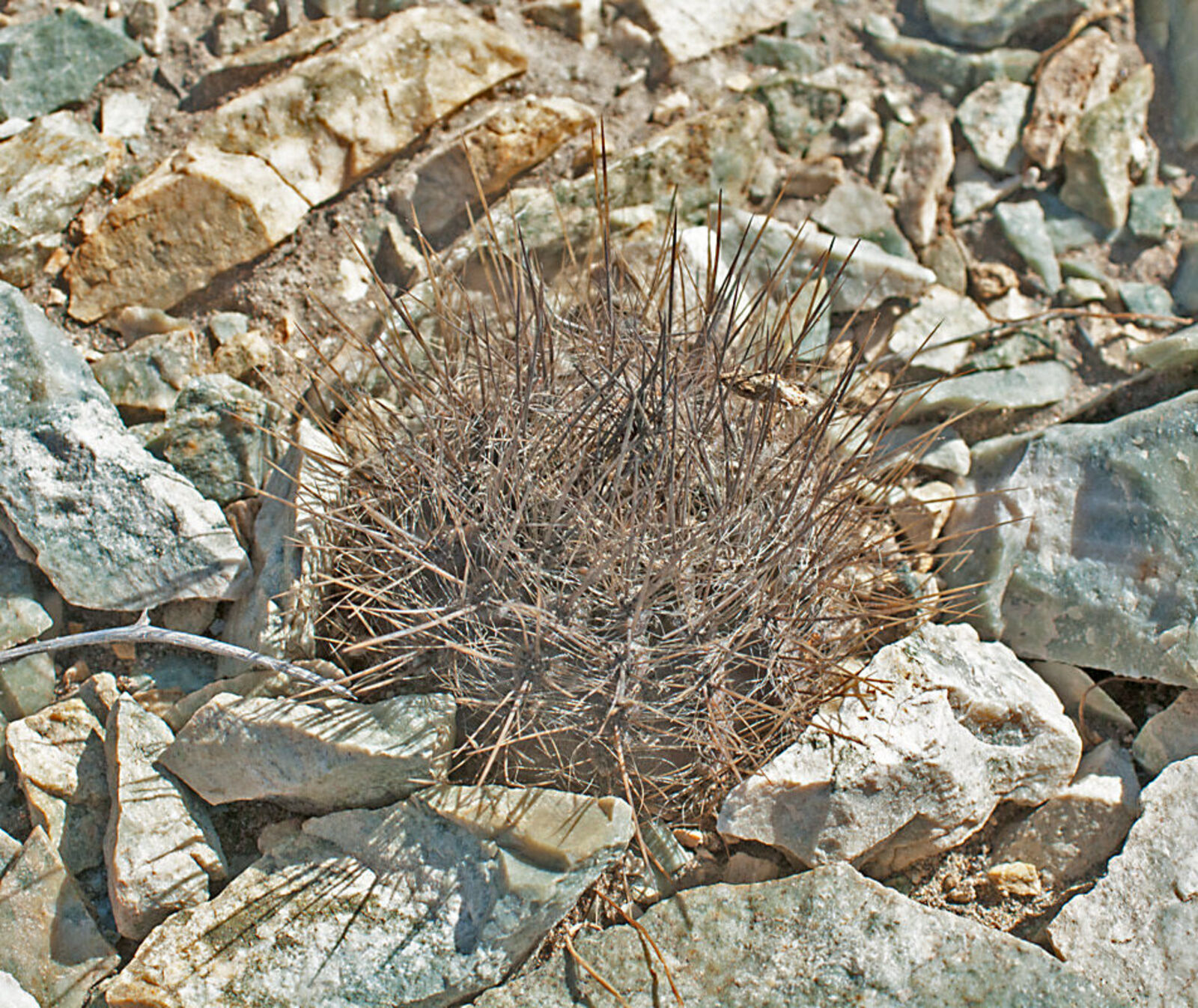 Reference image
Woolly Neoporteria
Eriosyce villosa, previously widely classified under the genus Neoporteria, is a highly prized cactus species characterized by its distinctive woolly crown, dense interlacing spines, and vibrant magenta flowers 1. It is well-adapted to hyper-arid coastal desert environments.
Originally described as Cactus villosus, the species underwent several taxonomic reassignments before molecular and morphological analyses placed it in the diverse genus Eriosyce 2. The specific epithet 'villosa' translates from Latin to 'shaggy' or 'woolly', highlighting the soft, dense trichomes present on its areoles.
This species is micro-endemic to the coastal regions of northern Chile, particularly around Huasco and Coquimbo in the Atacama Desert 1. It survives in rocky crevices and gravelly slopes, where rainfall is scarce but relative humidity is high due to coastal fog (camanchaca).
The stem is globose to short cylindrical, often presenting a dark green, grayish, or even purplish-brown epidermis. Areoles are packed with white wool, out of which grow numerous thin, flexible, needle-like spines. The funnelform flowers are bright magenta-pink, emerging from the woolly apex.
In cultivation, Eriosyce villosa requires extremely porous substrate to mimic its natural mineral-rich rocky habitat 2. Proper ventilation is critical to prevent stagnant air. Irrigation should be restricted to the growing season and withheld completely during the cold winter dormancy.
The most prevalent issue is root rot induced by overwatering or using soils containing high organic matter 1. Insufficient light leads to etiolation, causing the cactus to stretch and lose its compact, woolly form.
Requires bright, filtered sunlight; protect from intense, scorching midday summer sun.
Allow soil to dry out completely between waterings; keep bone-dry during the winter.
Use a low-organic, high-grit mixture dominated by pumice, perlite, and coarse sand.
The fine, interlocking spines can puncture skin easily. Handle with care. Non-toxic.
Requires strict moisture control and excellent ventilation, presenting a moderate challenge.
Endemic to the extremely dry coastal hills of northern Chile, where it thrives in rocky gravel and relies on coastal fog for moisture.
