
Light
Full Sun
Requires full, direct sunlight; ideally suited for south-facing windows or outdoor patios.
 Reference image
Cardon Cactus
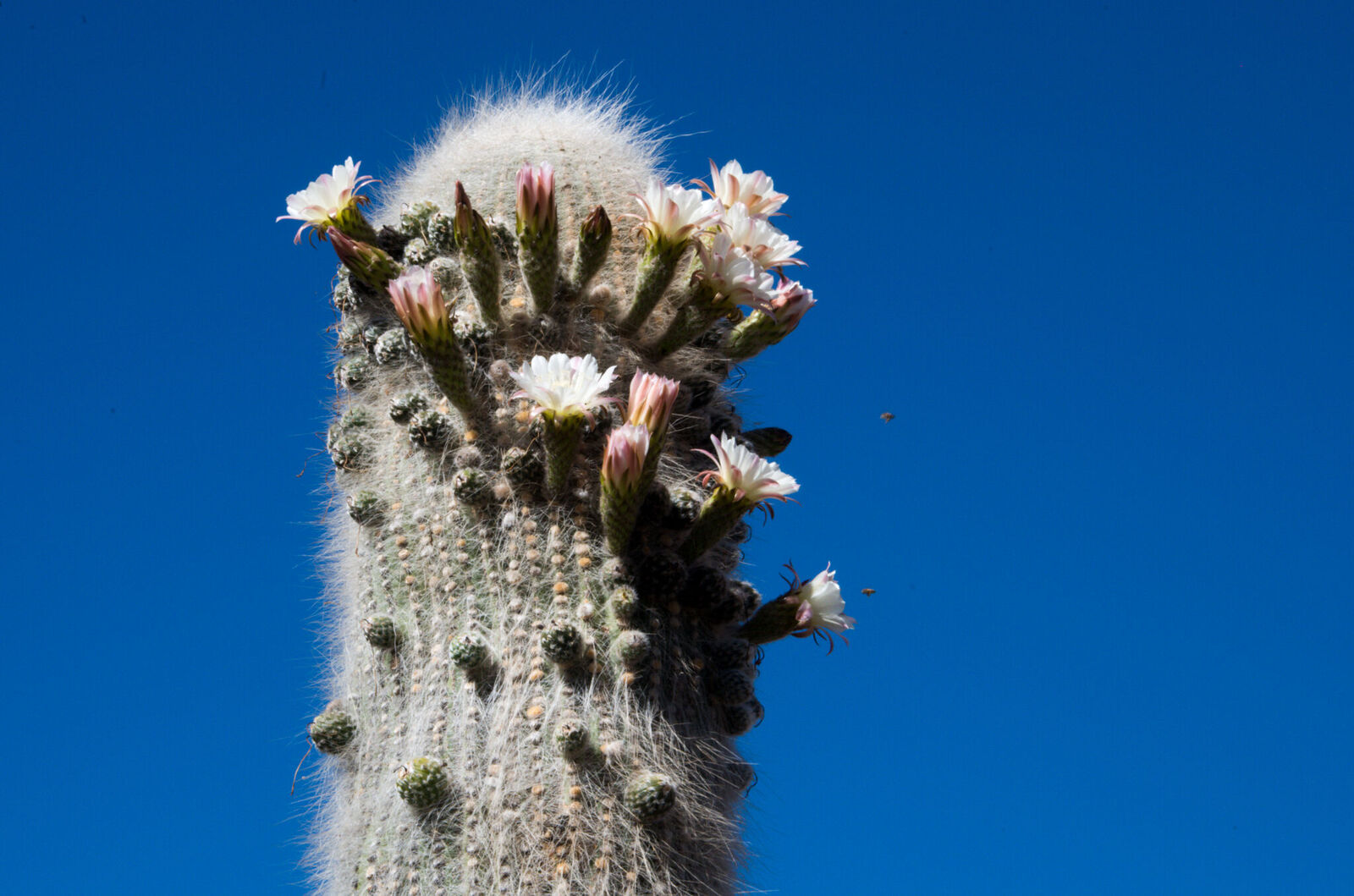
Leucostele atacamensis, commonly known as cardón, is a massive, columnar tree-like cactus native to the high-altitude arid regions of the Andes. It plays a crucial ecological role in dry shrubland and desert ecosystems 1.
A member of the Cactaceae family, this species was historically classified under the genera Echinopsis and Trichocereus. Recent molecular studies have reinstated it within the genus Leucostele 2. Two subspecies are recognized: subsp. atacamensis and subsp. pasacana.
This species is native to the high-altitude deserts of northern Chile, southwestern Bolivia, and northwestern Argentina 1. It thrives on rocky slopes and gravelly soils at elevations ranging between 2,500 and 4,000 meters above sea level.
This giant cactus can reach heights of 10 to 15 meters, developing a tree-like branched structure over time. The main stem grows up to 70 cm in diameter with numerous prominent ribs. It is heavily armored with thick, needle-like spines. Large, nocturnal white-to-pink flowers emerge from the upper stems 2.
In cultivation, it is extremely slow-growing but resilient. It requires full, direct sun and highly porous, mineral-based cactus soil. Water thoroughly during the active summer growth period only when the substrate is completely dry, and suspend watering entirely in winter.
The most frequent mistake is overwatering, especially during the cold winter dormancy, which leads to root and stem rot. Insufficient sunlight will cause etiolation, leading to weak, thin growth.
Requires full, direct sunlight; ideally suited for south-facing windows or outdoor patios.
Water only when the substrate is completely bone-dry. Cease watering during winter.
Use a heavily mineralized substrate with plenty of pumice to ensure rapid drainage.
Equipped with very sharp, strong spines. Place away from children and pets.
Easy to moderate; main challenge is avoiding overwatering and providing enough light.
Naturally distributed across the high-altitude, arid Puna ecoregion of the Andes, spanning northern Chile, southwestern Bolivia, and northwestern Argentina.
