
Light
Full Sun
Requires at least 6 hours of direct sunlight daily; low light will cause weak, stretched growth.
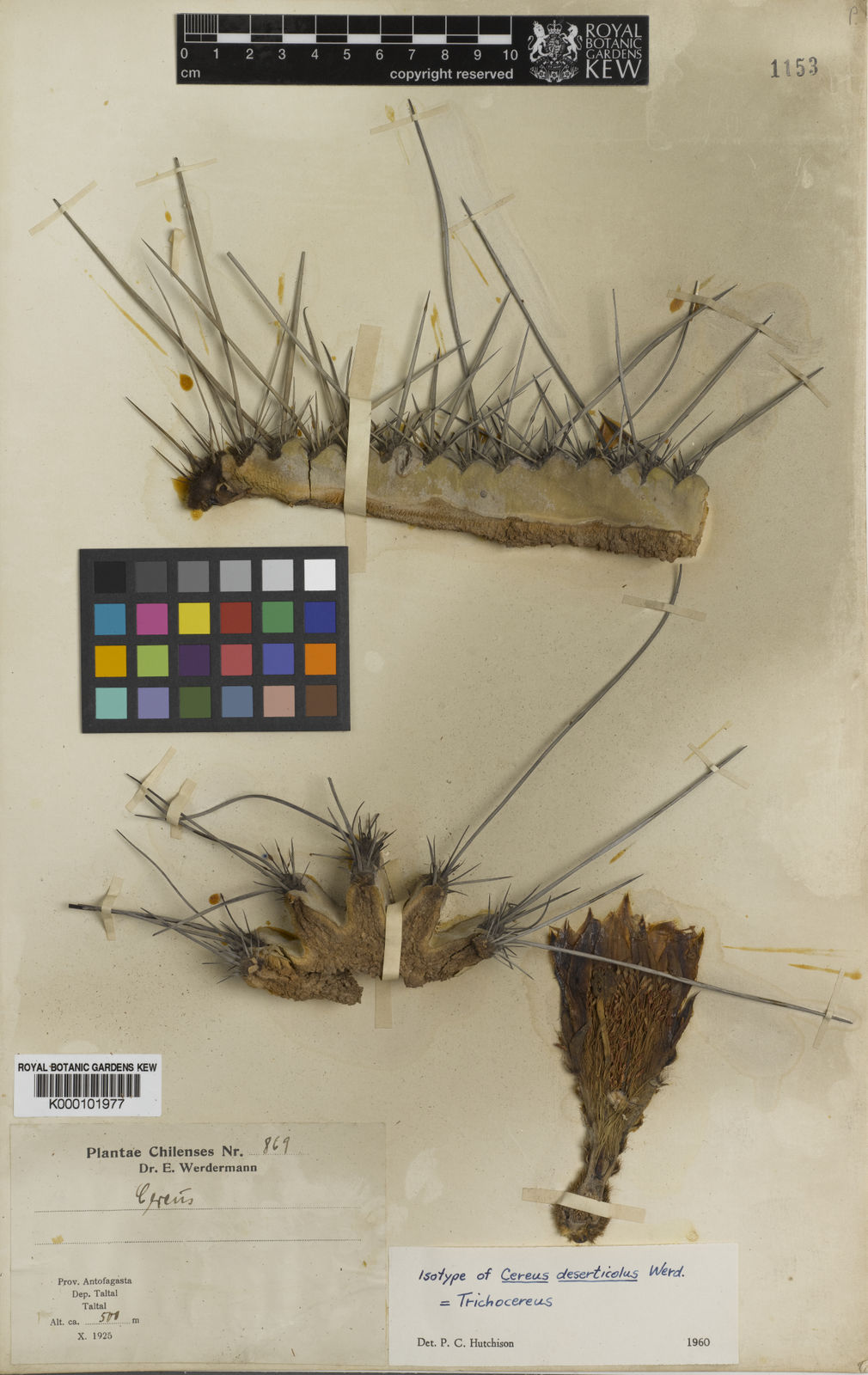 Reference image
Desert Column Cactus
Leucostele deserticola (formerly classified as Echinopsis deserticola) is an upright, shrubby columnar cactus belonging to the Cactaceae family. This resilient species is well-adapted to extremely arid environments and is characterized by its densely spiny stems and attractive white, funnel-shaped flowers 1.
Historically placed under various genera including Trichocereus and Echinopsis, modern molecular analyses have reclassified it under the genus Leucostele 2. The specific epithet deserticola translates from Latin as "desert dweller," highlighting its specialized ecological niche.
This species is native to northern Chile, particularly throughout the hyper-arid Atacama Desert and surrounding coastal hills 1. It thrives on rocky slopes, gravelly substrates, and dry shrublands, often at elevations up to 1000 meters above sea level.
Leucostele deserticola forms branched clusters of semi-erect or decumbent stems. The stems are grey-green to dark green with prominent ribbed structures. Each areole bears stout, greyish-brown spines. During the summer, it produces nocturnal white flowers that open in the evening and close by midday.
In cultivation, this cactus requires maximum sunlight and excellent ventilation. Watering should be done on a soak-and-dry method, ensuring the substrate dries out completely between applications. During winter, it should be kept dry and cool.
Overwatering and using heavy, moisture-retentive soils are the primary causes of root rot 2. Lack of direct sunlight leads to etiolation, where the plant grows unnaturally thin and weak.
Requires at least 6 hours of direct sunlight daily; low light will cause weak, stretched growth.
Water thoroughly only when the soil is completely dry in summer; keep dry in winter.
Highly gritty, mineral-heavy substrate with plenty of pumice and coarse sand.
Features sharp, rigid spines that can cause injury; keep away from pets and children.
Very easy to care for and highly drought-tolerant, making it perfect for beginners.
Native to the northern regions of Chile, specifically within the arid rocky slopes and coastal hills of the Atacama Desert ecosystem.
