
Light
Full Sun
Requires at least 6-8 hours of direct, intense sunlight daily.
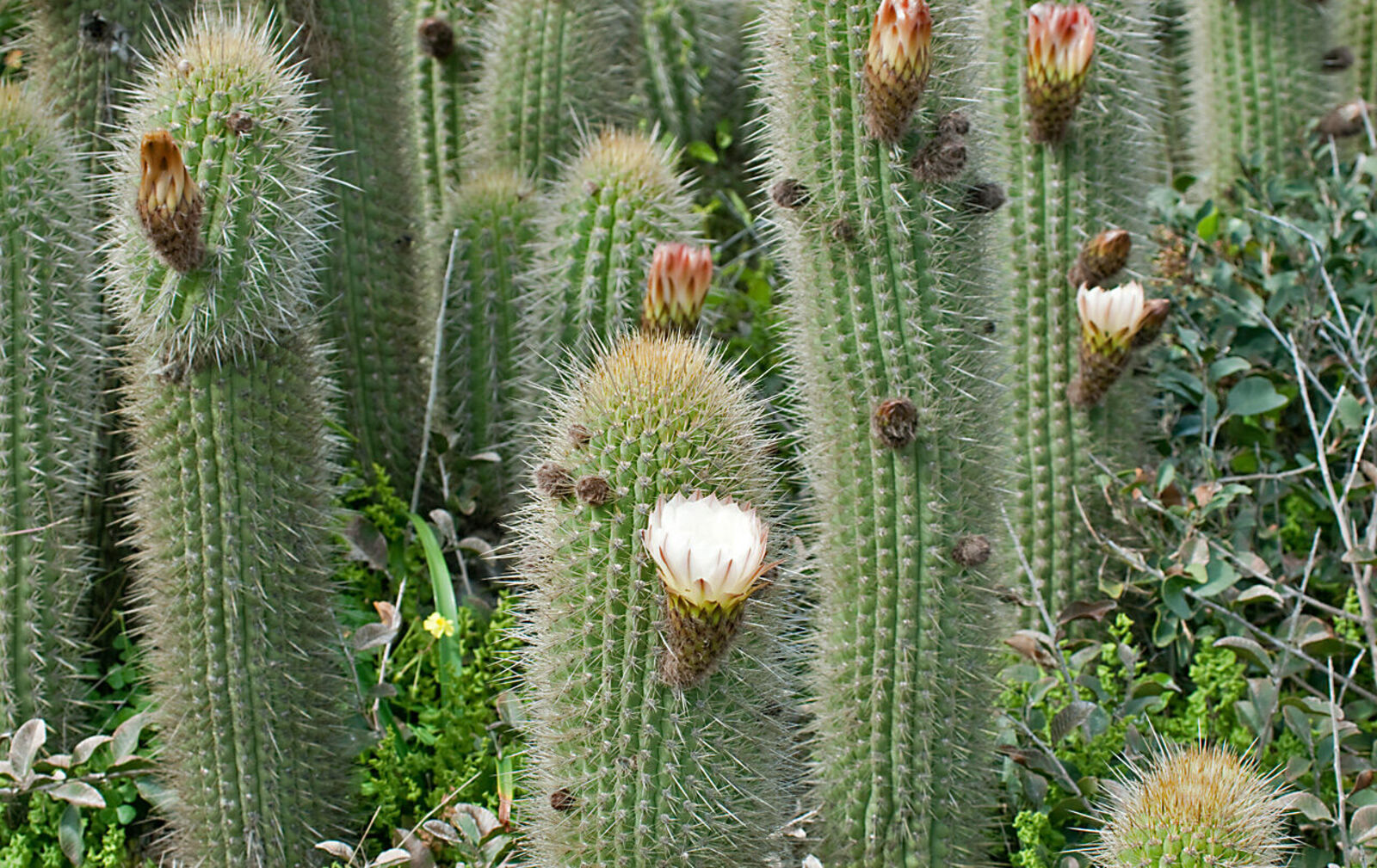 Reference image
Skottsberg's Woolly Torch
Leucostele skottsbergii (syn. Echinopsis skottsbergii or Trichocereus skottsbergii) is an impressive, columnar, succulent shrub belonging to the family Cactaceae 1. Native to the arid and semi-arid coastal zones of Chile, this species forms large, branched specimens in its natural habitat.
Named in honor of the Swedish botanist Carl Skottsberg, this species has undergone several taxonomic revisions. Modern molecular studies have resurrected the genus Leucostele, moving this species out of the broad Echinopsis classification 2.
It is endemic to central Chile, specifically found in the regions of Coquimbo and Valparaíso 1. It grows on rocky slopes and coastal hillsides, often associated with the dry Chilean matorral shrublands, at elevations up to 1000 meters.
This cactus exhibits a shrubby habit, branching from the base to reach heights of 2 to 4 meters. The stems are grayish-green with 16 to 21 ribs. Areoles are felted with yellowish-brown wool, giving rise to numerous long, needle-like, grayish spines. The flowers are funnel-shaped, white to pale pink, blooming in late spring to summer.
In cultivation, it requires a very bright position with plenty of direct sunlight and excellent ventilation. It is critical to provide a highly porous, mineral-based substrate to prevent waterlogging. During the winter, a dry and cool dormancy period is required.
The most frequent mistake is overwatering, particularly during the winter dormancy, which quickly leads to root and stem rot. Lack of adequate sunlight will cause the stems to etiolate and weaken.
Requires at least 6-8 hours of direct, intense sunlight daily.
Allow soil to dry out completely between waterings; suspend in winter.
Mineral-rich, highly porous cactus soil with excellent drainage.
Features sharp, long spines; handle with care and keep away from pets.
Moderately easy if watering is strictly controlled and light is abundant.
Native to the coastal mountains and dry shrublands of central Chile, where it adapts to rocky terrain and utilizes oceanic fogs for moisture.
