
Light
Full Sun
Requires full sun, ideally 6+ hours of direct sunlight daily to maintain its robust spine growth.
 Reference image
Cardon Grande Cactus
Leucostele terscheckii (formerly known as Trichocereus terscheckii), commonly referred to as the Cardon Grande or Argentine Saguaro, is a massive, tree-like columnar cactus belonging to the family Cactaceae 1. Despite its striking morphological resemblance to the North American Saguaro (Carnegiea gigantea), it represents an independent evolutionary lineage native to the Southern Hemisphere.
This species was first described in 1837 as Cereus terscheckii. Over the years, it was transferred between Trichocereus and Echinopsis before modern phylogenetic studies placed it within the reinstated genus Leucostele 2. The specific epithet 'terscheckii' honors Carl Terscheck, a prominent 19th-century court gardener.
Leucostele terscheckii is native to northwestern Argentina (including regions like Salta, Jujuy, and Tucumán) and parts of southern Bolivia 3. It thrives on dry, rocky slopes, canyon walls, and arid scrublands within the Monte and Chaco biomes, typically at elevations between 700 and 1,500 meters above sea level.
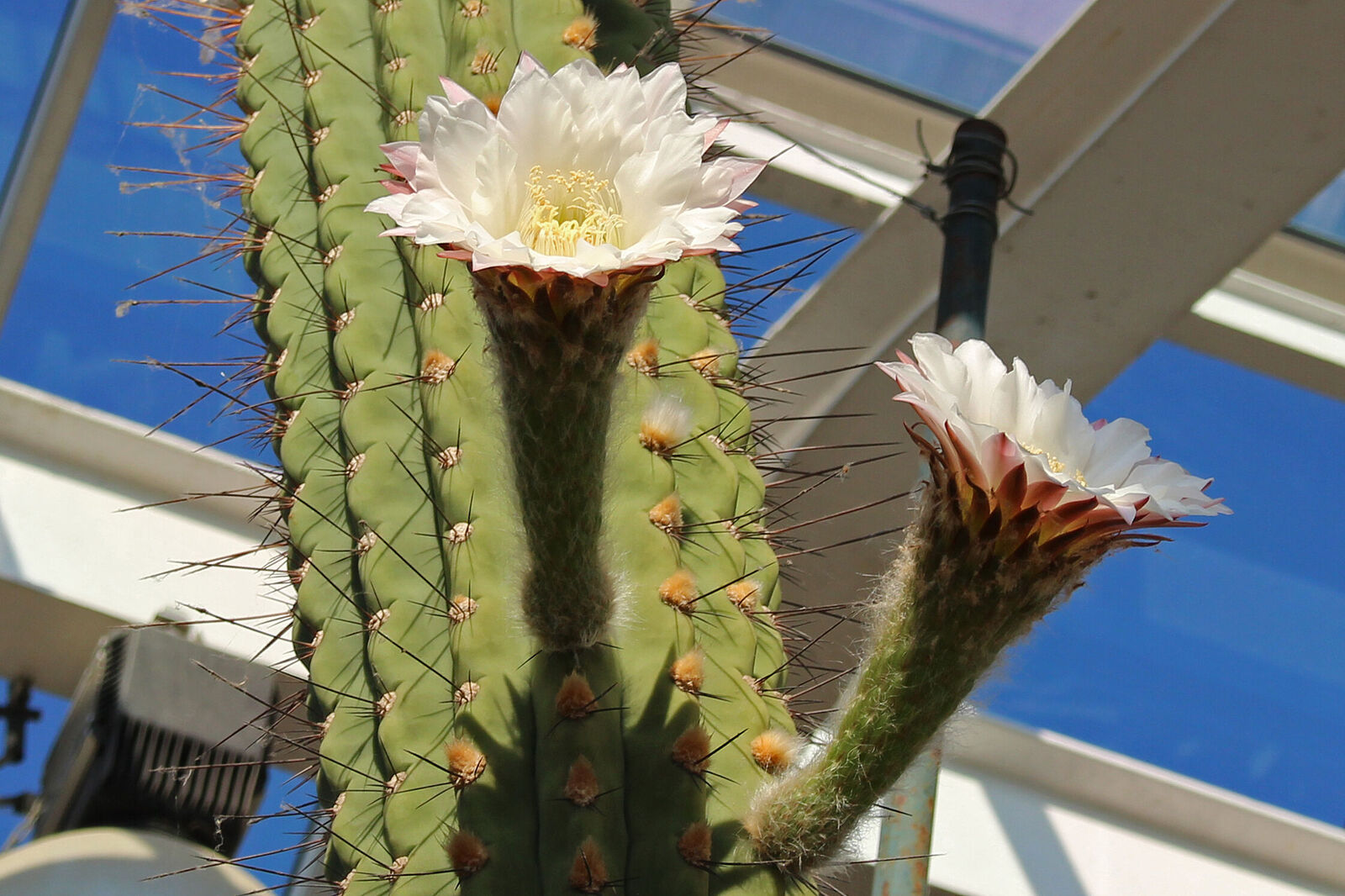
This giant cactus can reach heights of 10 to 15 meters, with a massive central trunk up to 45 cm in diameter. As it matures, it develops numerous thick, vertical branches, forming a candelabra-like silhouette. The stems feature 8 to 14 deep ribs adorned with large areoles. From these areoles, 8 to 15 stiff, yellowish-brown spines project, measuring up to 8 cm in length. Its large, white, funnel-shaped flowers are nocturnal, blooming during late spring and summer 4.
In cultivation, Leucostele terscheckii is highly prized for its structural form and hardiness. It requires full sun, excellent drainage, and mineral-heavy soil. Water thoroughly during the growing season only after the soil has completely dried out. In winter, keep the plant dry and cool to encourage dormancy.
The most frequent issue is root rot caused by overwatering or poorly draining soil, especially during the cold winter dormancy. Insufficient sunlight will lead to etiolation, causing the stems to stretch and weaken.
Requires full sun, ideally 6+ hours of direct sunlight daily to maintain its robust spine growth.
Adopt the 'soak and dry' method. Water deeply in summer, keep completely dry in winter.
Requires a mineral-based cactus mix containing pumice, coarse sand, and minimal organic matter.
Equipped with extremely long, sharp spines. Keep away from high-traffic areas, children, and pets.
Very easy to grow, making it ideal for beginners who can resist the urge to overwater.
Native to the high-elevation arid valleys and gravelly mountain slopes of the eastern Andes, adapted to survive extreme heat and cold droughts.
