
Light
Bright Indirect Light
Needs bright, filtered sunlight; protect from intense, scorching midday sun.
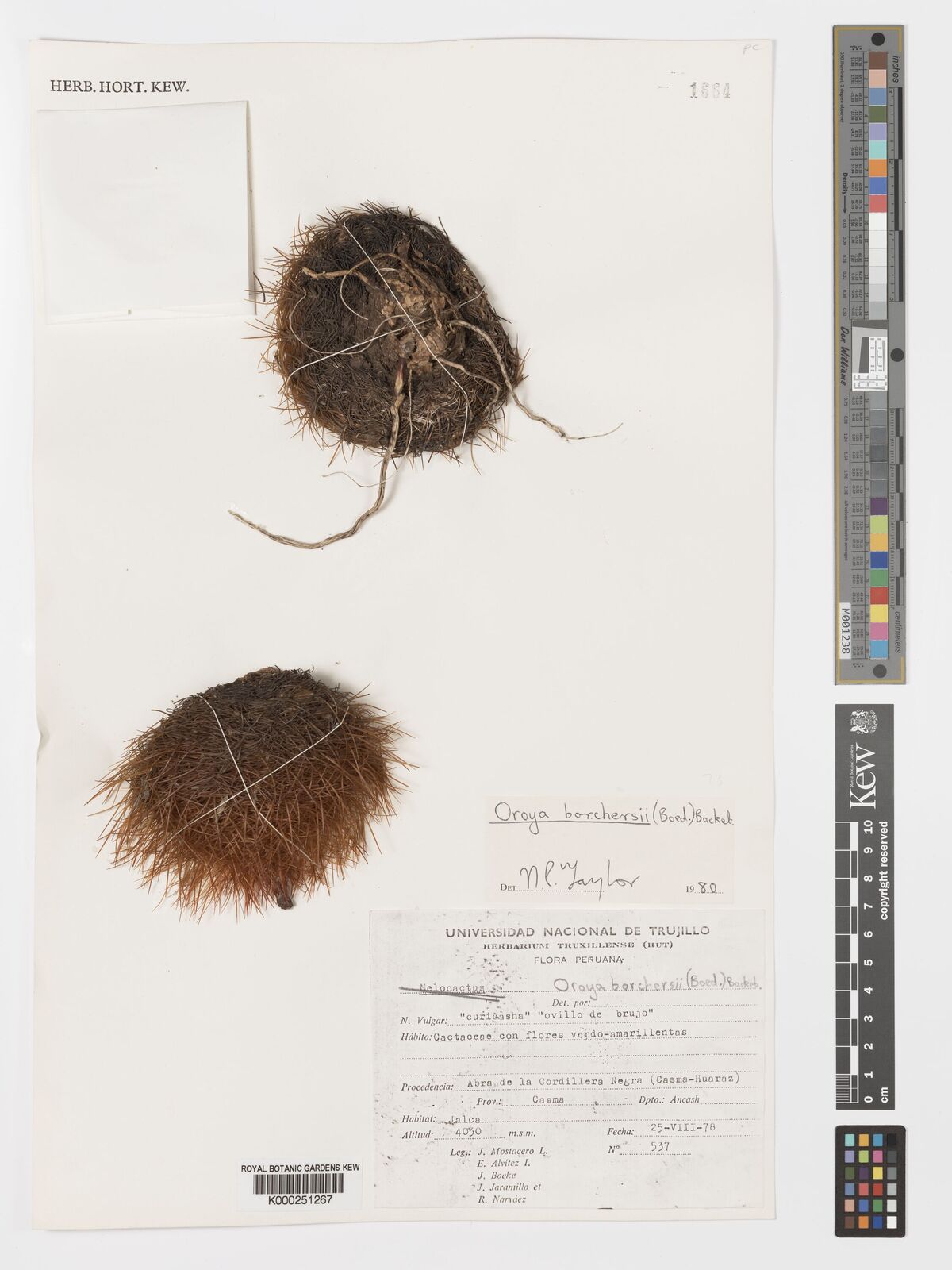 Reference image
Golden Matucana
Matucana borchersii is a stunning and sought-after globose cactus species native to the high-altitude regions of the Peruvian Andes, celebrated for its dense, golden-yellow spination.
Belonging to the family Cactaceae, the genus Matucana is named after the Peruvian town of Matucana 1. The specific epithet 'borchersii' honors the German botanist and researcher Philipp Borchers, who explored the Andean flora 2.
This species is restricted to the high-altitude montane tropical zone of Peru, particularly in the Ancash region (Cordillera Negra and Cordillera Blanca) at elevations of 3,500 to 4,100 meters above sea level 1. It thrives on steep, rocky grasslands and mineral-rich volcanic soils, where it has adapted to intense solar radiation with its dense protective spines.
Matucana borchersii grows as a succulent subshrub, initially globose and later slightly cylindrical, reaching up to 15 cm in height and 10 cm in diameter. The stem has around 25 tuberculate ribs, almost completely covered by 3-4 cm long, needle-like, golden-yellow to straw-colored spines. During summer, it produces funnelform flowers from the apex, which are bright yellow, orange, or sometimes greenish-yellow 1.
In cultivation, this high-alpine specialist requires excellent air circulation and bright, filtered sunlight. Water thoroughly during the active summer growing season, allowing the mineral-rich, porous soil mix to dry out completely between waterings. Keep cool and strictly dry in winter to mimic its natural dormant cycle.
The most prevalent mistakes are overwatering and low light levels, which quickly trigger root rot and cause the cactus to stretch unnaturally (etiolation), losing its compact form and golden spine density.
Needs bright, filtered sunlight; protect from intense, scorching midday sun.
Allow the potting mix to dry out completely. Keep completely dry in winter.
Prefers a highly mineral, porous cactus mix rich in pumice and coarse sand.
Non-toxic, but features sharp, dense spines that require careful handling.
Moderate difficulty due to its high-altitude requirements for fresh air and precise watering.
Occurs naturally in the high-altitude mountainous terrains of Peru's Ancash region, particularly along the Cordillera Negra, growing on steep rocky slopes at elevations between 3,500 and 4,100 meters.
