
Light
Bright Indirect Light
Thrives in bright indirect light or morning sun. Avoid harsh, unfiltered midday summer glass exposure.
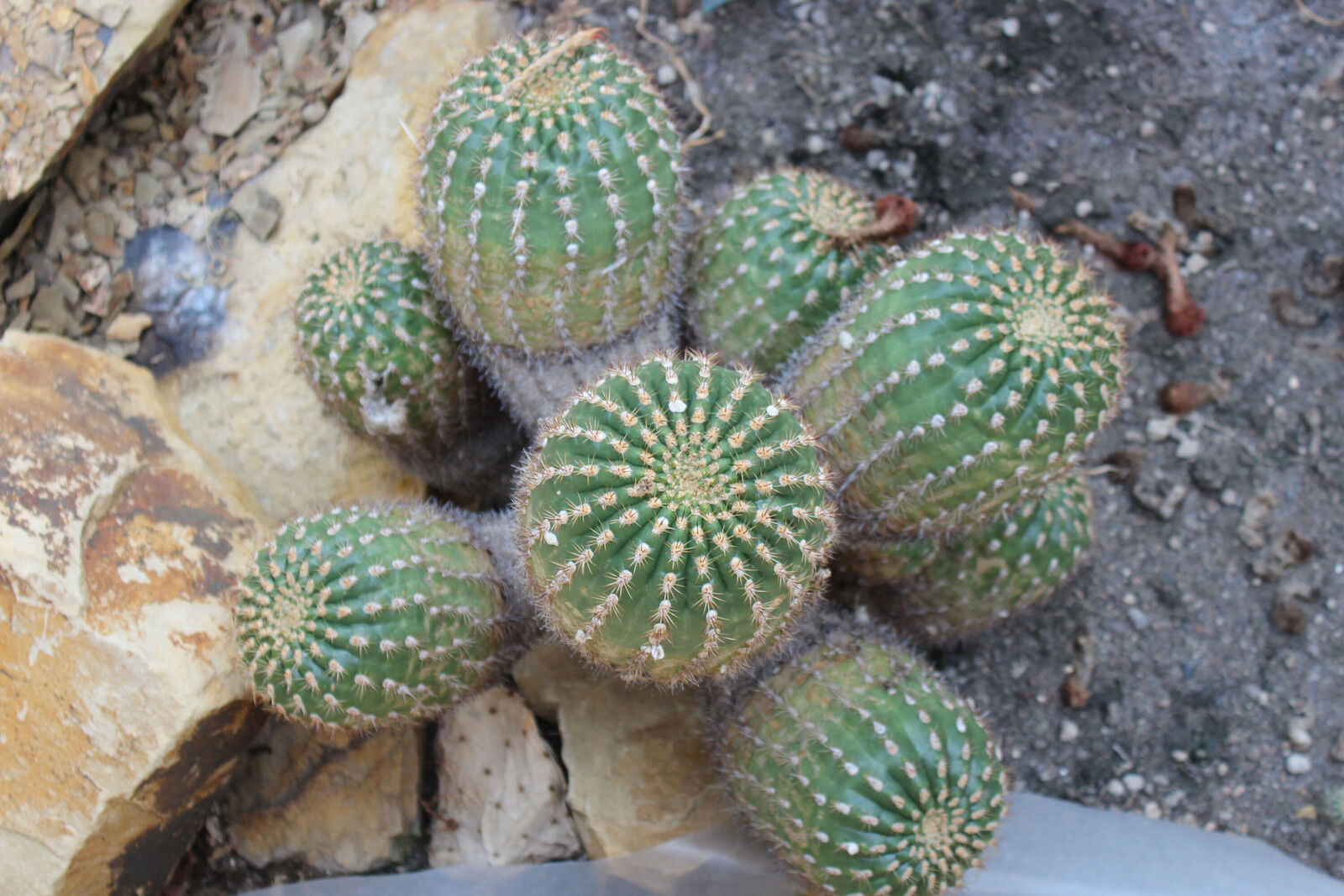 Reference image
Interwoven Matucana Cactus
Matucana intertexta is a captivating globular cactus species native to the high-altitude regions of Peru. Highly esteemed among succulent enthusiasts for its neat symmetry, dense golden-yellow spines, and vibrant tubular flowers, it represents a hardy yet ornamental addition to specialized collections.
Belonging to the family Cactaceae, genus Matucana, this species was formally described by the German botanist Friedrich Ritter. The specific epithet intertexta originates from Latin, meaning "interwoven" or "interlaced," directly referencing the dense, crisscrossing arrangement of its spines that form a protective network over the plant body 1.
This species is endemic to northern Peru, specifically within the Cajamarca department along the steep slopes of the Marañón River basin, ranging at elevations between 1500 and 2300 meters above sea level 2. It thrives in dry, rocky shrublands and semi-desert conditions, growing in mineral-rich, highly porous soils.
The stem is solitary, initially spherical, and may become slightly short-cylindrical with age, reaching up to 15 cm in diameter. It features 15 to 25 distinct ribs adorned with closely set areoles. The spines are stiff, needle-like, golden-brown to yellow when young, and fade to a greyish tone. In summer, it produces spectacular, diurnal, funnel-shaped flowers in shades of bright orange to deep red.
In cultivation, it requires bright, filtered sunlight to retain its compact shape and robust spine density. Watering must be conducted on a "soak and dry" basis during the active spring and summer growth phases. During the winter dormancy, watering should be suspended entirely to prevent fungal pathogens.
Overwatering during cold periods is the leading cause of mortality due to root rot. Placing the plant in low-light environments causes etiolation, wherein the stem becomes pale, weak, and unnaturally elongated.
Thrives in bright indirect light or morning sun. Avoid harsh, unfiltered midday summer glass exposure.
Water thoroughly only when the substrate is 100% dry. Maintain near-total dryness throughout the winter months.
Requires an open, highly mineral substrate with plenty of pumice, grit, and minimal organic matter.
Non-toxic to pets, but the stiff, sharp spines pose a physical hazard; handle with care and keep out of reach.
Very easy and low-maintenance, provided the root zone is never subjected to prolonged, stagnant moisture.
Native to the dry valley slopes of the Marañón River in northern Peru, growing in rocky crevices and gravelly soils at high altitudes.
