
Light
Bright Indirect Light
Requires bright, indirect sunlight or filtered light. Avoid scorching direct sun.
 Reference image
Blue Turk's Cap Cactus
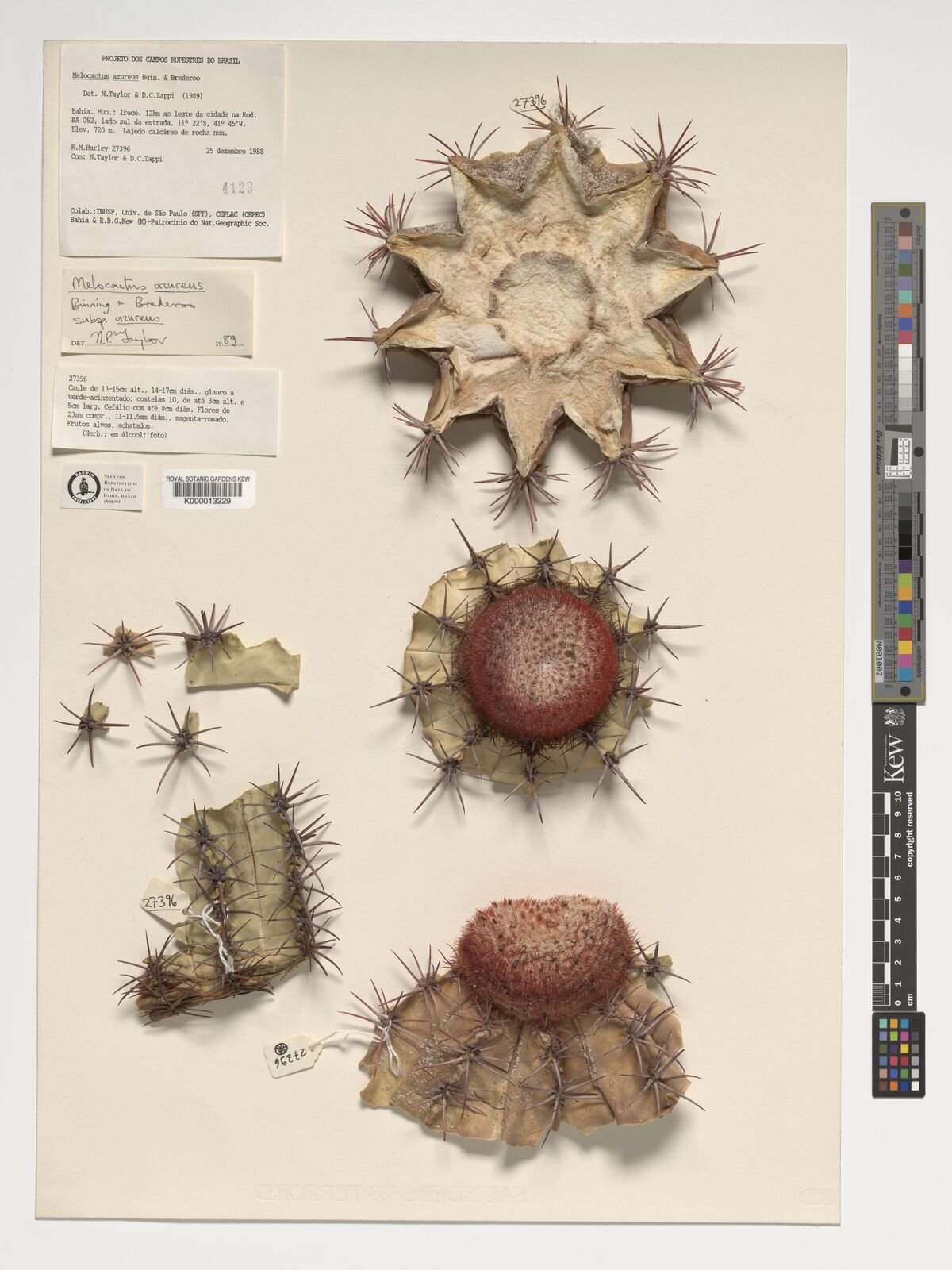
Melocactus azureus is an iconic and highly sought-after cactus species belonging to the family Cactaceae, famous for its striking glaucous blue-green stem and the distinctive woolly crown known as a 'cephalium' that develops at maturity 1.
Classified under the genus Melocactus, the species epithet azureus derives from the Latin word for sky-blue, referencing the characteristic waxy, frosty blue coating on its epidermis 2. It is a highly specialized member of the globose cactus group.
This species is endemic to eastern Brazil, primarily in the state of Bahia. It thrives in seasonally dry tropical environments, growing on limestone outcrops, rocky areas, and within the dry scrubby vegetation of the Caatinga biome at elevations between 450 and 800 meters 1.
The stem is initially globose, later becoming shortly cylindrical, reaching up to 13-19 cm in height. It features 9 to 10 prominent, well-defined ribs with greyish-brown, slightly curved spines. Upon reaching maturity, the vegetative growth stops, and it develops a terminal cephalium covered in white wool and reddish-brown bristles from which small pink flowers emerge 2.
Unlike arid desert cacti, this tropical species requires warmer winter temperatures and higher air humidity. It needs a very porous, mineral-rich substrate. Watering should be regular during the active growing season but must be significantly reduced during winter, though the soil should never be allowed to dry out completely for extended periods.
The most frequent mistakes are overwatering during winter and exposing the plant to temperatures below 10°C, which quickly leads to root rot and fatal stem collapse.
Requires bright, indirect sunlight or filtered light. Avoid scorching direct sun.
Water thoroughly once the soil dries, but maintain slight moisture during winter.
Requires a highly porous, mineral-based cactus mix containing limestone or gravel.
Equipped with sharp, rigid spines. Keep out of reach of curious pets and children.
Requires moderate to advanced care due to its strict temperature and moisture requirements.
Endemic to the semi-arid caatinga of Bahia, Brazil, where it grows exclusively on limestone rock formations under seasonally dry tropical conditions.
