
Light
Bright Indirect Light
Requires at least 6 hours of bright, indirect or filtered sunlight. Avoid intense direct midday sun.
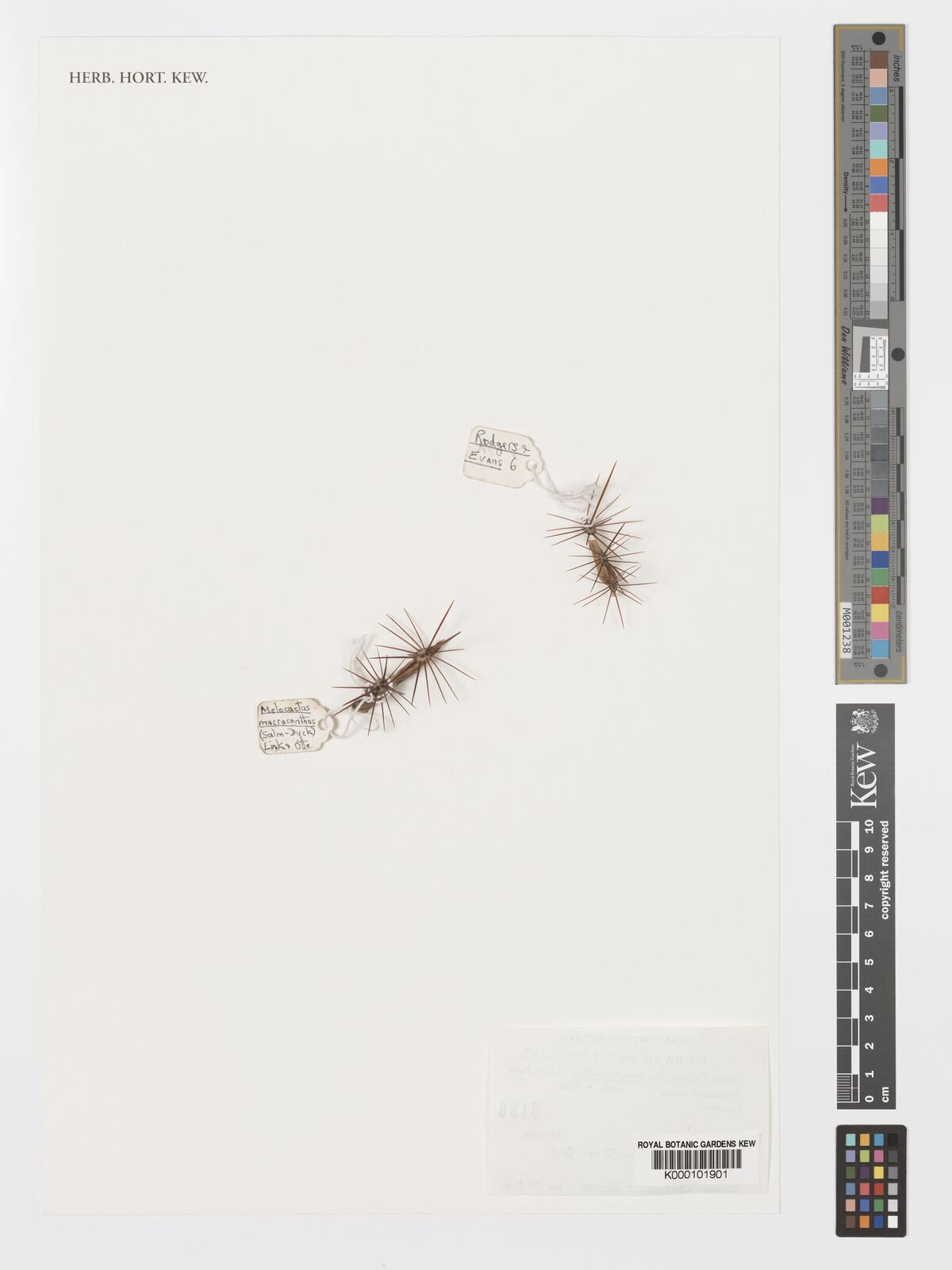 Reference image
Turk's Cap Cactus
Melocactus macracanthos is a unique succulent subshrub belonging to the Cactaceae family, highly sought after by collectors for its distinctive, woolly cephalium that forms at the crown of mature specimens 1.
This species belongs to the genus Melocactus. The specific epithet macracanthos derives from the Greek words 'makros' (large/long) and 'akantha' (spine), referencing the remarkably robust and imposing spine cluster that arms the plant's ribs 2.
Native to the Caribbean islands, including Aruba, Curaçao, and parts of northern South America, this cactus thrives in seasonally dry tropical biomes. It is primarily found growing on coastal limestone cliffs, rocky slopes, and arid lowlands near sea level.
The solitary, globose to short-cylindrical stem is light green, featuring 10 to 15 well-defined ribs. The areoles bear thick, radial, and central spines ranging from 3 to 5 cm in length, showing a greyish-yellow hue. Once the plant reaches reproductive maturity, it ceases stem growth and develops a terminal cephalium—a dense structure of reddish bristles and white wool where tiny pinkish flowers and subsequent club-shaped red fruits emerge.
Unlike desert cacti, Melocactus macracanthos demands a more tropical regimen. It requires bright, indirect sunlight and higher ambient humidity. The potting medium must be highly porous but kept moderately moist during the active growing season. It is highly cold-sensitive and should never be exposed to temperatures below 10°C.
Overwatering in low winter temperatures is the most common cause of root rot. Additionally, applying heavy nitrogen fertilizers once the cephalium has formed can damage the plant, as vegetative growth has naturally concluded.
Requires at least 6 hours of bright, indirect or filtered sunlight. Avoid intense direct midday sun.
Keep the soil lightly moist during the warm season. Reduce watering significantly in winter, keeping it barely damp.
Use an extremely porous mineral mix consisting of pumice, coarse sand, and a small amount of organic matter.
Equipped with very long, rigid spines that can cause severe punctures. Keep away from pets and children.
Classified as moderate because of its specific winter temperature and tropical watering requirements.
Naturally occurs in the dry coastal zones, limestone terraces, and rocky arid scrublands of the Caribbean islands where it experiences constant sea breezes and high solar radiation.
