
Light
Full Sun
Requires full sun or bright indirect light. Avoid shaded spots which lead to weak, stretched growth.
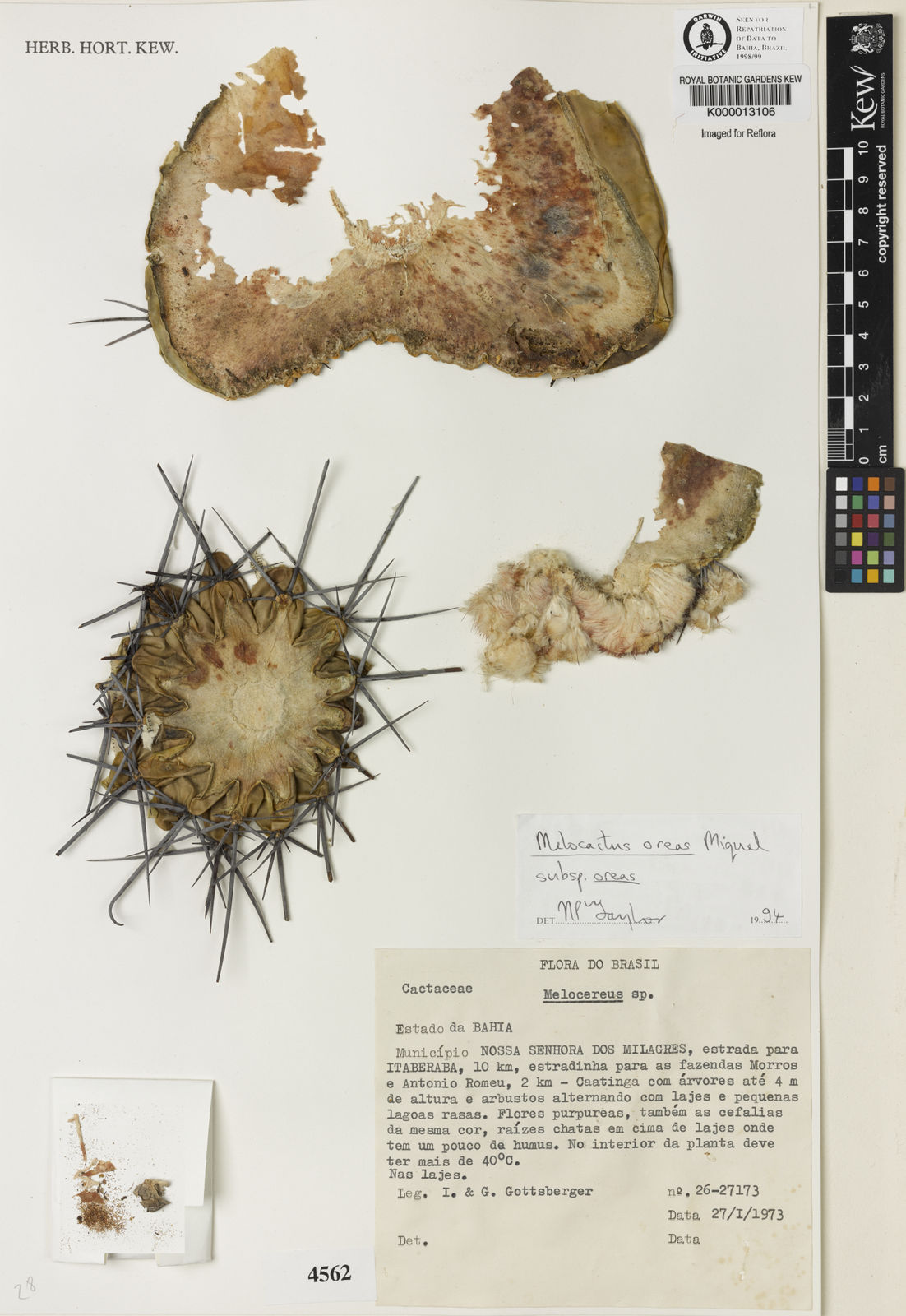 Reference image
Turk's Cap Cactus
Melocactus oreas is a distinctive globose cactus species belonging to the family Cactaceae. It is highly valued among collectors for its striking cephalium—a woolly, bristly structure that develops at the crown of mature specimens [1].
Classified under the genus Melocactus, this species exhibits the typical characteristics of the genus, commonly referred to as the Turk's cap cactus. The specific epithet 'oreas' relates to its mountainous or rocky natural habitats [2].
This species is native to northeastern Brazil, spanning regions such as Bahia, Pernambuco, Ceará, and Alagoas. It thrives predominantly in seasonally dry tropical biomes, growing on rocky outcrops, stony soils, and thin substrates [1].
The stem of Melocactus oreas is spherical to short-cylindrical with well-defined ribs lined with clusters of strong, spreading spines. Upon reaching reproductive maturity, it ceases stem growth and produces a colorful red-to-pink cephalium from which tiny flowers emerge.
Unlike many desert cacti, Melocactus oreas requires a warmer climate and cannot tolerate frost. Minimum winter temperatures should be kept strictly above 10°C. It benefits from bright, filtered sun to direct sunlight and highly porous, mineral-based potting media.
Overwatering during the dormant winter period or exposure to low temperatures can quickly lead to root rot. Additionally, repotting mature specimens with fully developed cephalia should be avoided as they do not tolerate root disturbance well [2].
[1] Plants of the World Online (POWO), Royal Botanic Gardens, Kew. [2] GBIF (Global Biodiversity Information Facility) Database.
Requires full sun or bright indirect light. Avoid shaded spots which lead to weak, stretched growth.
Allow the potting medium to dry out completely between waterings. Reduce watering to a minimum in winter.
Highly porous mineral substrate containing pumice, gravel, and coarse sand is essential.
Armed with very sharp spines that can cause painful punctures. Keep away from pets and children.
Classified as hard to care for due to its sensitivity to cold temperature fluctuations and root rot.
Endemic to the seasonally dry tropical zones of northeastern Brazil, where it can be found clinging to rocky surfaces and sandy substrates under intense equatorial sunlight.
