
Light
Filtered Sun
Requires bright filtered sun. Protect from intense, direct afternoon sunlight during summer.
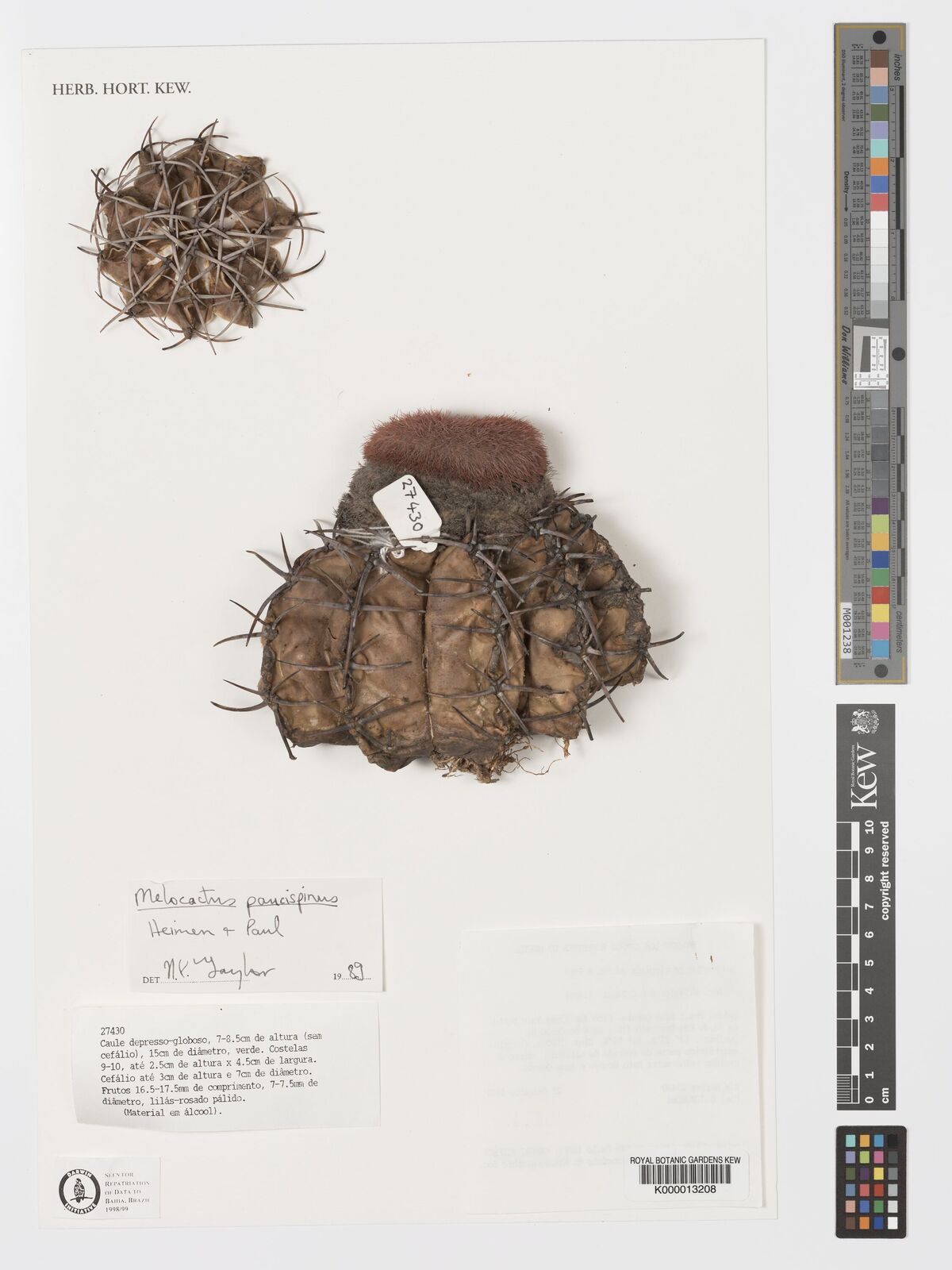 Reference image
Few-spined Melon Cactus
Melocactus paucispinus is a rare and distinctive globose cactus native to Brazil, famous for its flattened stem and the colorful, woolly "cephalium" that develops at the crown of mature specimens 1.
The specific epithet paucispinus translates from Latin to "few-spined", pointing out the remarkably sparse and short spine arrangement on its ribs. Taxonomically, it belongs to the diverse Melocactus genus, which is characterized by cephalium-bearing adults 12.
This species is endemic to northeastern and eastern Brazil, spanning regions such as Bahia, Pernambuco, and Ceará. It thrives in seasonally dry tropical biomes, typically growing on quartz-sand flats and rocky limestone outcrops under the shade of sparse shrubs 1.
The stem is greyish-green, depressed-globose, reaching up to 10-15 cm in diameter with approximately 10 distinct ribs. Areoles carry only 3 to 6 short, thick, backward-curved spines, making it look much less armature-heavy than its relatives. Upon reaching maturity, it stops growing vegetatively and produces a terminal cephalium made of white wool and reddish bristles. Tiny pink flowers appear from this structure, followed by club-shaped, edible pink-to-red fruits.
Unlike desert cacti, Melocactus paucispinus prefers a warmer, slightly more humid climate. It requires bright, filtered sunlight rather than scorching direct sun. The potting medium must be highly porous and mineral-heavy. It cannot tolerate freezing temperatures; keeping the winter minimum above 10°C is crucial for its survival.
Overwatering during the winter dormant period and exposing the plant to temperatures below 10°C are the most frequent causes of failure. Additionally, mature specimens with a cephalium do not tolerate root disturbance well, so repotting should be kept to an absolute minimum.
Requires bright filtered sun. Protect from intense, direct afternoon sunlight during summer.
Water once the substrate dries out completely. Keep dry and warm during winter.
Highly mineralized, gritty cactus mix with plenty of pumice and coarse sand.
Non-toxic to pets, but has short, stiff spines. Handle with care.
Moderate. Requires careful winter temperature control and minimal root disturbance.
Found in the semi-arid Caatinga vegetation of eastern Brazil, growing in sandy flats and gravelly soils.
