
Light
Full Sun
Requires full, direct sunlight to maintain its compact form and develop its cephalium.
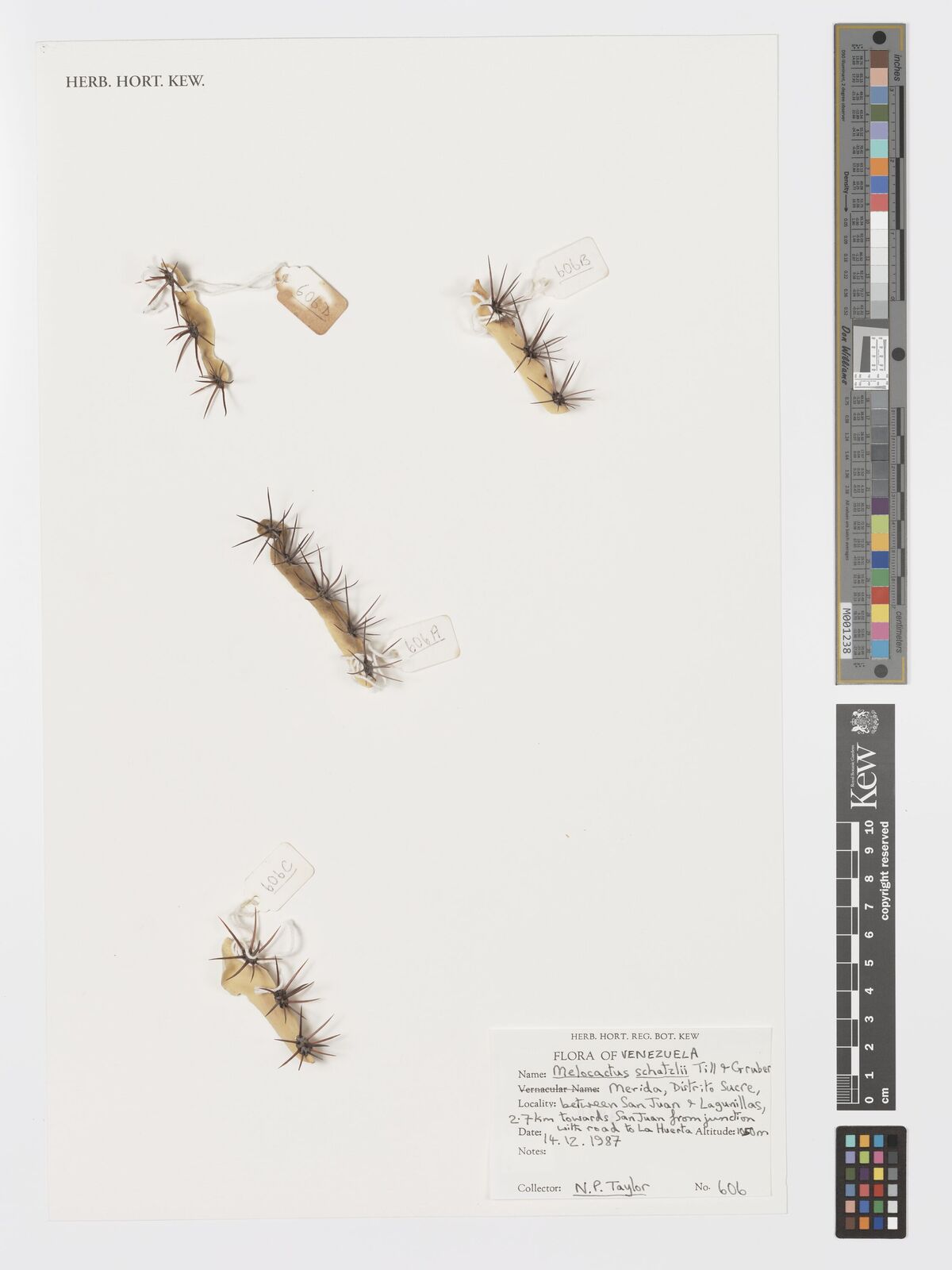 Reference image
Schatzl's Melon Cactus
Melocactus schatzlii is a distinctive members of the Cactaceae family, famous for its striking apical 'cephalium' which develops at maturity. It is highly sought after by succulent enthusiasts but faces threats in its wild habitats due to localized distribution 1.
Described in the late 20th century, the species name schatzlii honors the botanical collectors who documented it in the rugged valleys of South America. The genus name Melocactus stems from Latin and Greek terms comparing the ribbed globose body to a melon.
Native to Colombia and Venezuela, it thrives in seasonally dry tropical biomes. It is primarily found growing on steep, rocky slopes, often nestled in shallow pockets of soil on granite outcroppings 1.
This cactus exhibits a solitary, globular to short-cylindrical greyish-green stem with prominent ribs and sharp spines. Once mature, it develops a woolly, bristly cephalium at its apex. From this cephalium, small pinkish flowers emerge, followed by bright red, club-shaped ornamental fruits 2.
Unlike desert cacti, Melocactus schatzlii prefers a combination of high light, warm temperatures, and moderate air humidity. It cannot tolerate freezing temperatures, and the soil should never remain soggy.
The most frequent errors include overwatering in heavy clay soils and exposing the plant to temperatures below 10°C, which leads to root loss and severe rot.
Requires full, direct sunlight to maintain its compact form and develop its cephalium.
Water only after the substrate dries out completely. Avoid waterlogging at all costs.
Highly porous mineral mix rich in pumice, gravel, and minimal organic matter.
Equipped with sharp spines; keep out of reach of pets and small children.
Requires careful water management and winter warmth, making it moderately difficult.
Native to the dry, rocky valley biomes of northern South America, spanning across Colombia and Venezuela.
