
Light
Bright Indirect Light
Prefers bright, indirect light or filtered sun rather than harsh midday rays.
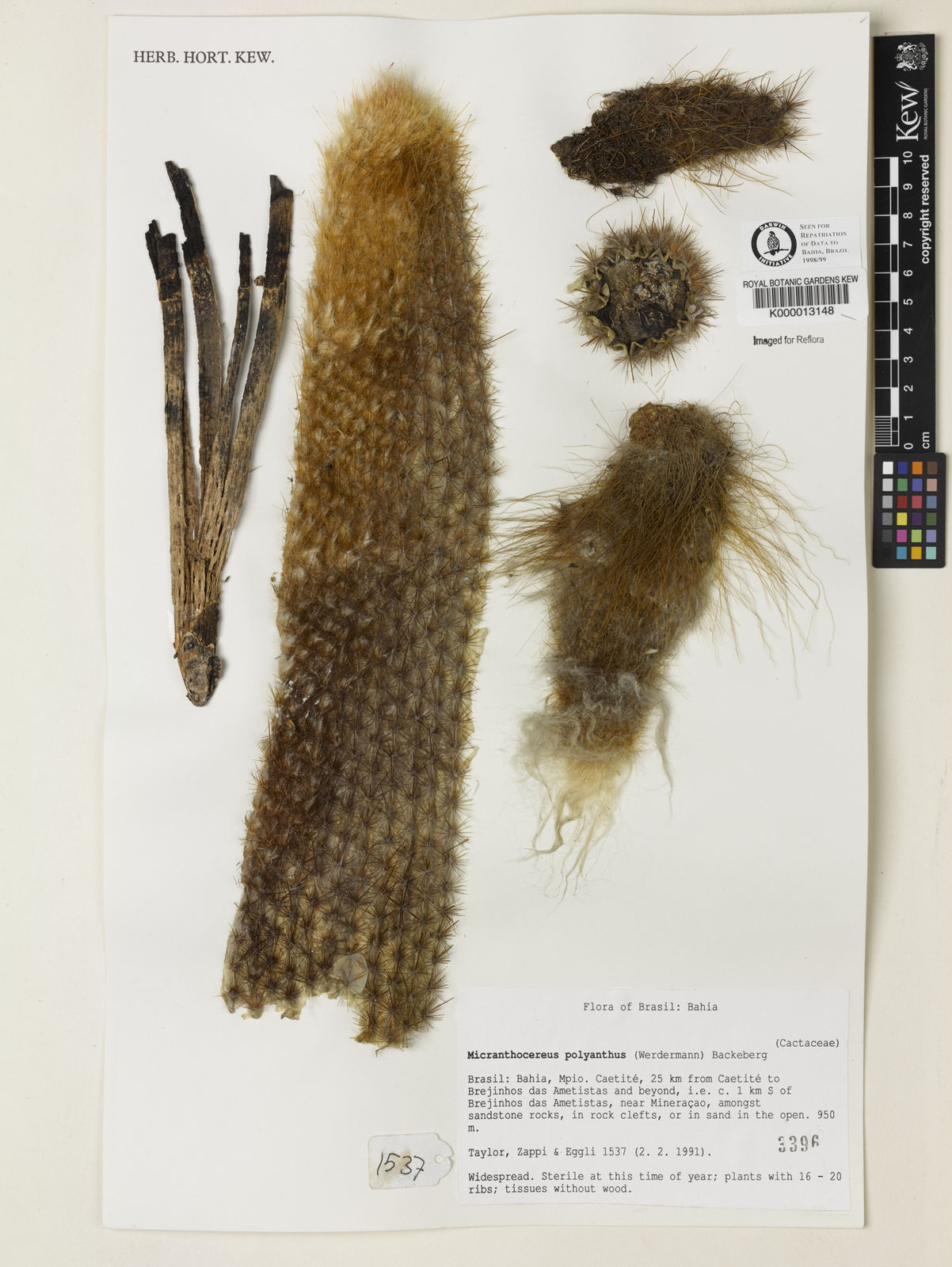 Reference image
Many-flowered Columnar Cactus
Micranthocereus polyanthus is an erect, columnar succulent shrub belonging to the Cactaceae family. Highly appreciated by succulent collectors, this species is renowned for its slender stems, dense spination, and numerous pinkish-red tubular flowers that emerge from specialized floriferous zones.
The species was formally described by the German botanist Kurt Backeberg 1. The genus name Micranthocereus is derived from the Greek mikros (small) and anthos (flower), combined with cereus, referring to the small-flowered columnar habit. The specific epithet polyanthus translates to 'many-flowered'.
This species is native to the eastern parts of Brazil, primarily in the state of Bahia 2. It thrives in montane tropical biomes, typically growing on rocky outcrops, steep quartzite cliffs, and sandy terrains in semi-arid zones. It has a restricted range, making it a conservation priority.
Micranthocereus polyanthus has a shrubby growth habit, branching from the base and reaching heights of up to 1.5 meters. The cylindrical stems are green to glaucous-blue, featuring 15 to 20 low ribs. The areoles are closely set, bearing numerous fine, golden-yellow to brownish spines. The small, tubular pink-to-red flowers are produced profusely along a pseudocephalium.
In cultivation, this species requires a mineral-rich, extremely well-draining soil mix. It is highly sensitive to overwatering, especially in cooler months. It benefits from bright, filtered sunlight and consistent warmth, with a minimum winter tolerance of around 8°C.
The most frequent error is overwatering in heavy, clay-rich soils, which inevitably causes root rot. Lack of adequate air movement and exposure to frost also quickly damage the stem.
Prefers bright, indirect light or filtered sun rather than harsh midday rays.
Allow the soil to dry out completely between thorough waterings.
Requires an acidic to neutral, extremely porous mineral soil mix with pumice.
Equipped with sharp, fine spines that can cause irritation. Keep out of reach of pets.
Classified as moderate; requires careful monitoring of moisture and winter temperatures.
Endemic to eastern Brazil, specifically the state of Bahia, where it populates rocky montane fields and slopes, growing in sandy pockets between quartz stones.
