
Light
Full Sun
Requires full sun; place in a south-facing window or greenhouse with at least 6 hours of direct sunlight.
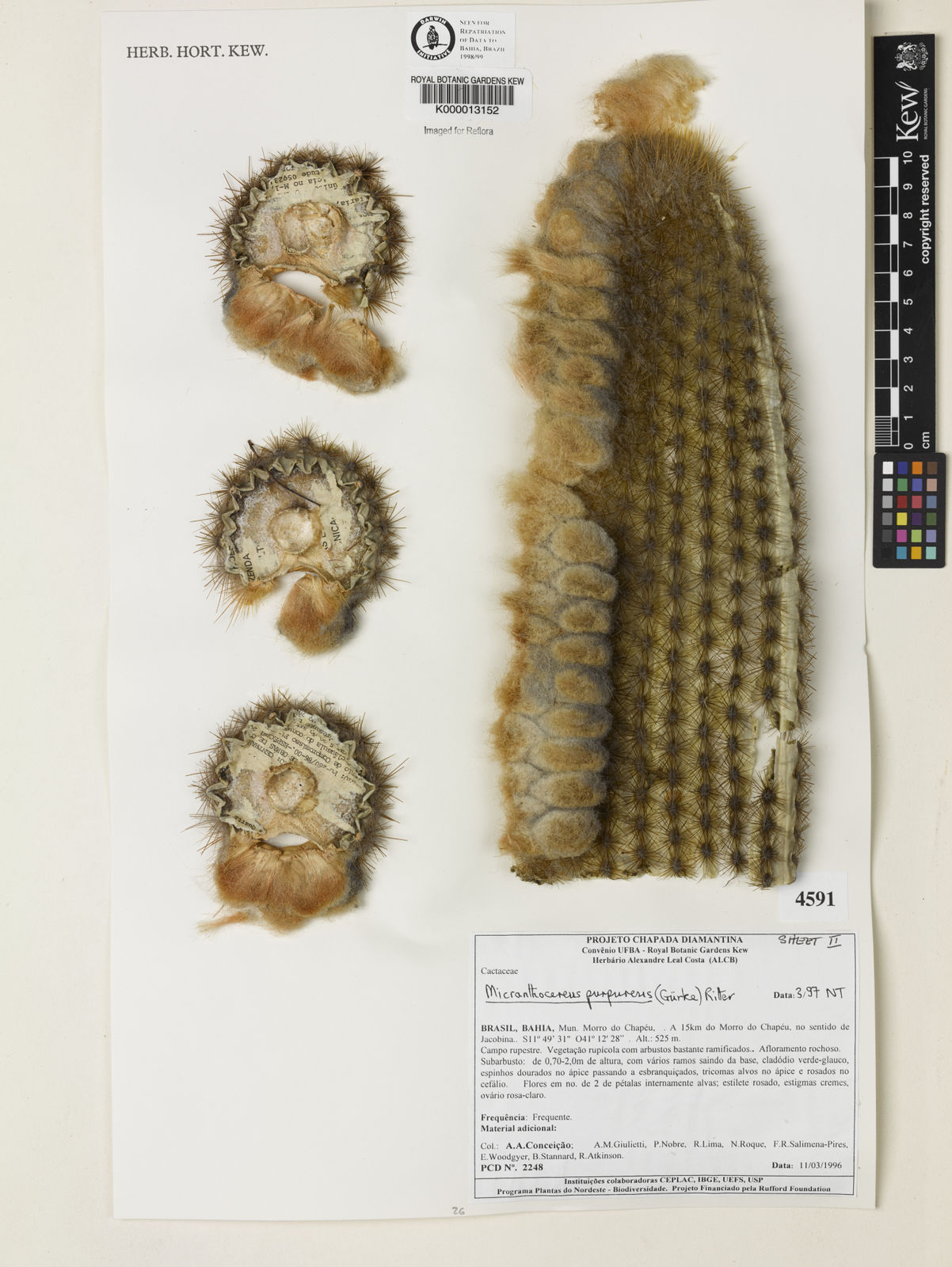 Reference image
Purple-Flowered Columnar Cactus
Micranthocereus purpureus is a striking, columnar cactus species in the family Cactaceae. Reaching up to 3 meters in height in its native habitat, this species is highly prized among succulent enthusiasts for its dense golden-brown spines and the woolly cephalium that forms on mature stems. It produces beautiful, nocturnal, purple-to-pink tubular flowers, which emerge from the lateral cephalium 1.
The species was initially described under different generic placements before being properly aligned with the genus Micranthocereus. The genus name refers to the relatively small flowers typical of these cacti, while the specific epithet purpureus highlights the rich purple and pink hues of its petals. Synonymy includes Cephalocereus purpureus 2.
This species is endemic to eastern Brazil, primarily restricted to the state of Bahia 1. It is found at elevations between 300 and 1000 meters above sea level, growing on rocky outcrops, steep quartzite cliffs, and within the dry, scrubby Caatinga vegetation. It thrives in seasonally dry tropical biomes, anchored in narrow rocky crevices with very little organic substrate.
The stems are erect, cylindrical, branching mainly from the base, and can measure up to 12 cm in diameter. There are 12 to 25 low ribs densely covered with needle-like spines. As the plant matures, it develops a prominent lateral cephalium filled with thick greyish-white wool and reddish bristles. The small, tubular flowers open at night and are adapted for pollination by bats.
In cultivation, Micranthocereus purpureus requires full sun and exceptionally bright light to maintain its dense spination and healthy structure. It must be potted in a fast-draining, mineral-heavy cactus soil mix with high pumice content. Watering should be thorough but infrequent, allowing the substrate to dry completely between cycles. During winter, watering must be suspended almost entirely 2.
The most prevalent issue is overwatering combined with poorly draining soil, which quickly triggers root and stem rot. Placing the cactus in shady indoor spots leads to etiolation (stretching) and prevents the development of the ornamental cephalium.
Requires full sun; place in a south-facing window or greenhouse with at least 6 hours of direct sunlight.
Allow soil to dry out fully before watering. Keep almost completely dry in winter.
Highly porous mineral substrate containing pumice, gravel, and minimal organic matter.
Has sharp, dense spines. Handle with thick gloves and keep out of reach of children and pets. Non-toxic.
Moderate difficulty. Requires strict winter dry period and highly controlled watering.
Indigenous to the Bahia state of eastern Brazil, where it thrives on rocky outcrops and quartzitic cliffs within the arid, seasonally dry Caatinga shrublands.
